
Approximately 40% of U.S. packaged food carries a kosher symbol. The Big Four certifiers — OU, OK, Star-K, Kof-K — control a global supply-chain gatekeeping system worth $400B+ in certified product value. Who pays. Who inspects. Who owns the mark.
Global food-supply infrastructure · The Big Four certifiers · China sourcing · Israeli Rabbinate reform · Passover economics · Trademark law.
Approximately 40% of packaged food sold in the United States carries a kosher symbol. Not because 40% of Americans are Jewish — Jews are 2.4% of the U.S. population. Because kosher certification has become a universal quality signal, a supply-chain gatekeeping function, and a global licensing business worth hundreds of billions of dollars in certified product value. This piece covers the certification economy's global financial scale; for the US governance history behind the Big Four, including the 1935 founder split between OU and OK, see Who Controls Kosher Certification in America?
The symbol on the package is a toll booth. Somebody pays for it. Somebody inspects for it. Somebody owns the trademark. This is the business underneath the hechsher.
The Big Four Certifiers
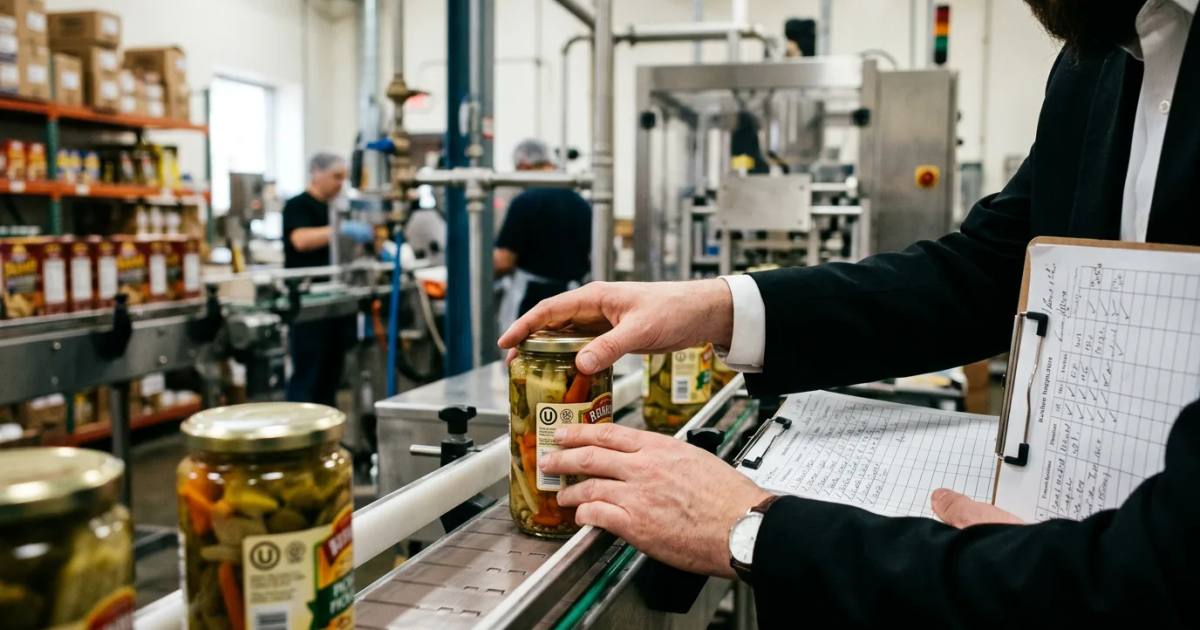
Four organizations dominate global kosher certification. Together, they certify the vast majority of kosher-labeled products sold in the United States and internationally. Each operates as a nonprofit, employs hundreds of rabbinic field inspectors, and maintains certification relationships with the world's largest food manufacturers.
The Orthodox Union (OU) is the largest. The OU symbol — a U inside a circle — appears on an estimated 1,000,000+ products from over 10,000 plants in more than 100 countries. The OU's kosher division, led by Rabbi Menachem Genack since 1980, employs approximately 1,000 rabbinic field representatives (mashgichim) who conduct on-site inspections of manufacturing facilities, ingredient sourcing, and production lines. The OU is a division of the Union of Orthodox Jewish Congregations of America, a nonprofit founded in 1898. The OU certifies Coca-Cola, Oreo, Tropicana, Heinz ketchup, and hundreds of other household brands.
OK Kosher Certification, founded by Rabbi Don Yoel Levy (d. 2020) and now led by Rabbi Chaim Fogelman, is the second-largest global agency, headquartered in Brooklyn. OK certifies major multinational food companies and operates field offices across six continents. Its reach into China — where OK has certified hundreds of factories producing ingredients for the global food supply — is a defining competitive advantage.
Star-K (the Vaad HaKashrus of Baltimore), led by Rabbi Moshe Heinemann, is the third major certifier, with particular strength in food-service equipment, institutional food programs, and consumer appliances. Star-K certifies Samsung and LG appliances with "Sabbath mode" features — a crossover between kosher law and consumer electronics.
The Kof-K, headquartered in Teaneck, New Jersey, rounds out the Big Four. Kof-K's certification focus includes industrial ingredients, flavoring compounds, and chemical additives used in food manufacturing.
Beyond the Big Four: The Long Tail
Below the Big Four, approximately 1,200+ kosher-certification agencies operate worldwide. Some are regional — the Chicago Rabbinical Council (cRc), the Vaad of the Five Towns, the London Beth Din. Others are niche. There is no global regulator. Any rabbi can, in principle, start a certification agency.
The credibility gap between the Big Four and smaller agencies is a live commercial issue. Major food manufacturers almost exclusively use OU, OK, Star-K, or Kof-K because their symbols are universally recognized. A regional hechsher may be halachically valid but commercially worthless outside that community. The symbol is a brand.
The Economics: Who Pays
Manufacturers pay. Fees range from $2,000 to $50,000+ per year depending on plant count, product complexity, and inspection frequency. Large multinationals — Coca-Cola, Nestlé, Kraft Heinz, Unilever, PepsiCo, General Mills, Mondelez — maintain certifications across dozens of plants globally.
The per-unit cost is trivial — fractions of a cent on a $3 box of cereal. But across billions of units, the aggregate total revenue of the Big Four certifiers combined is estimated at $100–200 million annually — modest relative to the $400+ billion in product value they certify.
Why Non-Jewish Consumers Buy Kosher
An estimated 12–13 million American consumers actively seek kosher-labeled products. Only about 1.5 million are religiously observant Jews. The remaining 10+ million include Muslims, lactose-intolerant consumers, vegans, people with food allergies, and quality-conscious buyers.
Kosher certification requires an independent third-party inspection of ingredient sourcing, production-line segregation, and cleaning protocols that exceeds what the FDA mandates.
The Israeli Kosher System: State-Run, Politically Charged
In Israel, kosher certification has historically been administered by the Chief Rabbinate. Until the 2023 Kashrut Reform Law, the Rabbinate held a legal monopoly on the word "kosher" in commercial use. The 2023 reform broke the monopoly — partially. Private agencies can now certify establishments, though the Rabbinate retains supervisory authority. The full mechanics of that monopoly and its 2026 reinforcement are covered in Who Controls Israel's Kosher Certification?
The Badatz (the kashrut authority of the Eidah HaChareidis in Jerusalem) operates as a stricter, haredi-standard certification. Products with both Rabbinate and Badatz certification command premium pricing.
The China Factory Floor
Chinese manufacturers produce a massive share of the global food-ingredient supply — citric acid, xanthan gum, soy lecithin, amino acids, maltodextrin, flavoring compounds. OK Kosher, the OU, and smaller agencies maintain permanent rabbinic representatives in Shandong, Zhejiang, Guangdong, Henan.
Chinese manufacturers have embraced kosher certification as an export credential. For a $50M-revenue Chinese ingredient supplier, the $5,000–$15,000 annual certification fee is a rounding error against the market access it provides.
The Trademark Question
Every kosher symbol is a registered trademark — legally protected intellectual property. Unauthorized use is trademark infringement, prosecutable in federal court. The symbol is the product. The mark is the moat.
Kosher-for-Passover: The Annual Supply-Chain Shock
Every spring, kosher-for-Passover certification creates a parallel supply chain. U.S. Passover food sales are estimated at $2.5–3 billion annually. The kitniyot split between Ashkenazi and Sephardi consumers adds another layer of complexity.
The Kosher Wine Industry
The global kosher wine market is estimated at $700 million–$1 billion annually. Israeli wineries (Golan Heights Winery, Barkan, Psagot, Dalton, Recanati), French producers, and California labels compete.
Frequently Asked Questions
What percentage of U.S. packaged food is kosher-certified? Approximately 40%.
Who are the Big Four kosher certifiers? The Orthodox Union (OU), OK Kosher, Star-K, and Kof-K.
How much does kosher certification cost? $2,000 to $50,000+ per year depending on complexity.
What is the Badatz? The kashrut authority of the Eidah HaChareidis in Jerusalem — stricter than the Rabbinate.
Does China have kosher-certified factories? Yes. Hundreds, with rabbinic inspectors in Chinese industrial provinces.
Jewish Law and Commerce on Olam
This article is part of Olam's Jewish Law and Commerce series — the halachic instruments, doctrines, and systems underneath Israel's economy:
The Shabbat Economy · Heter Iska · The Gemach Network · Hasagat Gevul · Shemitah Year Economics · Who Controls Kosher Certification in America?