
Netafim built Israel's water-tech reputation on hardware. CropX, SeeTree, Taranis, and BeeHero represent the newer, software-and-sensor layer of Israeli precision agriculture — $1.66B raised, 500 million trees monitored, zero pesticide beehives.
Netafim built Israel's reputation in agricultural water technology, but the country's precision-agriculture sector has moved well beyond drip irrigation into computer vision, tree-level monitoring, and soil sensing, a layer of software-and-sensor startups that sell data rather than hardware. CropX, SeeTree, Taranis, and BeeHero represent four distinct approaches to the same underlying problem: making farms measurably more resource-efficient without requiring farmers to replace their existing irrigation infrastructure.
What Does CropX Actually Sell?
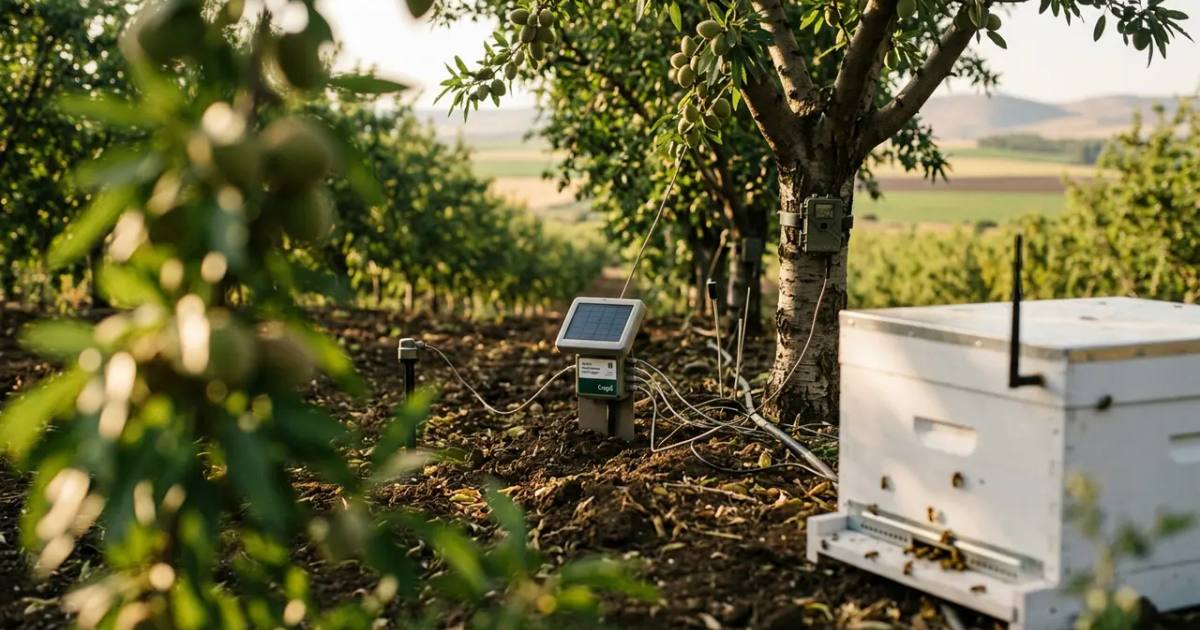
CropX, based in Herzliya, combines wireless soil-moisture and temperature sensors placed directly in farmland with cloud-based software that builds irrigation maps and calculates water needs automatically, consolidating agronomic data that would otherwise sit scattered across a farm's separate systems. The company's more recent Strato 1 product, an in-field weather station providing real-time hyperlocal weather data, extends that same sensor-plus-software model from soil conditions into weather conditions, per iGrow's 2026 tracking of the sector.
How Does SeeTree Monitor Half a Billion Trees?
SeeTree, founded in Tel Aviv in 2013 and now Series C-funded at roughly $65.2 million raised, built what it calls an "Intelligence Platform for Trees," using drone imagery, aerial and satellite data, and IoT sensors combined with machine learning to assess individual tree health across orchards rather than treating a farm as a single undifferentiated unit. The company has scanned over 500 million trees worldwide, serving growers in Brazil, California, Florida, Mexico, South Africa, and the Asia-Pacific region, a scale that makes tree-level (rather than field-level) precision agriculture SeeTree's specific commercial niche.
What Problem Does Taranis Solve That Netafim Doesn't?
Taranis focuses on crop-level pest, disease, and weed detection through high-resolution aerial imagery combined with AI analysis, aiming to catch problems at a scale and speed manual field-scouting cannot match. The company has partnered with US agribusiness Pivot Bio to promote regenerative agriculture practices supported by USDA programs, positioning Taranis's imaging technology as complementary to, rather than competitive with, the soil-health and cover-cropping techniques regenerative agriculture depends on.
Why Did BeeHero and BeeWise Build Businesses Around Bees?
BeeHero has expanded its pollination-monitoring service into new geographies, including a third season of operations in Australia in 2026 offering expanded pollination services and pre-pollination reporting to growers who depend on managed pollinator populations for crop yield. BeeWise takes a more hardware-intensive approach, building robotic beehives that use AI-powered precision robotics to automate beekeeping tasks, aiming to increase honey yield, reduce colony loss, and eliminate the need for chemical pesticides in hive management. Both companies treat pollinator health as a measurable, manageable input to crop yield rather than an unmanaged externality, a framing that positions bee-monitoring technology as a distinct precision-agriculture category alongside soil, weather, and tree monitoring.
How Big Is Israel's Broader Precision-Ag Sector?
Israeli agritech startups have raised more than $1.66 billion over the past decade, according to industry tracking, across an estimated 391 active companies, with government-backed collaboration between startups and research centers cited as a structural driver of the sector's depth. That $1.66 billion figure sits alongside, not instead of, Netafim's much larger irrigation-hardware business, reflecting how the sector has diversified into software-and-sensor plays that monetize data and analytics rather than physical infrastructure.
Why Does This Distinction Matter?
Netafim, Israel's original agricultural water-technology export and now part of Mexico's Orbia conglomerate, remains the reference case for hardware-based precision irrigation. But the newer generation of Israeli precision-ag companies, CropX, SeeTree, Taranis, BeeHero, BeeWise, sell software, sensors, and data services layered on top of a farm's existing equipment rather than replacing it, a lower-capital-intensity model that has attracted a different investor base and produced a wider spread of smaller, more specialized companies rather than a single dominant platform. Aleph Farms' Gulf expansion, covered separately by Olam, shows the same UAE sovereign-capital interest extending from Netafim-style irrigation hardware into cultivated protein, suggesting Gulf investors increasingly view the entire Israeli agrifood-tech stack, hardware and software alike, as a single investable category.
FAQ
What is the difference between Netafim and CropX?
Netafim manufactures and sells physical drip-irrigation hardware; CropX sells soil sensors and cloud software that optimize irrigation decisions, often working alongside existing irrigation infrastructure rather than replacing it.
How many trees has SeeTree monitored?
Over 500 million trees worldwide, using drone, aerial, and satellite imagery combined with machine learning to assess individual tree health.
What does BeeWise's robotic beehive do?
It automates beekeeping tasks using AI-powered robotics, aiming to increase honey yield, reduce colony loss, and reduce reliance on chemical pesticides in hive management.
How much has Israeli agritech raised in total?
More than $1.66 billion over the past decade, according to industry tracking, across an estimated 391 active Israeli agritech startups.
Related on The Olam
- Israel's Climate and Water Economy: The Complete Map
- The Israeli Climate-Tech VC Map
- Aleph Farms: The $105M DisruptAD Cultivated-Meat Deal
- The Israeli Climate-Tech Exit Ledger
Sources
iGrow News, "AgTech Companies In Israel," January 2026. AgFunderNews, "Israel Agritech Market Map: 400 Startups Putting The Tech in Agritech." StartupRise, "List of Agritech Startup Companies in Israel" and "Top Agritech Startups In Israel." Finextra, "How 9 Israeli Companies are Revolutionizing Agriculture."