A new 'NEVER AGAIN' report documents xenophobic violence against Ukrainian refugee, migrant and disabled children in Poland, and asks whether Poland's 2022 solidarity still includes the children who remained.
A new report from the Polish anti-racist organization 'NEVER AGAIN' documents a rising pattern of xenophobic violence against refugee, migrant, and disabled children across Poland. This includes Ukrainian children beaten and verbally attacked for speaking their own language. Published on September 17, 2026, the 50-page report titled "This Is a Polish Bench" has been sent to the Ombudsman for Children, the Commissioner for Human Rights, and the Ministry of National Education.
The "NEVER AGAIN" Association's report details xenophobic hostility toward various groups of young people. These groups include refugee children who fled war, especially from Ukraine; children from migrant families; children with darker skin; and children with disabilities.
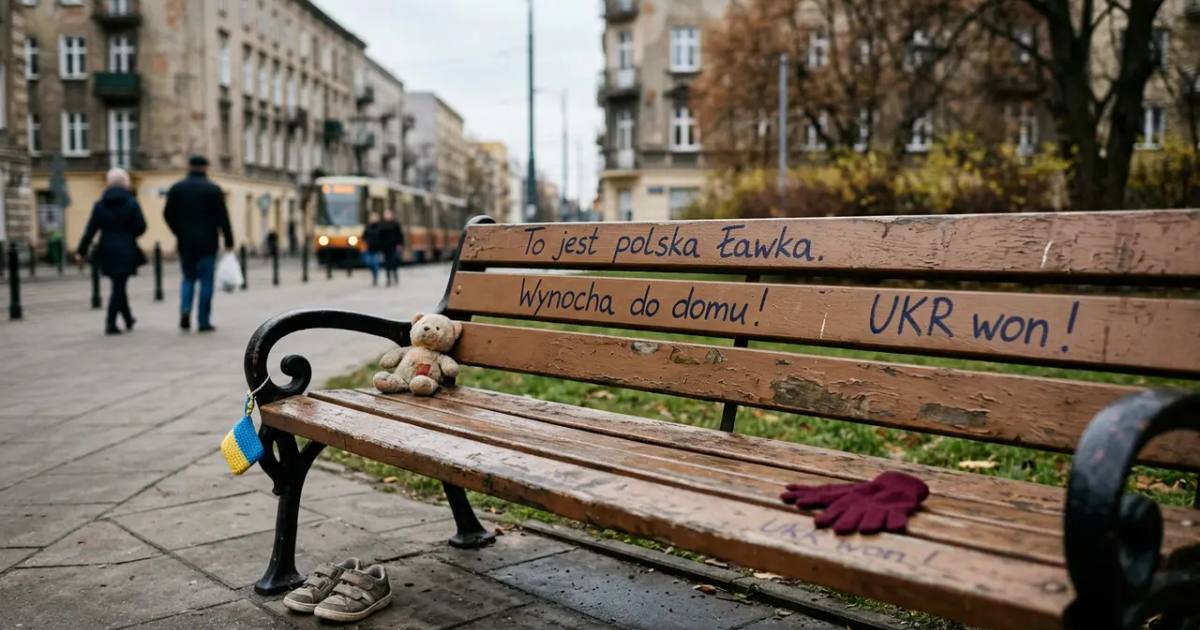
The report's title, "This Is a Polish Bench," comes from a real incident in Warsaw on September 2, 2022. A group of adults stopped Ukrainian teenagers from using a sports pitch, shouting that the school was Polish, not Ukrainian, and demanding they leave. Ordinary public spaces, like benches or playgrounds, should not require a child to produce a passport to exist there.
How Widespread is Xenophobia Against Children in Poland?
Xenophobic incidents against children in Poland are visible not only in polling numbers, but on the bodies of children, according to the "NEVER AGAIN" report. While Poland showed immense solidarity during the initial weeks of Russia's full-scale invasion of Ukraine, public support for accepting Ukrainian refugees has since declined. Far-right parties and Russia-aligned information operations have amplified negative sentiments.
The "NEVER AGAIN" organization reports a significant increase in such incidents in 2026 compared to previous years. The organization documented selected cases across various cities, including Legnica, Gdańsk, Warsaw, and Lublin. This indicates a national pattern of accepted xenophobic behavior, not an isolated local issue.
More than 353,000 young people from 148 countries study in Poland's non-university education system. This group accounts for 5.3% of the total student population. Ukrainian children alone represent 4.1% of all pupils in the Polish school system, totaling 237,000 school pupils, 62,600 nursery children, and 53,400 adult learners. Belarusians follow Ukrainians, making up 9% of this international group.
What Does the "This Is a Polish Bench" Report Document?
The "NEVER AGAIN" report details incidents of xenophobic violence across several categories. These categories highlight different systemic failures leading to attacks on children.
Street and Playground Violence by Adults
The report includes cases of adults physically assaulting minors. In Legnica, on July 18, 2026, a 26-year-old woman reportedly punched two Ukrainian girls, aged 13 and 14, for speaking Ukrainian. She also struck a Ukrainian boy who tried to intervene, breaking his nose, according to the children's mother. In Bydgoszcz, on August 14, 2026, a man and a woman attacked a 14-year-old Ukrainian girl and her 12-year-old brother for speaking Ukrainian, an assault reported by the Consulate General of Ukraine in Gdańsk.
Physical violence by adults against children, prompted solely by the sound of a language, constitutes a crime. Another incident in Lublin on January 7, 2023, involved two men assaulting a Ukrainian woman, her 13-year-old son, and her pregnant daughter after hearing them speak Ukrainian. They shouted slurs, pushed the boy to the ground, and punched him in the head. The attackers also assaulted the pregnant woman after she revealed her condition.
Peer Violence with Institutional Complicity
Peer violence often occurs with an institutional dimension. In Słupsk, on November 17, 2025, several students from a building-construction school attacked four Ukrainian teenagers from a private crafts school, shouting anti-Ukrainian slurs. One boy suffered a broken collarbone, and another was suspected of having a concussion. A teacher at the school had made contemptuous and xenophobic remarks about Ukrainian students in the weeks leading up to the attack.
Racist Violence Beyond Ukrainian Victims
The documented racist violence extends beyond Ukrainian children. On August 31, 2023, in Bielsko-Biała, a group of teenagers brutally beat two brothers evacuated from Afghanistan with their parents. In Ostrów Mazowiecka, on September 25, 2025, a local resident assaulted an 11-year-old dark-skinned boy, hurling racist abuse and kicking him twice. These incidents demonstrate broader patterns of racial prejudice.
Online Harassment and Political Incitement
The report also documents a politics of humiliation conducted online and by public officials. On June 7, 2024, Grzegorz Płaczek, a member of parliament from the far-right Confederation party, posted a TikTok video spreading false claims about Ukrainian children receiving preferential access to haemophilia treatment. Additionally, on October 27, 2025, the Warsaw branch of the Confederation of the Polish Crown condemned Polish government medical aid for children in Ukraine. These actions are signals from individuals seeking or holding power, normalizing hateful narratives.
A particularly revealing case involved a non-Ukrainian child. On August 1, 2025, a Facebook user in Szczecin incited violence against people with disabilities. The user threatened a girl with Down syndrome and invoked the language of the Holocaust, demonstrating the recycling of historical hate speech.
Why Does the "NEVER AGAIN" Association Matter?
The "NEVER AGAIN" Association, founded in Warsaw in 1996, brings a long history of anti-racist advocacy to this report. Initiated by Marcin Kornak, a social activist who lived with a physical disability, the organization has consistently focused on documentation. Its detailed work distinguishes it from newer advocacy groups.
The association maintains the 'Brown Book', the most extensive public register of racist, xenophobic, and antisemitic incidents in Poland. This resource is built through a network of correspondents and contacts within minority communities. "NEVER AGAIN" has collaborated with international bodies like the United Nations, the European Union, and the International Holocaust Remembrance Alliance. Its pedigree suggests a clear understanding of patterns of hatred, not moral panic.
Lukasz Jakubowski, speaking for the association, states that violence against children is morally reprehensible. He points out that far-right propagandists who spread this hatred are primarily motivated by political and financial interests. The organization's extensive documentation supports its claims, even if individual cases are not yet legally proven in court.
How Does Political Language Lead to Violence?
Assaults on children are not spontaneous expressions of public sentiment; language often precedes physical aggression. When elected officials invent stories about Ukrainian children receiving medical treatment over Polish children, they teach the public whom to resent. Similarly, when a political account attacks humanitarian aid for children, it removes moral status from a group of human beings.
The Poznań case in the report illustrates the extreme dehumanization possible. On July 15, 2026, Prof. Stanisław Żerko, an employee of the state-funded Institute for Western Affairs, mocked the fate of refugee children in social media posts. He used a photograph of Alan Kurdi, the three-year-old Syrian boy whose 2015 death symbolized a humanitarian catastrophe, as the subject of a joke. A society faces greater danger when those paid to think in public treat a child's death as humor, beyond mere anonymous online comments.
A video from Łódź on August 3, 2026, captured a man verbally abusing a Ukrainian teenager with nationality-based slurs at a tram stop. He then demanded to know why she was not at war. This sequence highlights how xenophobia progresses: a refugee is first welcomed as a victim, then suspected as a competitor, accused as a coward, and finally punished as an intruder. Children are not exempt from this escalating pattern.
What Role Do Poland's Schools Play?
Poland's schools must either successfully integrate hundreds of thousands of foreign children or risk teaching a generation that belonging is conditional. The "NEVER AGAIN" Association has long provided anti-discrimination training for teachers, youth workers, and students. This training includes recognizing hate symbols used by neo-fascist groups, directly addressing the underlying ideologies.
Since 2020, "NEVER AGAIN" has also run the online educational project Watch Out, in collaboration with the Forward Foundation. This initiative offers lectures by historians, sociologists, and social psychologists, along with lesson plans for history, social studies, and English classes. This educational work is crucial but remains insufficient if adults continue to model contradictory behavior.
A teacher who mocks Ukrainian pupils causes more damage than many anonymous comments. A parent who assaults children in a playground teaches all witnesses that state rules are optional. A politician who spreads lies about medical care for Ukrainian children transforms a clinic into a source of grievance, amplifying societal divisions.
What Should Europe Learn From This Report?
The issues highlighted in the "This Is a Polish Bench" report are not solely a Polish problem. Europe tasked front-line states with carrying the largest share of Ukrainian displacement, and Poland responded significantly. The European Union must not now treat the social repercussions as a mere local embarrassment.
Several actions are necessary. Hate crimes against minors must be accurately recorded and counted as such, rather than dismissed as generic disputes. Independent monitors like "NEVER AGAIN" require protection, not attacks, for their critical work. Legitimate debates about benefits, labor markets, and temporary protection must remain separate from the dehumanization of children. Online calls to harm a disabled child must be prosecuted as criminal matters. Finally, the historical memory embedded in the phrase "never again" must be actively maintained and applied, not reserved only for anniversaries.
What Does This Report Mean for Poland?
The attackers in Warsaw who claimed a school pitch was "Polish, not Ukrainian" asserted sovereignty in a small space, implying that coexistence is a concession. Their actions suggested a child's presence is a trespass, and violence is an acceptable method of enforcing their views. A bench in a Polish schoolyard can be Polish and still be shared; these facts are not inherently in conflict unless someone forces them to be.
The "This Is a Polish Bench" report will not, by itself, reverse hardening public sentiment. However, it removes the excuse of ignorance by clearly naming the cities, dates, victims' ages, and the words used against them. It also identifies the adults who should have intervened. Poland demonstrated extraordinary generosity in 2022 by welcoming a neighboring nation's catastrophe. The current question is whether that commitment still extends to the children who remain. Children did not start this war, and they should not be forced to justify their existence in the country that first offered them shelter.
Sources and Further Information
- 'NEVER AGAIN' Association report page, "This Is a Polish Bench"
- Watch Out anti-fascist educational project
More from Andy Vermaut on Hate, Human Rights and Jewish Life in Europe
- Leuven's Ban on Hapoel Be'er Sheva Sets a Dangerous Precedent
- A New Laeken Declaration Must Name What It Protects
- Brussels Launches Medical Certification Program for Mohels
- Britain Cannot Normalise 3,700 Antisemitic Incidents
- 72,000 Latvian Jews Were Murdered. One Museum in Riga Carries the Whole Story.
- The Generation That Leaves: Europe's Jewish Future Is Being Decided Now
- Quiet Departures, Institutional Failures: What Europe Must Change to Keep Its Jews
- Jihadism, Iran, and the Cost of Jewish Security in Europe
- Five Countries, One Pattern: Europe's Jewish Communities Live Under Permanent Alert
- AI Can Industrialize Antisemitism Faster Than Europe Can Regulate It
- Church of England Under Fire Over Kairos II Decision
- Europe Admitted Antisemitism Is Rising. Its Protection System Still Falls Short.
Andy Vermaut is president of the World Council for Public Diplomacy and Community Dialogue and editor-in-chief of indegazette.be. He writes on European institutions, fundamental rights, public diplomacy and the protection of vulnerable communities.