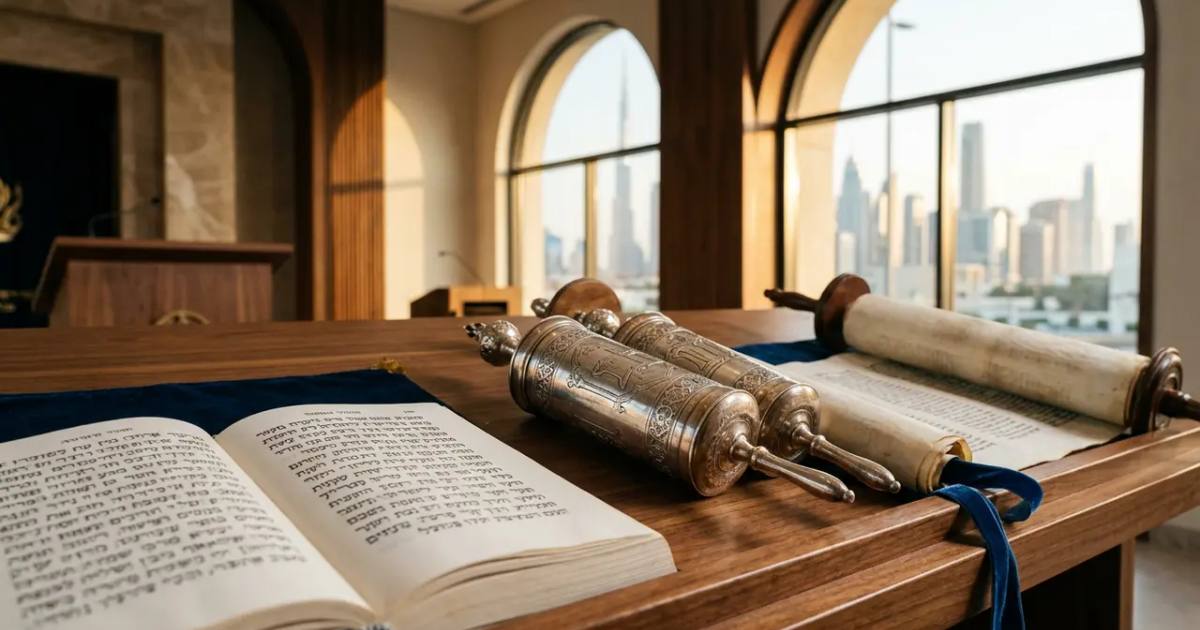

Roughly 7,000 Jews now live in the UAE, with three synagogues, a chief rabbinate, and a government-approved kosher system built almost entirely since 2019. Here is how, and how much of it is documented fact versus aspiration.
The United Arab Emirates is home to roughly 7,000 Jews, most of them in Dubai, with three functioning synagogues, a chief rabbi, and a kosher food and education system built almost entirely since 2019, according to Wikipedia's documented history of the community and the World Jewish Congress. Community members describe the country, on the record, as one of the safest places in the world for Jewish life today. That description did not exist a decade ago, and it did not happen by accident.
How Far Back Does Jewish History in the UAE Go?
Documented Jewish history in the territory now covered by the UAE dates to 1165, according to the Wikipedia entry on the history of Jews in the United Arab Emirates, centuries before the seven emirates federated into a single country in 1971. That early history left no continuous, visible community behind, unlike Bahrain's Iraqi-merchant lineage from the 1880s. The modern UAE Jewish community is therefore a recent formation built on a much older, thinner historical thread rather than a direct continuation of a single unbroken population.
For most of the twentieth century and the UAE's first five decades of statehood, the country had no formal Jewish institutions at all, and any Jewish residents, largely expatriate businesspeople and diplomats, worshipped privately if at all. The shift from that near-total institutional absence to three synagogues, a chief rabbinate, and a government-approved kosher system happened almost entirely inside a single decade, and mostly inside the five years following the Abraham Accords.
How Many Jews Live in the UAE Today?
Roughly 7,000 Jews live in the UAE as of 2025, split between about 6,000 in Dubai and 600 in Abu Dhabi, according to the Wikipedia entry on the history of Jews in the United Arab Emirates. That figure has grown from an estimate of 150 families, or 2,000 to 3,000 people, reported by Rabbi Marc Schneier in 2019, the year before the Abraham Accords normalized relations between Israel and the UAE. Rabbi Levi Duchman, the country's first resident rabbi, told The National in 2022 that the community's population had doubled and that Jews from more than 15 countries, including the United States, Canada, the United Kingdom, France, the Netherlands, Japan, Australia, Argentina, and Israel, now live in the UAE.
The growth did not begin with the Accords. A small, largely undocumented Jewish presence existed in the UAE for decades before 2020, living what the World Jewish Congress describes as a life "mostly in the shadows," worshipping in private villas rather than public buildings. What changed after 2020 was not the existence of the community but its visibility, its institutions, and its legal standing.
Timeline: How Did the UAE's Jewish Revival Actually Unfold?
The UAE's Jewish institutions were built in a compressed sequence rather than gradually over decades. The dates below are the documented markers of that build-out.
- 2014: Rabbi Levi Duchman arrives in the UAE and begins building Chabad operations in Abu Dhabi and Dubai, according to his Wikipedia biography.
- 2018: Pope Francis visits Abu Dhabi, and the UAE government announces plans for the Abrahamic Family House, per the World Jewish Congress.
- 2019: The UAE designates its Year of Tolerance, launches the National Tolerance Programme, and the Jewish Council of the Emirates holds its first general meeting, electing Ross Kriel as president and Rabbi Yehuda Sarna as chief rabbi.
- September 2020: The Abraham Accords normalize relations between Israel and the UAE, and the JCE represents the community at the White House signing.
- December 2020: The community holds a public Hanukkah menorah lighting and concert at the foot of the Burj Khalifa, per the World Jewish Congress.
- February 2023: The Moses Ben Maimon Synagogue opens at the Abrahamic Family House on Saadiyat Island, described by UK Chief Rabbi Ephraim Mirvis as the first purpose-built synagogue in the Arab world in nearly a century.
- 2025: The documented Jewish population reaches roughly 7,000, across three functioning synagogues and a government-approved kosher certification system.
Why Do Jewish Families Call the UAE a Safe Place to Live?
Jewish residents interviewed by the Abraham Accords Peace Institute in 2022 described the UAE, in their own words, as "the safest place in the world" for a Jewish family. Adi Zamir, a diamond and jewelry dealer from Ramat Gan who relocated his business and his family to Dubai after the Accords were signed in September 2020, told the outlet that the shift in the global diamond trade toward Dubai, away from Antwerp, made the move a business decision first. The sense of personal safety, he said, made it an easy one. That same relocation logic, business first and family second, is documented in more detail in why Jewish business families are moving to Dubai.
An unnamed community member quoted in the same report put it directly: "We as Jews feel very safe. I know local people respect the Jewish people. When we have celebrations, they respect and understand that we have our services and prayers." She added that relatives visiting from abroad, told to enjoy a year and then come home, no longer want to leave. These are testimonials from named and unnamed residents, not editorial claims, and they describe a specific, observable pattern: public religious practice, previously conducted in private villas and hotel function rooms, now happens openly, with local acknowledgment rather than local objection.
Rabbi Duchman told The National that the next priority for the community is a standalone synagogue building in Dubai itself, since worshippers currently gather at the Jewish Community Centre in Al Wasl or rent space at the Address Dubai Marina Hotel. He said the plan is to welcome "thousands of new families" over the following decade.
What Government Recognition Changed Jewish Legal Status?
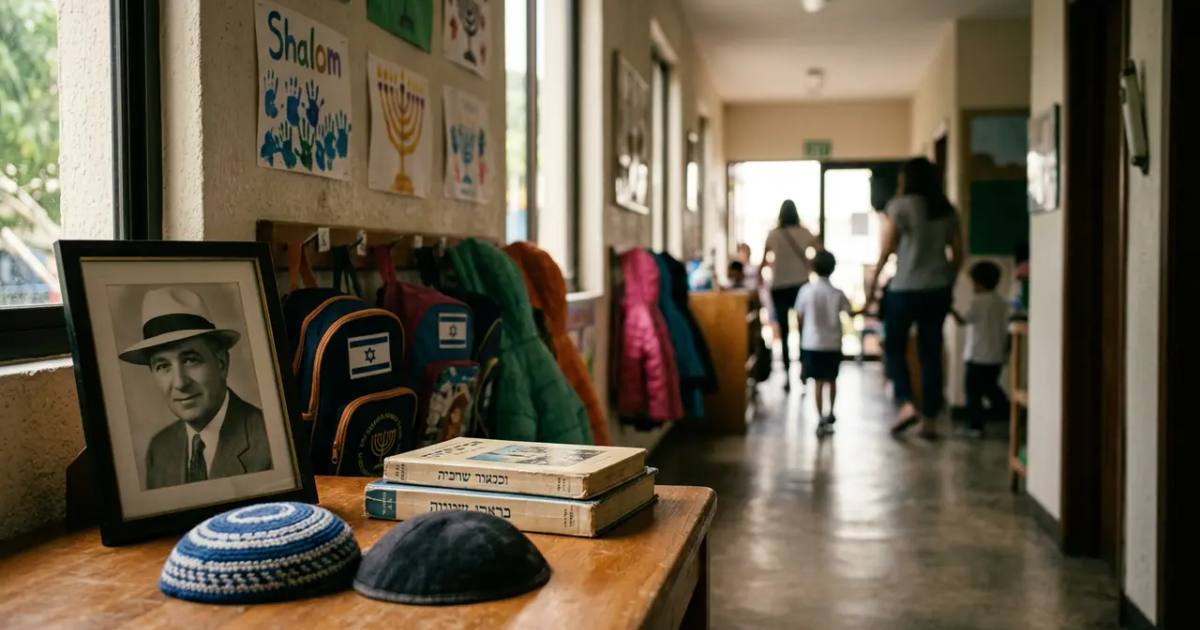
Judaism became a publicly recognized religion in the UAE through the government's Ministry of Tolerance and its 2019 National Tolerance Programme, according to the World Jewish Congress. That recognition followed the UAE's designation of 2019 as its own Year of Tolerance, marked by the publication "Celebrating Tolerance: Religious Diversity in the United Arab Emirates." The practical effect, per the World Jewish Congress, is that observant Jewish men in Dubai can wear a kippah in public, something that was not the case before the recognition.
The Jewish Council of the Emirates, known as the JCE, held its first general meeting and adopted a constitution in 2019, electing Ross Kriel as its first president and declaring Rabbi Yehuda Sarna as chief rabbi, according to the World Jewish Congress. The JCE describes its mission as advancing "the unity, welfare, standing, and security of Jews living in the UAE by bridging the Muslim and Jewish communities." The organization represented the community at Pope Francis's 2018 visit to Abu Dhabi and at the White House signing of the Abraham Accords in 2020, giving it standing in both religious and diplomatic settings before most of its members had synagogues to pray in. The recognition sits alongside a broader, separate pattern of institutional engagement documented in where Muslim institutions recognize Israel as a Jewish state, where the UAE is one of a small number of documented examples.
What Is the Abrahamic Family House and Why Does It Matter?
The Abrahamic Family House on Abu Dhabi's Saadiyat Island houses a mosque, a church, and a synagogue on one site, and it opened its synagogue, the Moses Ben Maimon Synagogue, in February 2023, according to the Abraham Accords Peace Institute. UK Chief Rabbi Ephraim Mirvis affixed the building's mezuzah at the opening ceremony and described it, in a statement quoted at the event, as "the first purpose-built synagogue in the Arab world for nearly a century." A Torah scroll donated by UAE President Sheikh Mohamed bin Zayed Al Nahyan was brought into the synagogue in a separate dedication ceremony the following Sunday.
The synagogue's architect, Sir David Adjaye, designed the building as a modern interpretation of traditional Jewish forms, according to the Wikipedia entry on the Moses Ben Maimon Synagogue. At the dedication, Rabbi Sarna invited Rabbi Duchman, the head of Chabad in the UAE, to recite a Hebrew prayer for the UAE's leaders and government. The same prayer was delivered in Arabic by Rabbi Yosef Hamdi, who leads Abu Dhabi's small Yemenite Jewish community, a group the Emirati government helped rescue two years before the synagogue opened.
The Atlantic Council's assessment of the opening, published in 2023, described the synagogue as intended to be "the flagship center for Jewish life in Abu Dhabi," equipped with a mikvah, an on-site residence for visiting rabbis and scholars, and space for the full range of Jewish lifecycle events, from weddings to bar and bat mitzvahs. Former Trump administration aide Avi Berkowitz held his wedding there before the site opened to the public, according to the same report.
Who Leads the UAE's Jewish Community?
The UAE's Jewish community operates under a small, named leadership structure rather than a single chief rabbinate model. Rabbi Yehuda Sarna holds the title of chief rabbi of the UAE, according to the Wikipedia entry on the community's history. Rabbi Elie Abadie serves as senior rabbi. Rabbi Levi Duchman, who arrived in the UAE in 2014 and has run its Chabad operation since, heads the Jewish congregation in Abu Dhabi and leads the Jewish Community Center of UAE in Dubai. Ross Kriel remains president of the Jewish Council of the Emirates.
Duchman's biography, documented on Wikipedia, credits him with establishing Jewish communities in both Abu Dhabi and Dubai since 2014, along with a government-approved kosher certification system, a Jewish education network, and business networking and relocation services for arriving families. He also sits on the executive board of the Alliance of Rabbis in Islamic States, a body that did not exist in any practical form in the Gulf before the wave of normalization agreements that began with the UAE in 2020.
The leadership structure has not been without friction. A 2020 Times of Israel report, cited in the Wikipedia entry on the Jewish Community Center of UAE, described tension between Duchman's Chabad-affiliated institution and an earlier, smaller Jewish community that had operated quietly in Dubai for years before 2020. The dispute illustrates a real feature of the UAE's Jewish revival: it involves multiple communities, denominations, and leadership claims arriving and consolidating within a compressed timeframe, not a single, uncontested institution growing at a steady pace.
What Kosher Infrastructure Exists in the UAE?
Dubai's Jewish communal institutions expanded fast in the four years after 2020, according to the World Jewish Congress, which reports that a religious school, kindergartens, synagogues, mikvahs, and multiple kosher restaurants were all built in that window. Before 2020, community life centered on a single private villa in Dubai. Kosher food is now available at markets, hotels, and restaurants, and Elli's Kosher Kitchen provides catered kosher meals for events and private clients, per the same source.
The UAE's government-approved kosher certification system, credited to Rabbi Duchman's Chabad operation on Wikipedia, gives kosher-observant businesses and consumers an official standard to operate against, rather than relying on informal or imported certification from abroad. That infrastructure is what allows the UAE's kosher hospitality sector, including hotel kitchens and standalone restaurants, to serve both resident families and the growing volume of Israeli and diaspora tourists visiting Dubai and Abu Dhabi.
Hanukkah has moved from private observance to public spectacle in the same period. In December 2020, the community held a public menorah lighting and concert at the foot of the Burj Khalifa, the world's tallest building, according to the World Jewish Congress. That kind of visible, government-sanctioned public religious display would not have been plausible under the UAE's pre-2019 religious framework.
What Are the Real Limits of This Openness?
The UAE's Jewish community remains small relative to Dubai's population of roughly 3.7 million, and its public visibility, while new, coexists with a UAE legal and social system that is not a liberal democracy on Western terms and does not extend the same openness to every form of religious or political expression. The community's own leaders describe growth in terms of institutions and safety, not universal social acceptance, and community members interviewed by the Abraham Accords Peace Institute in 2022 described a pattern of respect for private religious practice specifically, rather than a claim that antisemitism does not exist in the region or that every resident of the UAE shares the government's tolerance policy.
The Abraham Accords themselves remain a government-to-government framework, and the pace of communal growth has tracked the diplomatic relationship closely. Community leaders, including Rabbi Duchman, frame the UAE's trajectory as a multi-decade project, not a finished state. His own goal, a standalone Dubai synagogue building to replace villa and hotel-based worship, remained unbuilt as of the reporting cited above, four years after the Accords were signed. The institutions that exist today, the Moses Ben Maimon Synagogue, the JCE, the kosher certification system, and three functioning synagogues, are the product of a five-year building period following decades in which no equivalent public infrastructure existed at all.
How Does the UAE's Jewish Community Compare to Bahrain's?
Bahrain's Jewish community numbers about 50 people today, down from a peak of roughly 1,500 when Iraqi Jewish merchants first settled the island in the 1880s, according to Ebrahim Dahood Nonoo, the community's leader, speaking to the Jewish Telegraphic Agency. That is a smaller, older, and more thoroughly indigenous community than the UAE's, and it produced a different kind of milestone: Houda Nonoo, Ebrahim's cousin, became Bahrain's ambassador to the United States in 2008, the first Jewish person appointed as an ambassador by any Arab country, according to Touro University's account of her public remarks.
Bahrain's King Hamad bin Isa personally marked Hanukkah for the first time in 2015, five years before the Abraham Accords existed, according to a history of the Bahrain-Israel relationship published by the Every Generation Investment Company. Bahraini Jews, however, did not practice their faith in a public synagogue building until recently, since the country's sole synagogue had remained closed for years, per the same source. That is the reverse of the UAE's pattern: Bahrain had earlier political recognition of individual Jewish citizens but slower public religious infrastructure, while the UAE built public religious infrastructure fast but from a newer, more transient, and more international community base.
Both communities now sit inside the Association of Gulf Jewish Communities, a regional body serving Jews in Bahrain, Kuwait, Oman, Qatar, Saudi Arabia, and the UAE, according to Touro University's summary of a 2021 talk by Ambassador Nonoo. The AGJC held its first Shabbat dinner in Bahrain in 2021, drawing diplomats and community members from across the Gulf Cooperation Council, Nonoo told The Jerusalem Post at the time. Nonoo has also said publicly, per the Touro summary, that antisemitism is "not an issue in the Arabian Gulf" in the way it has become in parts of the West, a claim made by a named, on-the-record former ambassador rather than an outside observer.
What Economic Role Does the Jewish Community Play in the UAE?
Kosher tourism has become a measurable part of Dubai's hospitality sector since 2020, driven by Israeli visitors seeking kosher-certified hotels and restaurants alongside the emirate's existing luxury tourism draw. The kosher certification system Rabbi Duchman's Chabad operation built with UAE government approval, per Wikipedia, underpins that sector by giving hotel groups and restaurant operators a locally recognized standard rather than forcing them to import certification from Israel, the United States, or the United Kingdom.
Diamond trading is the clearest case of Jewish business migration reshaping a UAE industry outright. Adi Zamir's relocation from Ramat Gan to Dubai after the 2020 Accords, reported by the Abraham Accords Peace Institute, was part of a broader shift of the diamond trade away from Antwerp, Belgium's historic hub, toward the Dubai Diamond Exchange. Zamir framed the move as a bet that Dubai would become "the center of the diamond business in the world instead of Belgium." That bet mirrors a pattern documented across other sectors on Olam, including the UAE's adoption of Israeli cyber and AI technology, UAE acquisitions of Israeli defense systems, and the $3.2 billion bilateral trade relationship, in which individual relocations and formal trade agreements moved in parallel rather than in sequence.
Community leaders describe the relationship as circular: business relocation brought families, and families brought the demand for synagogues, schools, and kosher infrastructure, which in turn made further business relocation easier for the next arriving family. Rabbi Duchman's own services, which Wikipedia describes as including "business networking and relocation services," formalize that circularity into an actual offering rather than an incidental byproduct of communal growth. The mechanics of that relocation case, tax structure, legal frameworks, and the family offices actually moving, are covered in full in why Jewish business families are moving to Dubai.
How Does This Compare to Israeli Family Capital in the Gulf?
Israeli family capital and UAE-based Jewish communal capital are related but distinct flows. The families mapped in Olam's profile of Israeli family offices including Ofer, Wertheimer, and Azrieli largely built their fortunes inside Israel before diversifying regionally, while the diamond dealers and fintech entrepreneurs relocating to Dubai since 2020 are, in many cases, moving primary operations rather than diversifying an existing Israeli base. Global Jewish philanthropic capital, mapped separately in Olam's overview of global Jewish philanthropy, has not yet built a comparable UAE-specific giving infrastructure, since the community itself is still young enough that its own institutions, not outside diaspora philanthropy, have funded most of its recent growth.
Frequently Asked Questions About the UAE's Jewish Community
How many synagogues are in the UAE? Three synagogues operate across the UAE as of 2025, according to the Wikipedia entry on the history of Jews in the United Arab Emirates, including the Moses Ben Maimon Synagogue at the Abrahamic Family House in Abu Dhabi and community spaces in Dubai.
Is it legal to practice Judaism openly in the UAE? Yes. The UAE's Ministry of Tolerance and its 2019 National Tolerance Programme gave Judaism formal recognition as a practiced religion, and the World Jewish Congress reports that observant Jewish men in Dubai can wear a kippah in the street as a direct result of that recognition.
Who is the chief rabbi of the UAE? Rabbi Yehuda Sarna holds the title of chief rabbi of the UAE, with Rabbi Elie Abadie serving as senior rabbi and Rabbi Levi Duchman leading Chabad operations and the Jewish Community Center of UAE in Dubai and Abu Dhabi, according to Wikipedia's entry on the community's history.
When did the UAE's first official synagogue open? The Moses Ben Maimon Synagogue at the Abrahamic Family House on Saadiyat Island in Abu Dhabi opened in February 2023, described by UK Chief Rabbi Ephraim Mirvis as the first purpose-built synagogue in the Arab world in nearly a century, per the Abraham Accords Peace Institute.
Can Jewish families get kosher food in Dubai? Yes. Kosher markets, hotel kitchens, and standalone restaurants operate in Dubai under a UAE government-approved kosher certification system, and Elli's Kosher Kitchen provides catered kosher meals for private events, according to the World Jewish Congress.
What This Means for the UAE's Jewish Community Today
The evidence for the UAE as a secure environment for Jewish communal life rests on a specific, checkable set of facts: a government tolerance policy dating to 2019, a purpose-built synagogue opened in 2023 with state involvement in its dedication, three functioning synagogues and a government-approved kosher certification system, named leadership across multiple denominations, and consistent, on-the-record testimony from residents describing public religious practice without incident. It does not rest on the absence of risk anywhere in the world for Jewish communities, a claim no reporter or rabbi interviewed in the sources above made. What has changed, measurably, since 2019 is the UAE's own institutional posture toward its Jewish residents, and that shift is documented, named, and dated rather than asserted.