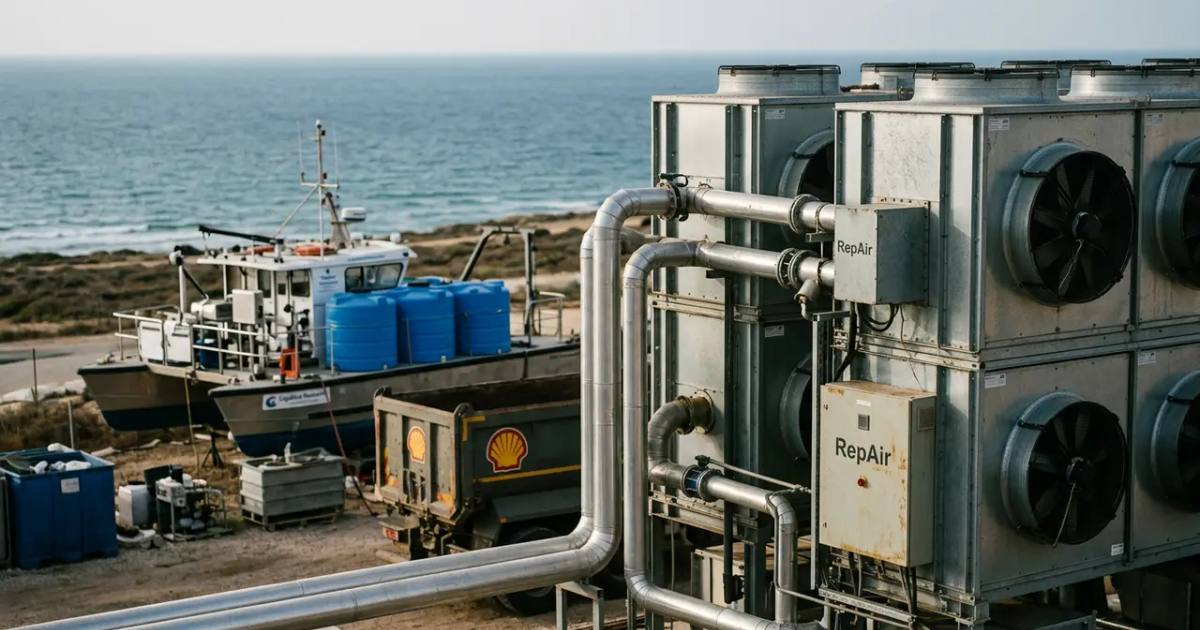

Israeli carbon tech splits into two very different bets: hardware-heavy direct air capture (RepAir) and ocean-based carbon removal (Gigablue) — one backed by Shell and Equinor, the other facing open scientific skepticism over its methodology.
Israel's carbon-tech sector splits cleanly into two camps: a small group of hardware-intensive direct air capture (DAC) developers building machines that pull CO2 out of ambient air, and a newer, more controversial wave of nature-based and ocean-based carbon removal startups selling credits against processes that are harder to independently verify. Both camps are still early-stage by global standards — Israeli climate tech researchers classify carbon capture, utilization and carbon management as among the youngest cohorts in the country's broader climate-tech portfolio, with the majority of companies under seven years old.
What Is RepAir Carbon and How Does Its Technology Work?
RepAir Carbon Capture has built an electrochemical direct air capture system that operates at room temperature rather than the high heat most DAC processes require, which the company says cuts energy use by roughly 70% versus industry-average thermal DAC. The system uses stacked electrochemical cells rather than a single large reactor, making it modular and, in principle, easier to scale incrementally than a monolithic plant.
RepAir raised a $10 million Series A in December 2022, led by climate-focused fund Extantia Capital, with Equinor Ventures, Shell Ventures, and Zero Carbon Capital also participating — a notable roster given that Equinor and Shell are both oil majors with direct commercial interest in carbon-removal technology that could offset their own emissions. The company estimates its approach could bring DAC costs down to around $70 per ton of CO2 captured, which would be competitive with the lower end of current DAC pricing globally. RepAir has also received a total of five million shekels (roughly $1.4 million) across three R&D grants from the Israel Innovation Authority.
What Is Gigablue and Why Has Its Technology Drawn Scientific Skepticism?
Gigablue, founded roughly three years ago by Ori Shaashua and Sapir Markus-Alford, takes a completely different approach: engineered particles released into the ocean that are designed to grow phytoplankton, which absorb CO2 and, per the company's claim, sink to the seafloor when the particles and organisms die, locking the carbon away. The company began ocean trials in the South Pacific in 2024 and announced in 2025 that it had sold 200,000 carbon credits against the technology — a scale the company described as a milestone, framed explicitly around the industry benchmark of one gigaton of annual carbon removal needed globally to meaningfully slow warming.
Gigablue raised a $20 million round in early 2026, led by ocean-climate-technology fund Planet Ocean Capital, with a second close of the Series A still in progress as of that announcement. But independent scientists, in reporting by the Associated Press and Times of Israel, have raised open questions about whether Gigablue's particles reliably sink and sequester carbon at the rate or verifiability the company claims, given the difficulty of independently measuring what happens in an open ocean environment. Puro.earth, one of the private registries that verifies carbon credits for the voluntary market, is the entity actually determining whether Gigablue's methodology holds up — not a government regulator, reflecting the largely self-regulated structure of the voluntary carbon credit market globally.
Is There Academic Research Behind Israel's Carbon-Capture Push?
Yes. Researchers at Hebrew University, led by Noga Moran, published findings in late 2025 describing a laboratory system that accelerates a naturally slow geological process — running CO2 and seawater through common rocks like limestone and dolomite — from a timescale of thousands of years down to hours, locking carbon dioxide in dissolved mineral form before it can escape back into the atmosphere. The research is aimed at industrial and power-plant emissions rather than atmospheric DAC, and represents a third, more nascent technical approach — mineral-based carbon locking — distinct from both RepAir's electrochemical DAC and Gigablue's ocean-based approach.
How Does Israel's Carbon-Tech Cohort Compare?
| Approach | Lead Company | Stage | Notable Backers |
|---|---|---|---|
| Electrochemical direct air capture | RepAir Carbon | Series A ($10M, 2022) | Extantia Capital, Equinor Ventures, Shell Ventures |
| Ocean-based carbon removal | Gigablue | Series A, first close ($20M, 2026) | Planet Ocean Capital |
| Mineral-based carbon locking | Hebrew University (academic, pre-commercial) | Lab-stage research | N/A |
Per Israeli innovation-sector research, carbon capture and utilization is a hardware-intensive category with fewer entrants than the software-based carbon management, risk, and finance segment — meaning most of the activity in Israeli "carbon tech" broadly defined is actually MRV (measurement, reporting, and verification) software and carbon-accounting platforms serving corporate compliance, not physical carbon-removal hardware. Both segments remain, by the sector's own classification, in an early stage of investment relative to Israel's more mature climate-adjacent categories like desalination and irrigation.
Why Does This Matter for Israel's Climate-Tech Positioning?
Israel's global reputation in climate-adjacent technology rests overwhelmingly on water — desalination, drip irrigation, atmospheric water generation — categories where Israeli companies hold genuine global market share and decades of operating history. Carbon tech is a newer, thinner bet: a handful of companies, mixed scientific reception, and a funding base that leans on climate-specialist funds and oil-major corporate venture arms rather than Israel's deep domestic tech-investor base. Whether RepAir's more conventional DAC engineering or Gigablue's more speculative ocean approach ends up defining Israel's carbon-tech reputation is still an open question — and one with real reputational stakes, given the scrutiny already directed at Gigablue's methodology.
FAQ
What is Israel's biggest carbon-tech company?
By funding and technical credibility with oil-major backers, RepAir Carbon is the most established, having raised a $10 million Series A from Extantia Capital, Equinor Ventures, and Shell Ventures. By carbon-credit volume sold, Gigablue claims the larger footprint, having sold 200,000 credits, though its methodology has faced open scientific questions.
How does RepAir's direct air capture technology work?
RepAir uses an electrochemical process operating at room temperature, using stacked cell modules rather than a single large thermal reactor, which the company says cuts energy use by around 70% versus industry-average DAC.
What does Gigablue actually do?
Gigablue releases engineered particles into the ocean designed to grow carbon-absorbing phytoplankton that the company says sink to the seafloor, sequestering the carbon. Independent scientists have raised questions about how reliably this process can be measured and verified.
Who verifies Gigablue's carbon credits?
Puro.earth, a private carbon-credit registry, is the entity assessing Gigablue's methodology — not a government regulator, reflecting the largely self-regulated nature of the voluntary carbon market.
Related on The Olam
- Israel's Climate and Water Economy: The Complete Map
- IDE Technologies: Inside Israel's Desalination Stack
- Israel's Grid-Tech and Battery-Storage Startups
- The Israeli Renewables Developer Wave
- Aleph Farms: The $105M DisruptAD Cultivated-Meat Deal
Sources
ESG Today, "Gigablue Raises $20 Million to Scale Ocean-Based Carbon Removal Solution," January 2026. Associated Press / Times of Israel, "An Israeli startup says its new technology will save the planet. Scientists have doubts," July 2025. Calcalist/CTech, "Israeli startup raises $10 million for CO2 capture solution," December 2022. NoCamels, "Carbon Capture Startup Awarded Israeli Innovation Authority Grant," December 2023. TPS-IL, reporting on Hebrew University mineral carbon-capture research, December 2025. Innovation Israel, "Israel's ClimateTech Startups" sector report.