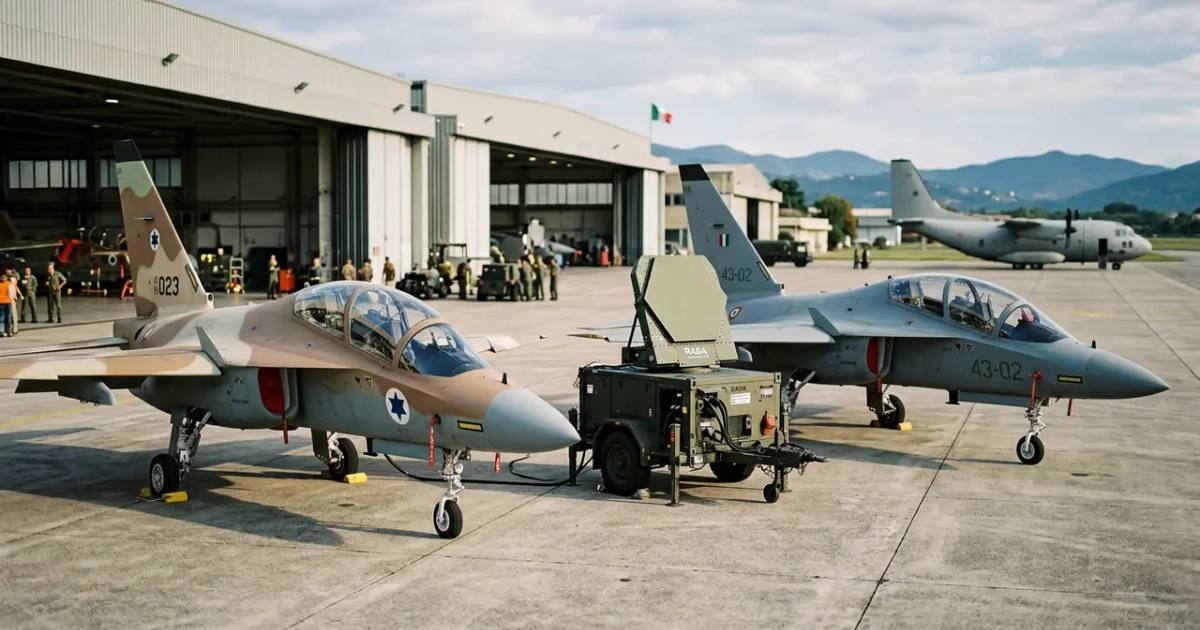

Italy's Leonardo owns an Israeli radar maker outright and trades trainer jets and satellites with Israel's defense ministry in a reciprocal deal.
Italy's Leonardo became the first major Western defense prime to acquire an Israeli defense technology company outright when its US subsidiary Leonardo DRS bought radar maker RADA Electronic Industries in a 2022 all-stock deal valued near $670 million. That corporate relationship now sits awkwardly alongside a government-to-government defense framework that Italy formally suspended in April 2026, making Italy's relationship with Israeli defense technology a study in how private-sector integration and state-level cooperation can move in opposite directions at the same time.
Italy suspended its defense cooperation agreement with Israel in April 2026
Italian Prime Minister Giorgia Meloni announced on April 14, 2026 that Rome would not renew the bilateral defense memorandum of understanding with Israel, a pact originally signed in 2003 and ratified by the Italian parliament in 2005 that had auto-renewed every five years since. Defense Minister Guido Crosetto sent formal written notice of non-renewal to his Israeli counterpart, Israel Katz. The MOU had governed cooperation in defense-industry procurement policy and the import, export, and transit of military equipment — the framework underneath deals like the 2020 helicopter-for-missile exchange and the M-346 trainer swap described below. A defense ministry source told Italian media the immediate practical effect was the end of joint military training between the two countries' armed forces; Israeli officials, for their part, told Israel Hayom the agreement carried "not much substance" to begin with. The suspension does not touch existing contracts or deliveries already underway, including the RADA acquisition itself, and Italy had already stopped issuing new arms-export licenses to Israel back in October 2024 while continuing to fulfill pre-war orders. Analysts described the move as more symbolic than operationally significant in the near term, but as an unprecedented break by one of Israel's most reliable European allies, driven by Italian criticism of Israeli strikes in Lebanon that affected Italian UN peacekeepers.
What did Leonardo actually buy when it acquired RADA?
Leonardo DRS, the Virginia-based US subsidiary of Italy's Leonardo, agreed in June 2022 to acquire 100 percent of Netanya-based RADA Electronic Industries in exchange for giving RADA shareholders approximately 19.5 percent equity in the combined company. The deal, valued at roughly $670 million according to Calcalist's reporting, closed in the fourth quarter of 2022 and made RADA a wholly owned Israeli subsidiary operating as its own business unit. RADA's CEO Dov Sella called it the first time a major US-based defense company backed by a global defense prime had acquired a significant Israeli defense technology company.
RADA builds software-defined tactical radars used for active vehicle protection, counter-drone missions, and border surveillance, manufactured at the company's site in Beit Shean, Israel. The acquisition gave Leonardo DRS a sensor capability it previously lacked entirely, adding roughly 300 Israeli employees and a domestic Israeli manufacturing base to the combined company, which began trading on both the Nasdaq and Tel Aviv Stock Exchange.
How does Leonardo's Trophy partnership with Rafael work?
Beyond the RADA acquisition, Leonardo DRS serves as a primary US distributor for Rafael's Trophy active protection system, developed jointly with the Israeli company for vehicle protection against anti-tank threats. RADA's radar technology has been selected by the Israeli Ministry of Defense itself to support Israeli air surveillance and early warning capabilities, meaning the Italian-owned subsidiary now sells systems back into the Israeli military it originally spun out from. This corporate-level relationship runs through Leonardo's US subsidiary and existing contracts, which is precisely why it continues unaffected by the April 2026 suspension of the government-level MOU.
What was the 2020 helicopter-for-missile exchange?
Italy and Israel structured a direct government-to-government trade in September 2020: Italy's Ministry of Defense purchased 12 AW119KX training helicopters and two trainer units from Leonardo for the Israeli Air Force Flight School, while Israel's Ministry of Defense sold Spike anti-tank launchers and missiles to the Italian military. The arrangement replaced Israel's aging Bell 206 Saipan helicopters, in service since the 1970s, and extended an exchange relationship that began the previous year with an initial batch of seven helicopters. This is exactly the category of government-to-government deal the suspended MOU had provided a framework for.
What is the M-346 trainer and early-warning satellite swap worth?
Israel's Air Force flies 30 Leonardo-built M-346 training aircraft, known in Israeli service as the Lavi, under a reciprocal purchase agreement the Israeli Ministry of Defense valued at approximately $2 billion when signed in 2012. In exchange for the 30 trainers, Italy's Ministry of Defense purchased two airborne early warning aircraft and an observation satellite with advanced systems from Israel Aerospace Industries for approximately 4 billion shekels. As of December 2023, the remaining liability on that arrangement stood at approximately 361 million euros, expected to be repaid by 2032. The first M-346 was delivered to the Israeli Ministry of Defense in 2014, and the Israeli Air Force conducted its first Lavi training flight that August.
Elbit Systems holds its own stake in the M-346 program despite the aircraft being Italian-built: as part of the original Leonardo-IMOD contract, Elbit's participation was valued at approximately $420 million, covering maintenance services, logistical support, and an advanced ground training system for the Lavi fleet. Separately, Leonardo's US subsidiary DRS Sustainment Systems won a $15.37 million contract in December 2023 to supply heavy-duty tank trailers to the Israeli military, funded through US Foreign Military Sales financing for Israel and running through December 2026, a reminder that the Italy-Israel defense relationship flows in both directions simultaneously through different corporate arms of the same parent company.
Is Leonardo building its own version of Iron Dome?
Italian Defense Minister Guido Crosetto unveiled Leonardo's "Michelangelo Dome" air defense concept in November 2025, describing it explicitly as inspired by Israel's Iron Dome system and designed to protect critical infrastructure, including energy sites and airports, against threats ranging from hypersonic missiles to small drones. Crosetto said Italy had already discussed the concept with other European governments and that the system is targeted to be fully operational by 2028. The announcement placed Italy alongside Turkey, which signed $6.5 billion in contracts to develop its own "Steel Dome" architecture, and the United States, where the Trump administration's "Golden Dome" missile shield has faced delays following a government shutdown, as one of several nations building Iron Dome-inspired systems rather than purchasing the Israeli original outright. Notably, Crosetto is the same minister who sent Italy's April 2026 non-renewal notice on the bilateral defense MOU — underscoring that Italy's posture is less about rejecting Israeli-derived defense concepts than about formally distancing state-to-state cooperation while private industrial ties continue.
Where has the relationship run into friction?
Not every recent Italian-Israeli defense tender has gone Israel's way. Italy's Council of State, the country's highest administrative court, ruled in August 2026 that the contract to supply an anti-drone system at Rome's Fiumicino airport would go to Italian contractor ELT rather than Rafael, which had partnered with Italian firm Altintech on its bid. The ruling reversed an earlier May 2024 decision by the Regional Administrative Court of Lazio that had upheld the Israeli consortium's award, and gave airport operator ADR 60 days to finalize a replacement contract with ELT. The court found the anti-drone equipment fell outside the civilian procurement category the airport operator had specified, removing both Rafael and Altintech from one of Italy's most visible civilian infrastructure projects and illustrating that Italy's defense-industrial relationship with Israel runs through formal procurement competition, subject to multiple rounds of appeal, rather than automatic preference — a pattern of friction that predates and continues alongside the April 2026 MOU suspension.
What makes Italy's relationship with Israeli defense industry unique?
No other country on this list has purchased an Israeli defense company outright, and no other country on this list has formally suspended its bilateral defense cooperation framework with Israel while that corporate ownership continued uninterrupted. Poland, Finland, Greece, Cyprus, and the Czech Republic buy finished Israeli systems or negotiate industrial offsets requiring local production, but Italy's Leonardo now owns and operates Israeli radar manufacturing as a subsidiary, sells Trophy systems in partnership with Rafael, and maintains a reciprocal-trade legacy structured around aircraft and satellites — even as the government-level MOU that once underwrote new deals of that kind sits suspended. That split between commercial integration and political distance gives Italy's defense sector a direct equity stake in Israeli defense technology unmatched among Israel's NATO partners, and also makes it the clearest example in this series of how the war has changed government-to-government defense ties without necessarily touching the underlying industrial relationships.
Does Leonardo's Israel exposure extend beyond RADA and Rafael?
Leonardo's Israeli-linked supply chain runs deeper than the RADA acquisition and the Rafael Trophy partnership. The company's Edinburgh facility manufactures the laser targeting system integrated into Lockheed Martin's F-35 fighter jet, a platform Israel operates and, per Project Ploughshares research cited by the Campaign Against Arms Trade, Leonardo's F-35-related subcontracts across Italy and the UK have totaled more than $3 billion. Separately, Leonardo's subsidiary Secondo Mona supplies fuel equipment to Israel Aerospace Industries' Heron drone program, another point of overlap between the two countries' aerospace supply chains that sits outside the headline RADA and M-346 deals. The Edinburgh site has become a recurring target of pro-Palestinian protest activity since 2023, including an August 2025 blockade and demonstrations in early 2026, reflecting how the same corporate relationship that gives Italy equity in Israeli defense technology also exposes Leonardo to political pressure tied to Israel's conduct of the Gaza war.
Sources
Israel Hayom, Italy suspends renewal of defense agreement (April 2026); Jerusalem Post, Meloni announcement; Al Jazeera, background on the 2003/2005 MOU terms; Aerotime, suspension scope and prior October 2024 export-license halt.