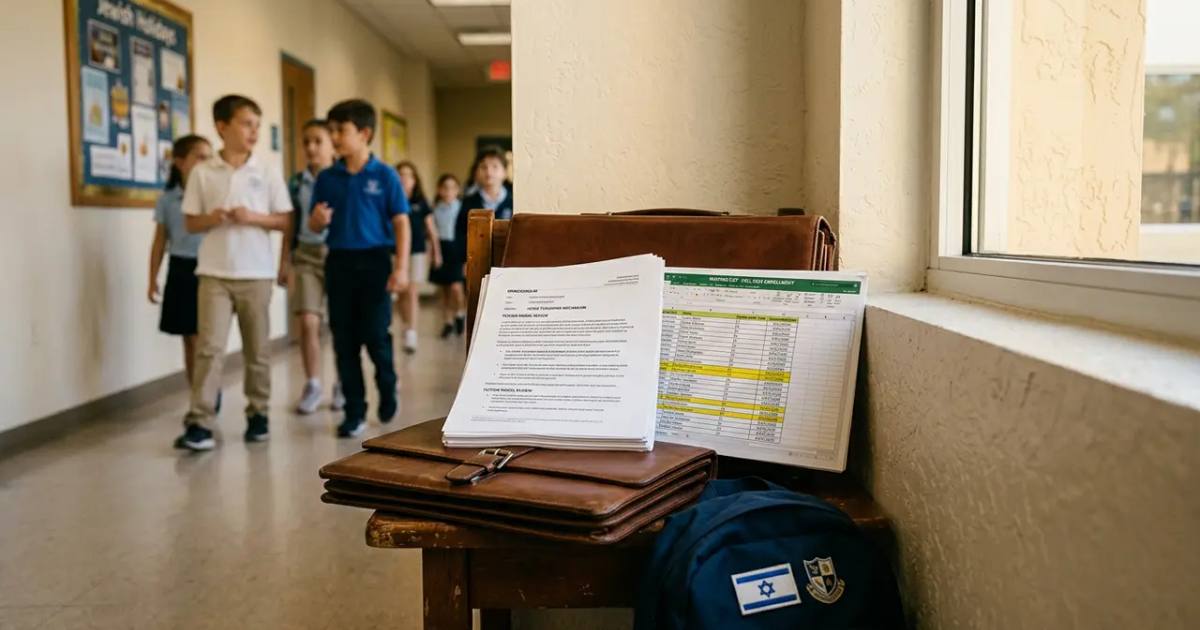

Florida posted the largest Jewish day school enrollment increase in the country at 15%. Vouchers, post-October 7 demand, and one school funding tuition with a hedge fund. The waiting lists are real and documented.
Jewish day school enrollment in the Prizmah network rose from 94,008 students in 2021-22 to a projected 101,041 in 2025-26, and Florida posted the largest single-state increase in the country at 15 percent. Behind that number sits a specific mechanism, state-funded scholarship vouchers, a specific post-October 7 psychological shift, and a specific new institution, the Jewish Leadership Academy, that is funding tuition with a hedge fund rather than a donor base. The waiting lists mentioned in passing elsewhere on this site are not a rhetorical flourish. They are a documented, national-news-level growing pain.
How Much Has Jewish Day School Enrollment Actually Grown?
Jewish day school and yeshiva enrollment across the Prizmah network grew from 94,008 students in the 2021-22 academic year to a projected 101,041 in 2025-26, an increase of more than 7,000 students nationally, according to a 2026 Prizmah report covered by Jewish News Syndicate. That growth marks a documented reversal of a decades-long decline in non-Orthodox Jewish day school enrollment previously tracked by the Avi Chai Foundation's 2020 census.
Florida posted the highest state-level increase in the country at 15 percent, more than triple the 4 percent increase recorded in the New York metropolitan area, according to the same Prizmah report. A separate analysis by Gabe Aaronson, director of the Orthodox Union-affiliated Teach Coalition's Office of Jewish Education Policy and Research, found that Jewish day school enrollment in Florida grew by 58 percent between 2007 and 2023, from 8,492 students to 13,379, a trajectory the report attributes directly to the state's education choice scholarship programs rather than to organic demographic growth alone.
What Is Actually Driving the Growth?
Florida's expanded school-voucher and tax-credit scholarship programs are the single largest documented driver of Jewish day school enrollment growth in the state, according to both Prizmah and the Teach Coalition analysis. Unlike enrollment growth driven purely by population inflow, voucher-funded growth shows up specifically in tuition-sensitive families who could not previously afford day school tuition at all, expanding the addressable population rather than just redistributing existing day-school families among more schools.
A second, independently documented driver emerged after October 7, 2023. Ninety-five percent of 110 Jewish day schools surveyed nationally received inquiries about enrolling temporary Israeli students in the aftermath of the attack, logging more than 2,000 such inquiries between October and December 2023 alone, according to the Prizmah report. Beyond the temporary-student inquiries, Prizmah's report describes a broader shift in family behavior: parents are "moving closer to Jewish community, enrolling children in Jewish schools and seeking out institutions that offer both belonging and confidence," driven by concern about rising antisemitism combined with an active desire for deeper Jewish identity formation, not fear alone.
Florida's specific pull as a migration destination compounds both effects. Families relocating from New York and elsewhere for the tax and lifestyle reasons documented separately in Olam's coverage of the Florida-Israel corridor arrive already primed to enroll in day school, rather than needing to be persuaded into Jewish education after the fact, and Prizmah's report explicitly names migration to growing Jewish population centers like Florida as one of its identified enrollment drivers.
What Do the Waiting Lists Actually Look Like on the Ground?
More than half of Jewish schools surveyed in the Miami area reported active waitlists, and one school in southern Miami-Dade County had doubled its student body, according to 2024 reporting by WLRN that drew on Teach Coalition's data alongside comparable Catholic-school figures from the Archdiocese of Miami. The archdiocese, tracked as a rough proxy for the same voucher-driven demand curve, added two high schools in one year and reopened a previously shuttered elementary school the following year specifically to absorb overflow demand, per the same report.
A year later, the pattern had not eased. Miami-area Catholic schools projected a combined enrollment increase of 600 students for the 2026-2027 school year, and reporting from the Florida Catholic in August 2026 described schools "at or near capacity" with "substantial waiting lists," met by "facility upgrades, additional classroom space, renovation projects, expanded academic programs and other amenities." Jewish day schools in the same market face the identical structural problem: interest is outrunning physical building capacity, not simply outrunning marketing or awareness.
What Does Miami's Flagship Jewish Day School Actually Look Like?
Scheck Hillel Community School in North Miami Beach enrolls approximately 1,350 to 1,360 students from 18 months through grade 12, making it one of the largest Jewish community day schools in the world, according to Wikipedia's documented history of the school and the school's own enrollment figures. Founded in 1971, the school expanded to its current North Miami Beach site in 1976, opened its high school wing in 1994, and added a dedicated athletic complex, the Diener Athletic Center, in 2014.
The school's most recent expansion reflects the same capacity pressure documented across the sector. Scheck Hillel's 14-acre campus now includes a new 115,000-square-foot athletic complex with additional academic expansion plans already underway, according to the school's own program materials, evidence that even one of the region's largest and most established Jewish day schools is still actively building to keep pace with demand rather than treating its footprint as finished.
Tuition at Scheck Hillel is structured as a single comprehensive figure covering books, daily hot kosher lunch, and 24-hour security, with no separate fees for re-enrollment, technology, or facilities, and families enrolling a third child receive a 500 dollar tuition reduction per additional child, according to the school's published tuition policy. That comprehensive-fee structure is itself a response to the same affordability pressure driving the voucher expansion: schools competing for enrollment increasingly bundle costs into a single predictable number rather than layering fees a price-sensitive family might not anticipate.
How Do Broward and Palm Beach Compare to Miami-Dade?
David Posnack Jewish Day School in Davie, in Broward County, enrolls 507 students in its K-8 division and maintains an average class size of 16 students, according to 2026 rankings published by Niche and Private School Review. Its affiliated Hochberg Preparatory School serves toddlers through eighth grade with an explicit STEM focus, while the broader Posnack Jewish Day School network reports a 70 percent acceptance rate and average Fort Lauderdale-area private tuition running roughly 15,300 dollars for elementary grades and 20,200 dollars for high school, per Private School Review's 2026 data.
Donna Klein Jewish Academy in Boca Raton, serving Palm Beach County, enrolls 770 students with a 6-to-1 student-teacher ratio and holds an overall Niche grade of A+ with a 4.8-star average parent and student rating, according to Niche's 2026 comparison of Miami-area Jewish schools. A senior reviewed by Niche described the school's appeal in terms that echo the broader community-infrastructure story: a place "where people with all sorts of interests can express themselves," even while acknowledging the tradeoff of a less demographically diverse student body than a public alternative would offer.
Across Florida's Jewish private schools generally, average tuition runs 21,120 dollars, notably higher than the state's overall private-school average of 13,830 dollars, according to Private School Review's statewide data. That premium reflects the added cost structure of religious and Hebrew-language instruction, kosher food service, and security infrastructure layered on top of a standard college-preparatory curriculum, costs a secular private school does not carry.
What Is the Jewish Leadership Academy, and Why Does Its Funding Model Matter?
The Jewish Leadership Academy, which opened in Miami Shores in 2023, represents the most structurally distinctive response to Florida's day-school affordability problem anywhere in the Prizmah network. Founding head of school Rabbi Gil Perl, previously head of school at Kohelet Yeshiva outside Philadelphia, built JLA around a fully need-blind admissions process paired with an indexed tuition model, meaning admission decisions are made without regard to a family's ability to pay, and actual tuition owed is then scaled to what each family can afford, according to the Jewish Telegraphic Agency's 2022 reporting on the school's launch.
The numbers behind that model are stark. JLA's full annual tuition runs 50,000 dollars for middle school and 52,500 dollars for upper school, reflecting what the school describes as the true cost of a JLA education, according to the school's own published tuition policy. Yet only 25 percent of JLA families pay that full tuition, and nearly 30 percent fall into the lowest tuition tier, just 4,500 dollars for the 2025-26 year, according to a 2026 account published in Prizmah's own Hayidion journal, written by the school's leadership. That combination, a 42,000-to-52,500 dollar sticker price with three-quarters of families paying a fraction of it, creates exactly the sustainability problem Perl's team set out to solve differently than a conventional donor-dependent scholarship fund.
JLA's answer was to launch a scholarship vehicle structured as an actual investment fund rather than a charitable appeal. In partnership with Kawa Capital Management, JLA launched the JLA Scholarship Fund in July 2024, a "fund of funds" in which the firm and all service providers donate their management and incentive fees entirely, and investors agree at subscription to donate 50 percent of all future gross returns to the school's scholarship fund while retaining 100 percent of their original capital and 50 percent of the investment upside, according to Prizmah's Hayidion account of the launch. The structure explicitly borrows the pro bono service model used by corporate law firms and applies it, for the first time in Jewish day school finance, to the asset management industry.
Perl's own explanation for the fund's design reflects a specific institutional constraint new schools face that established ones do not. Because JLA is new, he said, the school "does not have a large donor base to rely upon," which required an alternative fundraising strategy rather than the traditional annual-appeal-plus-endowment model older schools like Scheck Hillel have built over five decades. JLA's founding plan, published at the school's 2022 launch, called this "A Third / A Third / A Third": one third of the annual scholarship deficit covered by the founding family foundation, the Gisela and Daniel Ades Foundation, one third by annual fundraising, and one third by endowment distributions, with the Kawa Capital fund built specifically to accelerate the third leg before a traditional endowment could realistically mature.
JLA opened with a 50 million dollar campus in Miami Shores, an explicit monthlong annual trip to Israel built into the curriculum, and a program helping students convert social-service ideas into fully operating nonprofits, according to JTA's original 2022 launch coverage, positioning the school deliberately against the country's most elite secular prep schools rather than against other Jewish day schools. Only about one-quarter of its curriculum is religious, compared to a roughly even 50-50 split at more traditional Jewish day schools, even though the school describes its guiding orientation as Modern Orthodox.
How Do Florida's Vouchers Actually Work for a Jewish Family?
Florida's education choice scholarship programs, administered through nonprofit scholarship-funding organizations including Step Up for Students and AAA Scholarship Foundation, allow eligible families to direct state-funded scholarship dollars toward private school tuition, including religious schools, with the scholarship amount deducted directly from what a family owes a participating school. At JLA specifically, a family's indexed tuition amount can be further reduced by any Step Up for Students or AAA scholarship they qualify for, with a 50,000 dollar middle-school tuition reducible to roughly 42,000 dollars or less once state scholarship funds are applied, according to the school's published tuition guidance.
That mechanism, a state scholarship stacking on top of a school's own indexed or need-based tuition reduction, is precisely why the enrollment growth statistics cited by Prizmah and Teach Coalition track so closely with the years Florida's voucher programs expanded rather than with any single demographic or migration trend in isolation. A family that could not previously afford a 21,000 dollar average Jewish day school tuition, even before overlaying JLA's premium pricing, can now combine a state scholarship with a school's own indexed or tiered tuition to reach an affordable number, a combination that did not exist as recently as the mid-2010s.
What Are the Growing Pains Nobody Has Fully Solved Yet?
Physical capacity, not funding mechanism, is now the binding constraint across the sector. The 2024 WLRN reporting describing more than half of surveyed Miami-area Jewish schools with active waitlists, and one school doubling its student body, was not a snapshot of a temporary spike; the 2026 Florida Catholic reporting on the parallel Archdiocese system shows the same "at or near capacity" language persisting two years later, with schools responding through facility upgrades and renovation rather than through any sign that demand has leveled off.
That leaves Florida's Jewish day school sector in an unusual position relative to the rest of the country. Nationally, Jewish day school enrollment growth of roughly 7,000 students over four years is described by Prizmah as a "reversal" of decades of decline, a modest recovery story. In Florida specifically, the same period produced a 15 percent single-state increase, the country's largest, meaning the sector's most acute capacity strain is concentrated in exactly the state building the fastest-growing Israeli business corridor in America, documented separately in Olam's coverage of Florida's 429 Israeli-founded companies and 7.3 billion dollar economic footprint. Schools, synagogues, and communal infrastructure are being asked to absorb both a national enrollment recovery and a regional migration wave simultaneously, a combination no other state's Jewish day school system currently faces at this scale.
How Does This Fit the Longer National Story of Decline and Recovery?
The current growth reverses a genuinely long decline. The Avi Chai Foundation's 2020 census of non-Orthodox Jewish day schools, which did not include Canadian institutions, documented a multi-decade contraction across the non-Orthodox segment specifically, driven by rising tuition costs, shrinking non-Orthodox affiliation rates, and competition from strong public school districts in traditional Jewish population centers. Prizmah's 2026 report frames the current 94,008-to-101,041 national increase explicitly as a reversal of that documented decline, the first sustained multi-year enrollment recovery the network has recorded.
Florida's role in that reversal is disproportionate to its historical share of American Jewish population. New York's metropolitan area, still home to the largest concentration of Jewish day schools in the country, posted a comparatively modest 4 percent increase over the same period, while Ontario, helped by a dedicated tuition-relief program, the UJA Federation of Greater Toronto's Generations Trust Scholarship launched in 2021, added 306 students for a 4 percent gain. Florida's 15 percent increase is not simply the largest number; it is close to four times the rate of growth in the country's other major Jewish day school markets, evidence that Florida is not merely sharing in a national recovery but driving a disproportionate share of it.
Which Other Schools Are Absorbing the Overflow?
Beyond the three flagship institutions, Miami-Dade and Broward host a wider bench of Jewish day schools now sharing in the same enrollment pressure. Temple Beth Am Day School, a Reform-affiliated school on the Janet z"l and Richard Yulman Campus, serves students from 15 months through grade 5, while Katz Yeshiva High School, a Modern Orthodox school in Boca Raton, competes directly with Posnack's high school division on the athletic field as well as in admissions, according to Private School Review's coverage of regional matchups. Arthur I. Meyer Jewish Preparatory School, Community Day School, Bnai Israel Community Day School, Beth Emet School, and Lehrman Community Day School round out a bench of smaller, community-affiliated schools that Private School Review's 2026 Florida rankings list alongside the three flagship institutions.
What distinguishes this wider bench from the flagship schools is capacity rather than reputation. Several of these smaller schools operate at enrollment levels in the low hundreds rather than the near-1,400 seats Scheck Hillel fields, meaning the sector's overall capacity strain cannot be solved simply by directing overflow demand toward smaller alternatives; the smaller schools are themselves capacity-constrained, which is precisely why the Archdiocese of Miami's parallel voucher-driven system, tracked in the same 2024 and 2026 reporting cited above, responded by opening entirely new schools rather than redistributing students among existing ones.
Why Is Teacher Supply, Not Just Classroom Space, Part of the Constraint?
Physical classroom space is the most visible constraint, documented directly in the "facility upgrades, additional classroom space, renovation projects" language the Florida Catholic used to describe the parallel Archdiocese system in 2026. But an enrollment increase of the scale Prizmah and Teach Coalition document, a near-doubling in Florida day school enrollment over 16 years, also requires proportional growth in a specific, hard-to-scale input: teachers qualified to deliver both a college-preparatory secular curriculum and Hebrew-language Judaic studies at the same time.
That dual-qualification requirement is structurally different from the hiring problem a growing secular private school faces. A school expanding its secular enrollment can recruit from the broader national teacher labor market. A Jewish day school expanding Judaic studies capacity at the same rate is recruiting from a narrower, specialized pool, which is one reason schools like Scheck Hillel emphasize student-to-teacher ratios as low as 8 to 1 as a competitive differentiator rather than treating them as a simple input cost, and why JLA's own materials describe an 8 to 1 ratio as central to its academic model rather than incidental to it.
What Role Do Federations and Communal Institutions Play?
The enrollment story does not sit in isolation from the broader communal infrastructure buildout documented elsewhere in Olam's Florida-Israel coverage. Miami-Dade's Jewish population grew 7 percent to 130,100 people, with the Jewish child population growing 13 percent and the county's count of day schools nearly doubling from 40 to 74, according to Olam's reporting on Florida's Jewish institutional build. That population growth is not incidental background to the enrollment numbers; it is the demand-side half of the same equation the voucher expansion and post-October 7 sentiment shift address from the supply and motivation side.
Aventura, documented separately in Olam's profile of the densest Israeli-American community in the country, sits inside this same dynamic as a concentrated node rather than an outlier: a city where Hebrew is spoken in 3.66 percent of households produces exactly the kind of family that arrives already seeking Jewish day school enrollment rather than needing to be persuaded into it after relocation. The same is true of the broader wealth migration documented in South Florida: The Jewish Wealth Corridor, where families relocating specifically for tax and lifestyle reasons routinely rank day school access as a non-negotiable factor in choosing a neighborhood, not an afterthought weighed once the move is complete.
What Would Actually Relieve the Capacity Strain?
Three distinct interventions are visible in the data, each addressing a different part of the constraint. Facility expansion, the approach Scheck Hillel has pursued continuously since 1976 and most recently with its 115,000-square-foot athletic complex, adds physical seats but requires capital and years of construction lead time that cannot respond quickly to a single strong enrollment year. New-school formation, the approach the Archdiocese of Miami took by opening two new high schools and reopening a shuttered elementary school within roughly two years, adds capacity faster than expansion of an existing campus but requires an institution, whether a diocese or a family foundation like JLA's Ades Family Foundation, willing to absorb the startup risk of an unproven school.
Tuition-model innovation, JLA's specific contribution, does not add a single classroom seat but does expand the pool of families who can compete for the seats that already exist, by converting the affordability constraint from a binary yes-or-no into an indexed, scaled number. None of the three approaches alone resolves the underlying strain Prizmah, Teach Coalition, and the Florida Catholic's 2026 reporting all independently document; together, they represent the sector's current, still-incomplete response to a growth rate none of Florida's Jewish day schools were originally built to absorb.
Frequently Asked Questions About Florida's Jewish Day School Growth
How much has Jewish day school enrollment grown in Florida specifically? Florida recorded a 15 percent enrollment increase, the largest of any state in the 2026 Prizmah report, and a separate Teach Coalition analysis found 58 percent growth in Florida Jewish day school enrollment between 2007 and 2023.
What is driving the growth? Florida's expanded education choice scholarship and voucher programs are the primary documented driver, compounded by a post-October 7, 2023 shift toward deeper Jewish institutional engagement and continued migration of Jewish families into Florida.
Do Miami-area Jewish day schools actually have waiting lists? Yes. More than half of surveyed Miami-area Jewish schools reported active waitlists as of 2024, and capacity strain persisted into the 2026-2027 school year across comparable religious school systems in the same market.
What is the Jewish Leadership Academy's tuition model? JLA uses need-blind admissions paired with indexed tuition, where families who can pay full tuition, 50,000 to 52,500 dollars annually, are asked to do so, while need is assessed independently of admission, funded in part by a dedicated investment fund launched with Kawa Capital Management in 2024.
How much does the average Jewish day school cost in Florida? Roughly 21,120 dollars annually on average, compared to Florida's overall private-school average of 13,830 dollars, according to 2026 data from Private School Review.
How does day school growth connect to the corridor's university pipeline? Florida's K-12 Jewish day school boom feeds directly into the university-level pipeline documented in Olam's coverage of the FAU-FIU Israel corridor, where day-school graduates increasingly stay in-state for Israel-linked higher education programs rather than leaving Florida after high school.
What This Means for Florida's Jewish Day School Sector Today
Florida's Jewish day school enrollment surge is a documented, mechanism-driven phenomenon, not an atmospheric side effect of the broader Florida-Israel corridor. State-funded scholarship vouchers expanded the addressable population of families who can afford day school tuition at all; the post-October 7 shift in Jewish communal behavior expanded families' willingness to seek out that education specifically; and migration into Florida added a population that arrives already primed to enroll. The result is a sector straining against its own physical capacity, with more than half of surveyed schools carrying waitlists and even a five-decade-old institution like Scheck Hillel still actively expanding its campus. The Jewish Leadership Academy's hedge-fund-financed scholarship model is the most structurally novel response to that strain so far, but it addresses funding, not classroom space, which remains the sector's unresolved constraint.