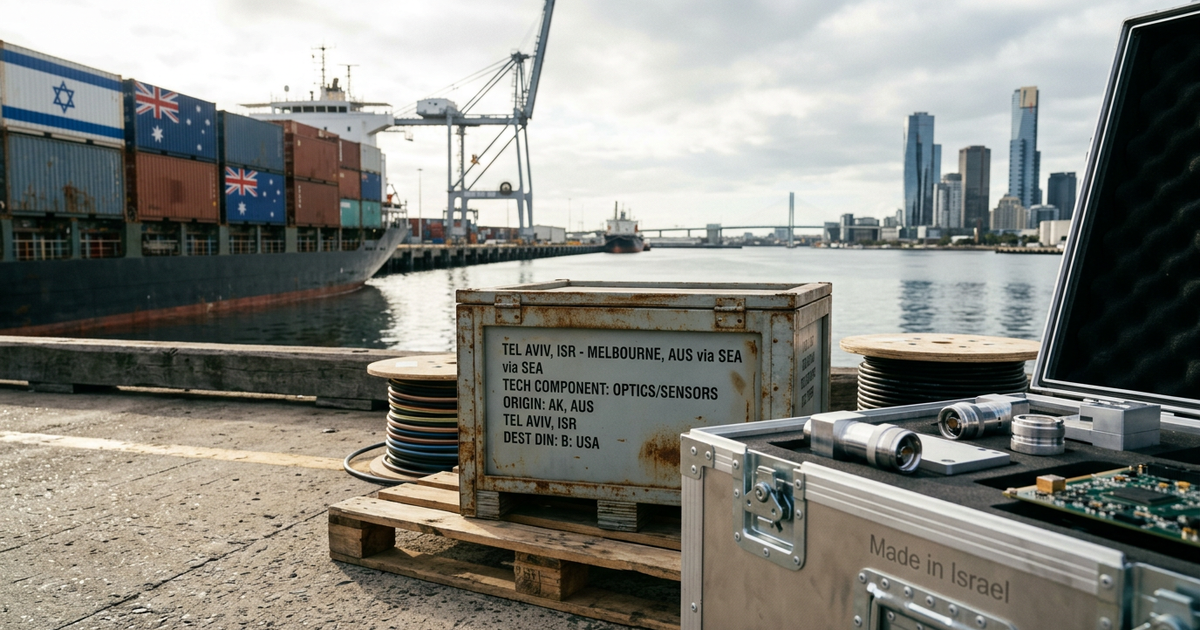
Strategic technology trade — the cross-border exchange of defense systems, cyber capability, dual-use technology, and adjacent industrial goods subject to export control — is one of the largest, least-mapped categories of Israeli external commerce. The architecture is governed by three principal bilateral relationships (Israel-United States, Israel-India, and the post-CEPA Israel-UAE corridor), regulated through a defense-licensing system operated by SIBAT (the International Defense Cooperation Directorate within the Israeli Ministry of Defense), and shaped by overlapping US export-control regimes that constrain Israeli technology transfer to third parties.
Key Facts
- Israeli defense exports reached a record $14.8 billion in 2024, up from $13 billion in 2023.
- India was Israel's largest defense buyer for the 2020-2024 period; cumulative Israeli arms sales to India total approximately $20.5 billion (SIBAT).
- The Israel-UAE Comprehensive Economic Partnership Agreement (CEPA) entered into force in April 2023 and is the only operational post-Accords CEPA in the region.
- Israeli defense exports for 2025 are tracking above $14.8 billion on initial SIBAT reporting; final figures pending publication.
- US export-control regimes (EAR, ITAR, end-use verification) constrain Israeli third-party transfer of US-origin components and technology, structuring the architecture.
What strategic technology trade covers
The pillar covers four categories of cross-border technology commerce involving Israeli industry.
Defense systems and platforms. Manned and unmanned aircraft, air defense systems, missiles, radar and electronic warfare systems, satellites, naval platforms, and adjacent integrated systems. This category generates the largest individual transactions and accounts for the bulk of Israeli "defense exports" as measured by SIBAT.
Cyber and intelligence capability. Defensive cyber systems, intelligence-collection platforms, and the specialized capability layer covered in detail in The Olam's Cyber & National Security pillar. Subject to a parallel and partly distinct regulatory framework from conventional defense systems.
Dual-use technology. Technology with both civilian and military applications — advanced semiconductors, encryption systems, certain sensors, navigation systems, and the broader category of dual-use goods regulated under Israeli, US, and multilateral frameworks.
Strategic industrial trade. Sectors where the Israeli industrial position is itself strategically significant — water technology in arid economies, agritech in food-security-concerned economies, certain pharmaceutical categories, and adjacent industrial layers. Not subject to formal defense export controls but coded as strategic in bilateral diplomatic frameworks.
The three principal corridors
Three bilateral relationships account for most of the volume.
Israel-United States. The deepest, oldest, and most institutionally complex of the three. Bidirectional flow: US technology and components enter Israeli defense and dual-use systems; Israeli systems are sold into US procurement and integrated into US-led coalitions. The corridor operates within a tight regulatory framework — EAR, ITAR, end-use monitoring, periodic dual-use review — and produces ongoing institutional engagement at the Israeli MoD/US DoD level.
Israel-India. The largest single defense-export relationship by volume in the 2020-2024 window. India accounted for an estimated 37-40% of Israeli arms exports during this period, with cumulative Israeli arms sales to India totaling approximately $20.5 billion through 2025. The architecture is evolving from procurement-based supply toward co-production and co-development models under India's Atmanirbhar Bharat self-reliance framework. Detail in The Israel-India Technology Corridor.
Israel-Gulf (post-CEPA). The newest and most structurally distinctive of the three. The May 2022 Israel-UAE CEPA created the regulatory architecture for direct bilateral technology trade between Israel and the UAE; the broader regional framework operates within the Negev Forum architecture. Defense and dual-use trade in this corridor remains subject to overlapping constraints (US export controls, Israeli MoD review, UAE regulatory framework) and is at an earlier stage than the volume in the US or Indian corridors.
A small but growing set of secondary corridors — Israel-Greece-Cyprus, Israel-South Korea, Israel-Singapore, Israel-Philippines (currently strained), Israel-Vietnam — operates around the three principal relationships.
The regulatory architecture
Israeli defense and dual-use exports operate under a multi-layered regulatory framework.
SIBAT (the International Defense Cooperation Directorate within the Israeli Ministry of Defense) administers Israeli defense-export licensing. SIBAT reviews proposed defense and dual-use transactions against criteria including end-use, end-user, regional security implications, US export-control compatibility, and Israeli national-security considerations. The Defense Export Control Agency (DECA) within SIBAT manages the licensing process.
The Israeli Defense Export Control Law (2007) provides the statutory basis for the licensing framework and defines the categories of controlled defense exports.
US export-control regimes create a parallel layer of constraint where Israeli systems incorporate US-origin technology or components. The Export Administration Regulations (EAR) and International Traffic in Arms Regulations (ITAR) apply extraterritorially to such components. End-use verification requirements constrain Israeli third-party transfer of US-origin items.
Multilateral frameworks — the Wassenaar Arrangement, the Missile Technology Control Regime, and adjacent regimes — provide additional layers governing dual-use technology export.
The regulatory architecture has substantive consequences for the structure of Israeli defense and dual-use trade: certain transactions are precluded by combinations of US, Israeli, and multilateral constraints; certain corridors carry more friction than others; and the architecture itself shapes which Israeli industrial capabilities are accessible to which partner economies.
What the pillar tracks
The Strategic Technology Trade pillar tracks four categories of activity on a continuing basis: annual SIBAT export data and underlying trend analysis; major individual transactions (over a defined disclosure threshold); regulatory changes affecting the architecture; and bilateral framework developments at the policy level.
The pillar's flagship data product — the Israeli Defense Export Index, in development for publication in Q3 2026 — will track Israeli defense exports by destination, by category, by primary contractor, on an annual basis with quarterly updates.
Why It Matters
Strategic technology trade is among the largest categories of Israeli external commerce and one of the most structurally complex — a multi-layered regulatory architecture, three principal bilateral corridors at different maturity stages, and ongoing state-to-state institutional engagement. The Olam covers the architecture as the unit of analysis.
Sources: SIBAT (Israeli MoD International Defense Cooperation Directorate); Stockholm International Peace Research Institute (SIPRI); Globes; The Jerusalem Post; Times of Israel; published US export-control documentation. Data current as of Q2 2026.
Related in The Olam: Defense · Cyber & National Security · Sovereign & Strategic Capital · Trade Corridors · Ports & Logistics