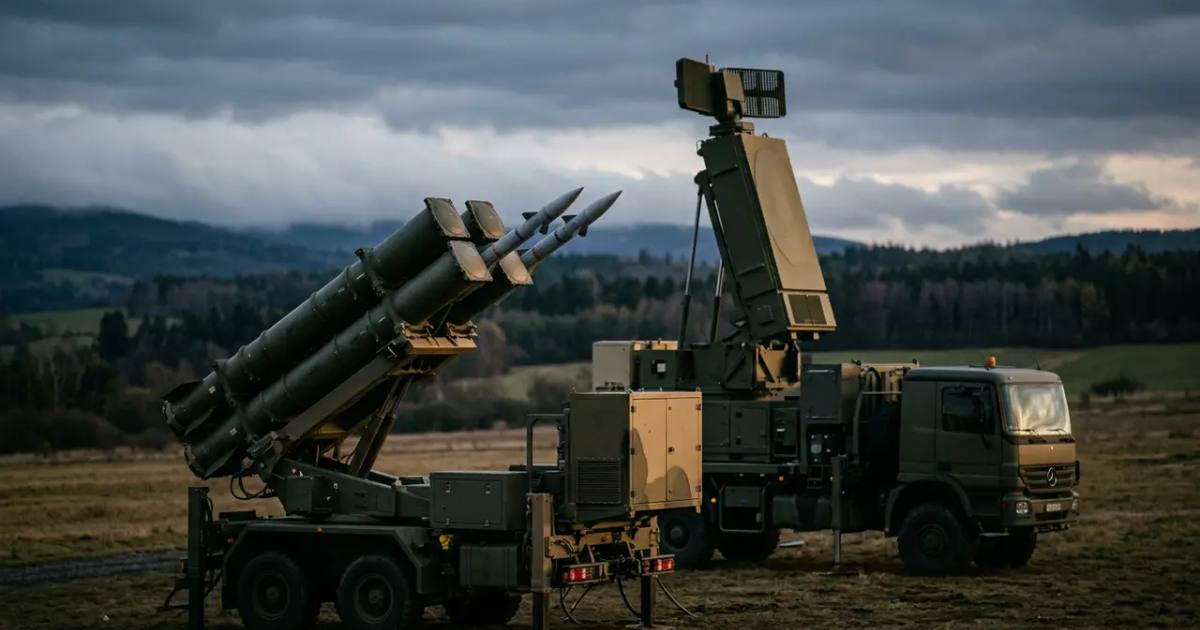

The Czech Republic anchors its air defense on Israeli MMR radar and SPYDER missiles, backed by a 20-year IAI sustainment contract signed in 2024.
The Czech Republic has built its air defense modernization around two Israeli systems, IAI's Multi-Mission Radar and Rafael's SPYDER, backed by a 20-year sustainment contract signed with IAI in 2024. The relationship runs through local Czech manufacturers rather than direct imports, with Czech industry absorbing roughly 30 percent of contract value across the radar and missile programs combined.
What does the Czech Republic's Multi-Mission Radar contract cover?
The Czech Republic signed a government-to-government agreement with Israel in December 2019 for eight EL/M-2084 Multi-Mission Radar systems from Elta Systems, the IAI radar subsidiary, valued at approximately $125 million. The MMR is the same radar technology used in Israel's Iron Dome, David's Sling, and Barak air defense systems, and IAI adapted the Czech units to operate with Czech and NATO command-and-control infrastructure. IAI delivered the radars through local partners RETIA and VTU rather than as a direct import, with the contract structured so Czech industry handled a meaningful share of integration work despite pandemic-era disruptions.
The radars passed Czech Army military testing in June 2023, three years after signing, and IAI-ELTA CEO Yoav Tourgeman said the delay reflected pandemic shutdowns and the work of integrating Israeli hardware into local and NATO command systems rather than a problem with the technology itself. The MMR replaced Soviet-era Czech radar technology and gives the Czech military detection and classification capability against drones, missiles, and rockets simultaneously.
Why did the Czech Republic sign a 20-year IAI contract in 2024?
IAI and the Czech Ministry of Defence signed a 20-year agreement to maintain and sustain the country's Multi-Mission Radar systems, extending the original 2019 deal into a long-term service relationship rather than a one-time purchase. IAI ELTA vice president Eyal Shapira framed the arrangement as knowledge and technology sharing rather than a straightforward vendor contract, pointing to the local Czech companies involved in keeping the radars operational over two decades.
What is the SPYDER air defense agreement worth?
The Czech Republic signed a government-to-government agreement in October 2021 for four Rafael SPYDER air defense batteries, each incorporating IAI-produced multi-mission radars. SPYDER is a joint Rafael-IAI system built around the Python-5 imaging infrared missile and the I-Derby active radar missile, designed to counter aircraft, helicopters, and drones at short to medium range. IMoD Director-General Amir Eshel signed the agreement with Czech Deputy Minister Lubor Koudelka, describing it as an extension of strategic cooperation between the two countries' defense industries rather than a standalone sale.
How does Czech industrial participation work in these deals?
Both the MMR radar and SPYDER contracts required meaningful Czech industrial content rather than functioning as simple export sales. IAI's radar program alone directed roughly 30 percent of total contract value to Czech industry, structured through the main supply agreement between the two countries' defense ministries. That approach mirrors the offset structure Israel has used with Poland's Bumar Group and other NATO customers, where local manufacturers absorb production work in exchange for market access, rather than Israel simply shipping finished systems into the country.
What happened with Elbit's planned drone center in Pardubice?
Elbit Systems and Czech company LPP Holding announced a partnership in October 2023 to build a "Centre of Excellence" for unmanned aerial systems in Pardubice, a city east of Prague, with LPP co-owner Radim Petras telling Czech media the center would produce drones for the Czech military and potentially other NATO customers. Elbit CEO Yoram Shmuely called the collaboration central to the company's entry into the European and NATO markets, and LPP had acquired the prospective site through its purchase of radar and radio equipment maker T-CZ. The Czech Defense Ministry later canceled the tender that would have funded the joint center, and the partnership never moved into production.
That did not stop an underground group calling itself the Earthquake Faction from setting fire to buildings at the Pardubice site on March 20, 2026, describing it in a claim of responsibility as the "epicenter of the Israeli weapons industry in Europe." Czech police opened an investigation into a possible terrorist link. A subsequent analysis by the investigative outlet Global Recon found the claim's central premise did not hold: no Israeli drones had ever been produced at the site, since the Elbit-LPP cooperation had already been canceled by the time of the attack. LPP confirmed the fire caused no injuries and said it was cooperating fully with Czech authorities. The episode illustrates a recurring pattern in Israel's European defense-industrial footprint, where announced partnerships and physical protest targets do not always track the same timeline as actual production activity.
What comes next for the relationship?
With the MMR sustainment contract now running through the 2040s and SPYDER batteries operational since 2021, the Czech Republic has structured its Israeli defense relationship around long-term technology partnerships rather than single transactions, a pattern distinct from the transaction-driven procurement seen in Finland or the industrial-offset model in Poland. The 20-year IAI agreement in particular signals that both governments expect the relationship to extend well beyond any single equipment purchase, anchored in Israeli radar and air defense technology built to interoperate directly with NATO command systems.
Is the Czech Republic considering additional Israeli air defense systems?
The Czech Republic's SPYDER batteries fill the short-to-medium range tier of its air defense architecture, sitting below the higher-altitude coverage that Israel's layered air defense stack is built around: Iron Dome at the shortest range, David's Sling in the middle, and Arrow at the top. Prague has not publicly committed to expanding beyond MMR and SPYDER, but the same Israel Aerospace Industries systems increasingly adopted by Cyprus, Slovakia, and Greece, including the Barak MX medium-range interceptor, remain available to the Czech military as it continues modernizing away from Soviet-era platforms. The 20-year IAI sustainment contract gives Czech officials a standing relationship through which any expansion could be negotiated without opening an entirely new competitive tender.