
Morocco was the largest Jewish community in the Muslim world before 1948. Today fewer than 3,000 remain, but a Jewish royal advisor, a constitutional heritage clause, and a national museum make it the Arab world's deepest Jewish institutional story.
Morocco was home to the largest Jewish community in the Muslim world, roughly 250,000 to 350,000 people in 1948, and today a Jewish royal advisor still sits beside the king. Fewer than 3,000 Jews remain in the country, concentrated in Casablanca, but the institutional relationship between the Moroccan monarchy and its Jewish minority is older, deeper, and more constitutionally formalized than anywhere else in the Arab world.
How Large Was Morocco's Jewish Community, and How Large Is It Now?
Morocco's Jewish population peaked at roughly 250,000 to 350,000 in 1948, according to the Museum of Moroccan Judaism's own history, making it the largest Jewish community anywhere in the Muslim world at the time. Emigration to Israel, France, and elsewhere, coordinated in part by the World Jewish Congress during the 1950s and 1960s, reduced that number to about 25,000 by 1971, per the World Jewish Congress. Hebrew University demographer Sergio Della Pergola estimated 2,150 Jews in Morocco as of 2015, and current estimates from multiple sources place the community at roughly 2,000 to 3,000 people today, with about 1,000 to 2,000 of them in Casablanca alone.
The scale of emigration means today's Moroccan Jewish community is a small remnant of a once-vast population, but the Jewish diaspora it produced is not small at all. An estimated one million Israelis trace their ancestry to Morocco, according to reporting in Ynetnews, making Moroccan Jews the second-largest ethnic-origin group in Israel behind those of European descent. Neighborhoods in Ashdod, Netanya, Be'er Sheva, Lod, and Kiryat Gat still carry the Judeo-Moroccan Arabic phrase "Allah yensser sidna," meaning "may God grant victory to our king," used by Israelis of Moroccan descent when the Moroccan king's name comes up.
Who Is André Azoulay, and Why Does His Role Matter?
André Azoulay is a Jewish Moroccan from Essaouira who has served as senior advisor to two successive Moroccan kings, Hassan II and Mohammed VI, since 1991, a 35-year run confirmed across multiple sources including Aish and the SA Jewish Report, which notes he holds a Guinness World Record for the longest tenure as advisor to two kings. He shaped Morocco's economic reforms and privatization programs during his time advising Hassan II, before turning his focus under Mohammed VI toward preserving Jewish heritage and building bridges to Israel and the global Jewish community.
Azoulay's own family history sits inside the story he now stewards. Essaouira, his hometown, was "the only city in the Islamic world with a majority Jewish population" under 18th-century Sultan Mohamed III, Azoulay told the Times of Israel, and once held 37 synagogues, most now in ruin. His daughter, Audrey Azoulay, serves as director-general of UNESCO, and was present when King Mohammed VI personally visited the Jewish heritage center Azoulay built in Essaouira.
Azoulay's position is not symbolic in isolation. It sits inside a documented, decades-long royal policy, not a single appointment, which is the structural difference between Morocco's relationship with its Jewish community and the more recent, accord-driven communal building seen elsewhere in the region, such as the UAE's Jewish community, which was built almost entirely after 2019.
What Did Morocco's 2011 Constitution Change?
Morocco's 2011 constitution formally recognized "Hebraic influences" as one of the components that enriched and nourished Moroccan national identity, according to the World Jewish Congress and multiple heritage-tourism sources. Zhor Rehihil, the Muslim director of the Museum of Moroccan Judaism who holds a PhD in Jewish studies, has said the new constitution "emphasizes both ethnic and religious pluralism in Morocco," per reporting from The Arab Weekly.
The constitutional recognition followed a 2010 royal initiative to restore Jewish cemeteries across the country, according to the World Jewish Congress, and preceded a broader campaign of synagogue restorations, including the 17th-century Slat al Fassayine Synagogue in Fez, which the king personally funded and where he reiterated his commitment to religious freedom for "believers in the revealed religions, including Judaism, whose followers are loyal citizens for whom I deeply care."
What Is the Museum of Moroccan Judaism?
The Museum of Moroccan Judaism in Casablanca is the only museum in the Arab world dedicated entirely to Judaism, housed in a building that began in 1948 as a Jewish orphanage sheltering up to 160 children. Jewish Moroccans Serge Berdugo, Jacques Toledano, Boris Toledano, and Simon Levy founded the institution in the late 1990s specifically to keep Jewish identity present in Moroccan public discourse, and King Mohammed VI personally reopened the renovated museum on December 20, 2016, according to Wikipedia's documented history of the institution.
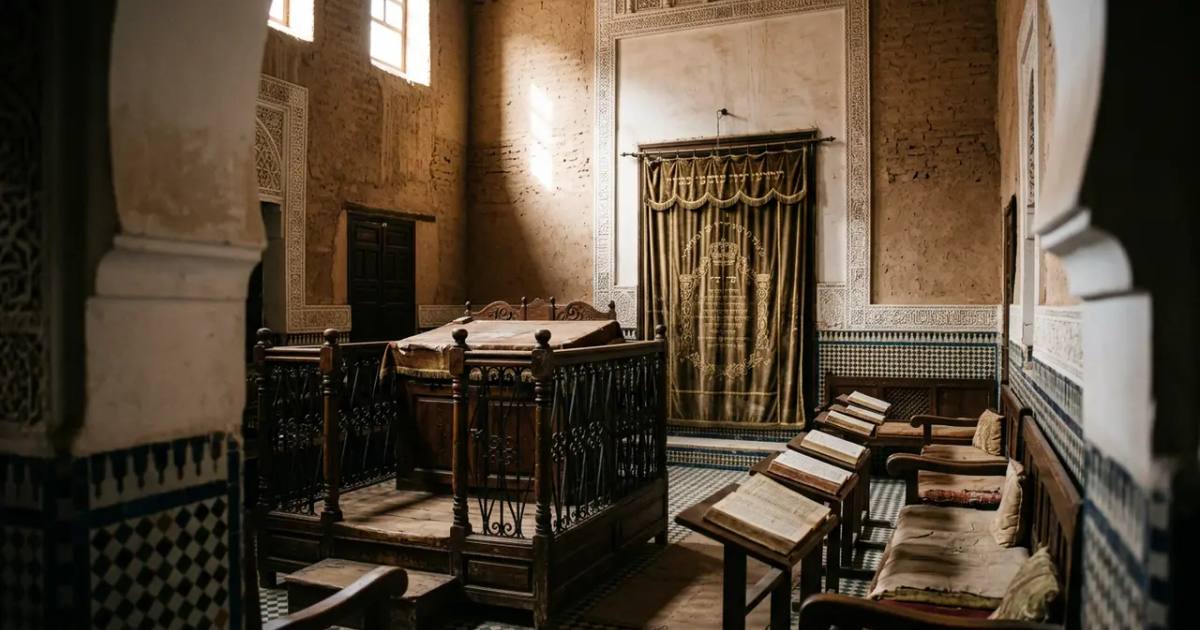
The museum's collection includes Torah scrolls, hand-embroidered caftans, a carved wooden bimah, Hanukkah lamps, and the Megilat Hitler manuscript, and it draws both Jewish and non-Jewish visitors to Casablanca's Oasis district. Rehihil has framed the museum's mission as a form of restitution for the Muslim majority as much as for Jews: "As Muslim Moroccans, we feel we lost a part of our identity when Moroccan Jews left the country," she told the Times of Israel.
What Does Bayt Dakira in Essaouira Represent?
Bayt Dakira, or the "House of Memory," is a restored spiritual and heritage complex in Essaouira's old medina that shelters the Slat Attia synagogue alongside a research center on Jewish-Muslim relations, and King Mohammed VI personally visited the site in January 2020 as part of what a Moroccan official described to Ynetnews as "a comprehensive strategy led by King Mohammed VI to preserve Jewish memory in Morocco." Azoulay, who launched the project with Morocco's culture ministry, told the king at the opening that the site "bears the hallmark of our secular and millennial Morocco which has known how to protect the great diversity which is the central wealth of our country."
Chief Rabbi David Pinto, born in Essaouira, told reporters at the opening that "if we are here today it's because of King Mohammed VI," while the Chief Rabbi of Casablanca, Joseph Israel, praised what he called centuries of coexistence between Jews and Muslims in the country, according to The Arab Weekly's coverage of the event.
What Does Daily Jewish Life in Morocco Look Like Today?
Casablanca hosts the largest remaining community, with the Beth-El Synagogue, Jewish schools, and kosher restaurants operating openly, and smaller communities persist in Marrakech, Fez, Rabat, Tangier, and Tetuan, according to multiple heritage guides. Marrakech alone counts several working synagogues, including Rabbi Pinhas Synagogue, the oldest in the city, founded in 1538 in the historic Mellah, alongside the modern Beth El Synagogue in the Guéliz district led by community president Jacky Kadoch.
A Touro University delegation that visited Morocco and was briefed directly by Azoulay found a local Jewish community of roughly 1,800 people with an average age of 70, alongside about 40 school-age children, most of them children of the rabbis and kosher supervisors who serve the community. Thirteen pilgrimage sites to Jewish holy sages draw visiting crowds, including from Israel, every year, according to the World Jewish Congress, maintained in part by local Muslim caretakers.
How Does Morocco's Model Compare to the Gulf States?
Morocco's Jewish institutional relationship predates the Abraham Accords by decades and rests on constitutional recognition and royal patronage rather than a diplomatic normalization event. That is a structural difference from the UAE, where three synagogues and a chief rabbinate were built almost entirely after the 2020 Abraham Accords, and from Bahrain, where a much smaller, older community exists without the scale of royal-funded heritage infrastructure Morocco has built. Morocco's Jewish community is far smaller in absolute numbers than the UAE's roughly 7,000, but its history runs continuously for two millennia rather than being substantially rebuilt inside a single decade.
The 2020 Abraham Accords normalization between Israel and Morocco did not create this relationship. It formalized diplomatic and economic ties on top of a Jewish-Moroccan royal partnership that had already operated for three decades under Azoulay. Since 2020, that formalization has produced Morocco's status as the single largest defense-trade destination of the Abraham Accords, documented in Olam's coverage of Morocco's $1.5 billion defense corridor, alongside the separate civilian trade and business relationship covered in why Jewish business families are moving to Morocco. The heritage and community story predates both.
Is Morocco Actually Safe for Jewish Visitors and Residents Today?
Morocco is widely described by Jewish travel guides as safe and welcoming for Jewish visitors, particularly in Casablanca, and roughly 200,000 Israeli tourists and business travelers visited the country in 2022, four times the pre-pandemic level, according to law firm Gide's market analysis. That figure held even as anti-normalization protests, organized by groups including the Moroccan Front for the Support of Palestine and Against Normalization, drew crowds of roughly 10,000 nationwide following October 2023, according to Morocco World News.
Those protests have targeted the 2020 normalization agreement itself, not Jewish visitors, Morocco World News reported, and a Marrakech tour guide told the outlet that "Israeli visitors continued coming even without direct flights," even during a three-year suspension of direct air routes that lifted in August 2026 with Arkia's resumption of Tel Aviv-Marrakech service. The distinction between political opposition to normalization and treatment of Jewish and Israeli visitors on the ground is one Moroccan officials and Jewish community leaders both draw explicitly, rather than one asserted from outside.
Frequently Asked Questions About Morocco's Jewish Community
How many Jews live in Morocco today? Estimates range from roughly 2,000 to 3,000 people, with the large majority in Casablanca, down from a peak of 250,000 to 350,000 in 1948, according to the Museum of Moroccan Judaism and the World Jewish Congress.
Who is André Azoulay? Azoulay is a Jewish Moroccan from Essaouira who has served as senior advisor to King Hassan II and King Mohammed VI since 1991, guiding Morocco's economic reforms and its Jewish heritage preservation efforts.
Does Morocco have a Jewish museum? Yes. The Museum of Moroccan Judaism in Casablanca, opened in its current form in 2016 by King Mohammed VI, is the only museum in the Arab world dedicated to Judaism.
Does Morocco's constitution recognize Jewish heritage? Yes. The 2011 constitution recognized "Hebraic influences" as part of Moroccan national identity, a provision unique in the Arab and Muslim world.
Is it safe for Israeli and Jewish tourists to visit Morocco? Roughly 200,000 Israeli tourists and business travelers visited Morocco in 2022 alone, and Jewish travel guides describe Casablanca in particular as safe and welcoming, though anti-normalization protests since October 2023 have targeted the diplomatic relationship rather than Jewish visitors specifically.
What This Means for Morocco's Jewish Community Today
Morocco's relationship with its Jewish minority rests on a longer, more institutionally embedded foundation than any other Arab country's: a constitutional recognition of Hebraic heritage, three decades of a Jewish senior royal advisor serving two kings, a state-supported national museum, and a personal royal commitment to synagogue and cemetery restoration that predates the Abraham Accords by years. The remaining community is small, aging, and concentrated in Casablanca, but the diaspora it produced, roughly a million Israelis of Moroccan descent, and the heritage tourism infrastructure built around it make Morocco's Jewish story one of continuity rather than recent construction.