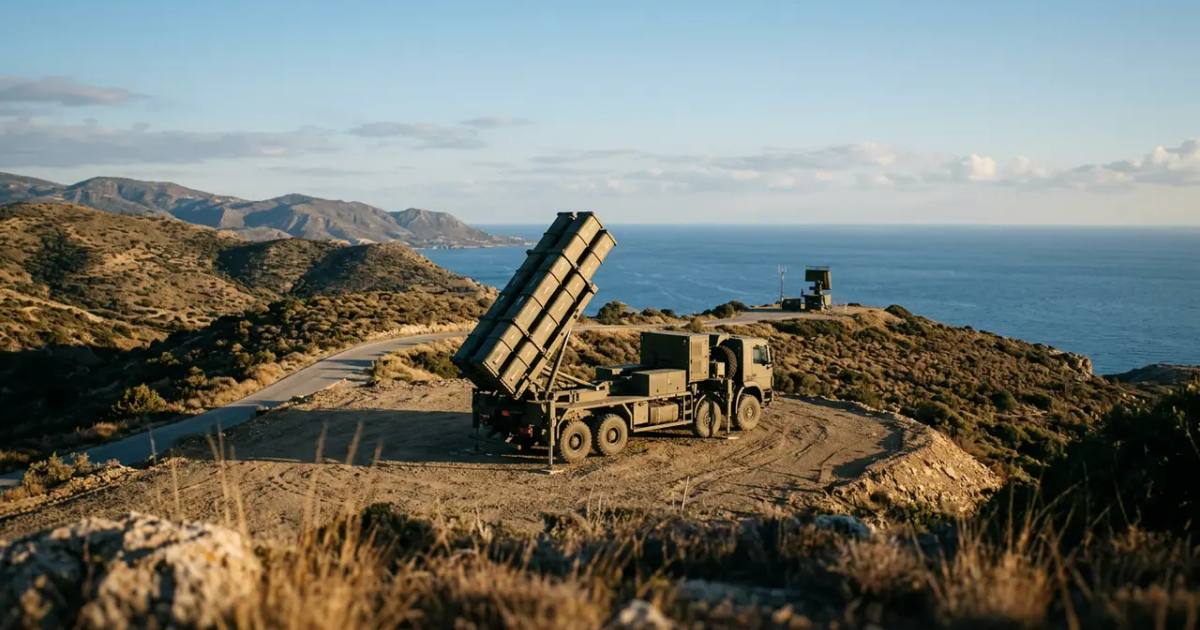

Greece approved a $4 billion Israeli air defense package while Cyprus already deployed Barak MX, drawing sharp warnings from Turkey.
Greece has approved a procurement package worth up to $4 billion built around three Israeli systems, Rafael's David's Sling and SPYDER and IAI's Barak MX, forming the core of a national air defense program called Achilles Shield. Cyprus moved faster, quietly deploying its own Barak MX batteries starting in December 2024, a decision that has drawn repeated warnings from Turkey and reshaped the security balance of the eastern Mediterranean.
What is Greece's Achilles Shield program?
Greece's security council approved the Achilles Shield procurement package in July 2026, covering roughly 3.5 billion euros, or about $4 billion, according to Defense Minister Nikos Dendias. The program centers on Rafael's David's Sling and SPYDER systems alongside IAI's Barak MX air and missile defense system, with ELTA Systems supplying the radar and command-and-control infrastructure to integrate the different interceptors into one network. Dendias said the system would be operational within 35 months of signing, with Greek companies manufacturing at least 25 percent of the system domestically.
Achilles Shield is designed to replace Greece's aging Patriot batteries and Russian-origin S-300 systems, which have been stationed on Crete since a 1998 crisis with Turkey and used mainly for training since 2013. Athens plans to spend approximately 28 billion euros through 2036 on broader military modernization, including up to 40 F-35 fighter jets from the United States, alongside the Israeli air defense package.
What did Greece buy from Elbit before Achilles Shield?
Greece signed a $750 million contract with Elbit Systems in April 2026 for PULS precision rocket artillery, a four-year deal covering launchers, training rockets, and operational precision-guided munitions with ranges of 40 to 300 kilometers. The contract includes a 10-year follow-on support period and industrial cooperation requiring some components to be manufactured by Greek defense companies. The deal followed more than two and a half years of negotiations that had been delayed by the war in the Middle East, and the Greek parliament had approved acquisition of 36 systems.
How did Cyprus deploy Barak MX before Greece finalized its own purchase?
Cyprus ordered the Barak MX air defense system from IAI in 2021, well ahead of Greece's Achilles Shield approval, with the first shipment arriving in December 2024 and remaining components delivered roughly nine months later. The system let Cyprus retire aging Russian BUK-M1 platforms and gave the Republic advanced anti-aircraft capability for the first time. The delivery was conducted at night through Limassol to limit visibility, though footage of the transport still circulated and drew sharp criticism from Turkish officials, including President Recep Tayyip Erdogan, who said Turkey would not allow renewed pressure on Turkish Cypriots.
The Barak MX configuration delivered to Cyprus pairs an ELTA multi-mission radar capable of detecting threats past 450 kilometers with a fire control center and launchers mounted on Tatra vehicles for the National Guard. Cyprus has continued operating its Russian-origin TOR-M1, BUK-M1, and French Mistral systems alongside Barak MX rather than retiring them immediately, using the Israeli system to fill specific coverage gaps.
Why does Turkey object to Israeli air defense in Cyprus?
Turkey's objections center on the Barak MX radar's range, which extends roughly 460 kilometers and reaches well into Turkish airspace, giving Cyprus and, by extension, Israel a surveillance capability over Turkish military activity. Turkish Republican People's Party deputy chairman Yanki Bagcioglu called the deployment a clear violation of international law, while Cypriot Defense Minister Vasilis Palmas said the Republic would continue strengthening its defenses to preserve sovereignty and territorial integrity. The tension echoes Cyprus's 1997 S-300 crisis with Turkey, though that standoff was resolved by transferring the missiles to Greece rather than deploying them, a resolution unlikely to repeat with the already-operational Barak MX system.
Is this a trilateral alliance rather than two separate bilateral deals?
Israel, Greece, and Cyprus have institutionalized their relationship through a recurring trilateral summit, with Prime Minister Benjamin Netanyahu, Greek Prime Minister Kyriakos Mitsotakis, and Cypriot President Nikos Christodoulides meeting in Jerusalem in December 2025 for what Netanyahu called their tenth such meeting, describing it as "the most consequential." Greece and Israel followed that summit with a bilateral cooperation agreement in January 2026 covering anti-drone systems and cybersecurity, with Greek Defense Minister Nikos Dendias and Israeli counterpart Israel Katz agreeing to exchange expertise on countering drone swarms, unmanned underwater vehicles, and cyber threats. Neither government named a specific adversary, but both Greece and Israel view Turkey as the primary regional security concern driving the cooperation.
The trilateral format gives the Achilles Shield procurement and Cyprus's Barak MX deployment a diplomatic structure beyond individual arms contracts: Greece and Israel already operate a joint air training center on Greek territory and hold regular joint military exercises, while Cyprus's deepening defense-industrial ties with Israel run parallel to, rather than separate from, the Greek relationship. That structure means further Israeli defense sales to either country are likely to be negotiated with an eye toward the trilateral relationship as a whole rather than as isolated bilateral transactions.
What comes next for Greece and Cyprus?
With Achilles Shield's 35-month implementation timeline now running and Cyprus's Barak MX batteries already operational, Israel has positioned itself as the primary air defense supplier for both Greek-speaking Mediterranean states simultaneously, a combined commitment across the two countries in the billions of dollars. Israeli defense officials have also showcased the LORA ballistic missile system in Athens for potential future purchase, suggesting Greece's Israeli procurement extends beyond the systems already approved under Achilles Shield.
How does the Greece-Cyprus procurement compare to other Barak MX customers?
Cyprus and Greece are not Israel Aerospace Industries' only recent Barak MX customers: Colombia signed a $131.2 million contract for mobile Barak MX units with deliveries expected by 2026, Morocco secured a $500 million deal to strengthen North African air defenses, and Slovakia's 560 million euro agreement includes deliveries beginning in late 2025, several of these customers replacing Soviet-era S-300 systems with the same Israeli platform Cyprus and Greece are adopting. On the offensive side, Elbit's PULS rocket system sold to Greece sits within the same Elbit Systems production line supplying similar precision rocket artillery to Germany, the Netherlands, and other European militaries, meaning Greece's procurement choices track a broader pattern of NATO members converging on the same small set of Israeli air-defense and strike systems rather than negotiating one-off national solutions.