Tel Aviv: The Anglo Startup Core
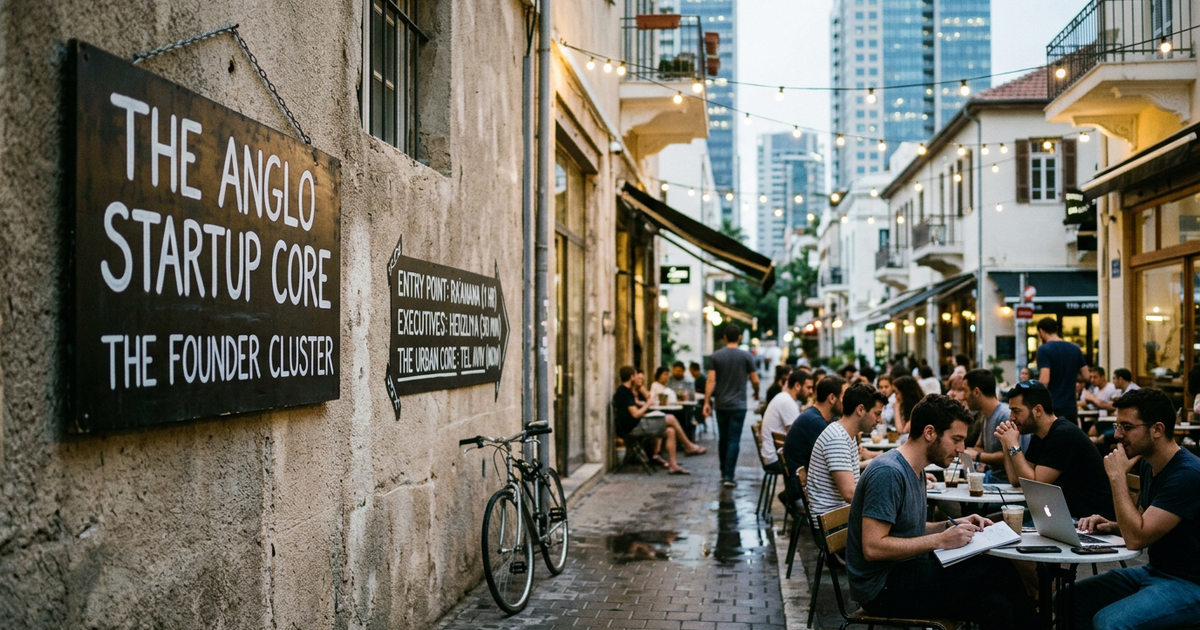
If Ra'anana is suburban Anglo Israel and Herzliya Pituach is executive Anglo Israel, Tel Aviv is the urban version. The entry point. The founder cluster. The lifestyle proposition that competes with London, New York, and Berlin.
The urban Anglo footprint inside Tel Aviv — younger, secular, startup-anchored, and structurally distinct from Ra'anana and Herzliya Pituach.
Haolam Atlas — Anglo Israel · The Olam Editorial Team
If Ra'anana is suburban Anglo Israel and Herzliya Pituach is executive Anglo Israel, Tel Aviv is the urban version.
Smaller in volume than the Anglo towns but distinct in flavor: the Tel Aviv Anglo footprint is younger, more secular, more single, more startup-anchored, and concentrated in a handful of neighborhoods that have become the entry-point for the early-career English-speaking professional in Israel.
The structural map
Tel Aviv's Anglo population is concentrated in five overlapping zones. Lev HaIr (the City Center) — the broadest concentration, anchored by Rothschild Boulevard and the Sheinkin / Allenby corridor. Florentin — the gentrified southern bohemian neighborhood, young Anglo creative-professional density, lower price points than the City Center. Neve Tzedek — older, more upscale, the historical pre-state Tel Aviv neighborhood, dense Anglo retiree and high-income professional presence. Bavli and Park Tzameret — the northern Tel Aviv high-rise corridors, secular wealthy Anglo and Israeli mixed presence. Kerem HaTeimanim and the Old North — smaller pockets of Anglo professional residence.
Who lives there
Four overlapping populations.
The young Anglo professional — typically twenty-five to thirty-five, recent oleh or extended-stay expat, working in Israeli tech, finance, law, journalism, or academia. Often single or recently partnered, frequently moving on from Tel Aviv to suburban Anglo Israel (Ra'anana, Modi'in, Givat Shmuel) within five-to-ten years if planning to start a family.
The startup founder Anglo — American, British, or South African Israeli founders or co-founders building Israeli technology companies, often shuttling between Tel Aviv and the US East or West Coast for fundraising and customer development. The cohort is small but disproportionately consequential in the Israeli venture ecosystem.
The Anglo academic and journalist — Tel Aviv University faculty, Reichman University (formerly IDC) commuters, the foreign-press correspondents and stringers based in Israel for global outlets. Often Lev HaIr or the Old North.
The Anglo retiree in Neve Tzedek and the Old North — typically wealthier, often part-time, with secondary residences in the US or UK. A smaller cohort than the equivalent in the Jerusalem corridor but visible in specific Tel Aviv neighborhoods.
The labor-market logic
Tel Aviv proper holds a significant fraction of the Israeli technology, finance, legal, and creative economy. The Rothschild–Sarona corridor and the Azrieli–Sarona office cluster house the headquarters or major Israeli operations of dozens of unicorns and growth-stage Israeli technology companies. The financial services sector — Bank Hapoalim and Bank Leumi headquarters, the Tel Aviv Stock Exchange, the senior tier of Israeli investment banking — is anchored in Tel Aviv. The major Israeli law firms have central Tel Aviv offices.
For the young Anglo professional, the calculus is simple: living within walking or short-bike distance of the office at a Tel Aviv tower beats commuting from a suburb. The trade-off is price, density, and the absence of family-scale infrastructure. The trade-off is acceptable for a specific demographic and time horizon, and becomes unworkable once children enter school.
Real estate
Tel Aviv is the most expensive residential market in Israel by per-square-meter price for tower apartments. Premium properties on Rothschild and in Park Tzameret clear well above NIS 50,000-80,000 per square meter. Two-bedroom units in central Tel Aviv routinely price at NIS 5-8 million. Penthouses in Park Tzameret, Sarona Tower, and the Yoo Tel Aviv project have crossed NIS 50-100 million for premium units.
Florentin entry-level apartments price meaningfully below the City Center but have appreciated sharply through gentrification cycles. Neve Tzedek is among the highest per-square-meter pricing tiers anywhere in Israel given its historic architecture and tight inventory.
Tel Aviv real estate is dollarized in the way Pituach and the Jerusalem corridor are. Anglo and foreign capital is a significant share of the buyer pool. The market clears against global rather than Israeli reference pricing.
The institutional layer
The Tel Aviv Anglo institutional layer is thinner and more informal than in the suburban Anglo towns. There is no Tel Aviv equivalent of AACI Ra'anana in scale. Anglo synagogues exist — Tiferet Yisrael (Modern Orthodox), the Florentin Modern Orthodox minyanim, the Conservative and Masorti footprints, the Reform Beit Daniel — but the religious community is smaller and more dispersed than in suburban Anglo towns.
The substitute infrastructure is informal — the Anglo professional networking events around Rothschild and Sarona, the Anglo-friendly coworking spaces, the English-language Tel Aviv professional groups, the WhatsApp networks of recent olim. The institutional layer is informal but functional.
Reichman University (IDC) in Herzliya, while not in Tel Aviv, functions as the Anglo-friendly higher education anchor for the metropolitan area. Many Tel Aviv-based Anglos studied at Reichman or maintain professional networks through it.
What Tel Aviv is and is not
Tel Aviv is the entry point. It is where the young Anglo professional lands, often immediately after aliyah or after the Reichman or Hebrew U pipeline. It is where the startup founder builds. It is where the journalist files. It is not, for most of its Anglo residents, the long-term family destination.
Tel Aviv is also the lifestyle. The beach, the restaurants, the secular culture, the European feel, the English-on-the-street comfort. For the demographic that Tel Aviv attracts, it competes with London, New York, and Berlin as a lifestyle proposition — and wins for a non-trivial share of Anglo professionals who would otherwise have chosen one of those cities.
Why it matters now
Tel Aviv's Anglo footprint has grown post-October 7, but unevenly. The cohort of US-based Israeli founders who have returned to Tel Aviv from Silicon Valley and New York has been substantial. The cohort of new young Anglo olim has continued. The cohort of foreign correspondents and academics has been more disrupted by the political and security environment than other Anglo segments.
The neighborhood that has absorbed the most growth has been Florentin and the southern City Center — the lower-price, younger, more international entry-point. Park Tzameret and the high-end tower market continues to attract returning Israeli founders and senior Anglo executives looking for in-Tel-Aviv-proper addresses.
The strategic implication
Tel Aviv is the urban Anglo Israel — smaller in absolute volume than Ra'anana or Beit Shemesh, but structurally important as the entry point, the founder cluster, and the lifestyle proposition that competes with global cities for a specific Anglo demographic.
It is the place that determines whether the young Anglo professional who arrives at twenty-five is still in Israel at thirty-five. The decision usually gets made in Tel Aviv. Then it routes outward — to Ra'anana, to Modi'in, to Givat Shmuel, to Herzliya Pituach — when family life begins.
Inside the Haolam Atlas
Tel Aviv is the eighth installment of the Anglo-Israel axis. The next pieces cover Netanya's French-and-Anglo coastal corridor; the secondary Anglo enclaves of Givat Shmuel, Hashmonaim, Ma'ale Adumim, Givat Ze'ev, and Zichron Ya'akov; and the religious-Zionist communities along the Highway 6 corridor.