
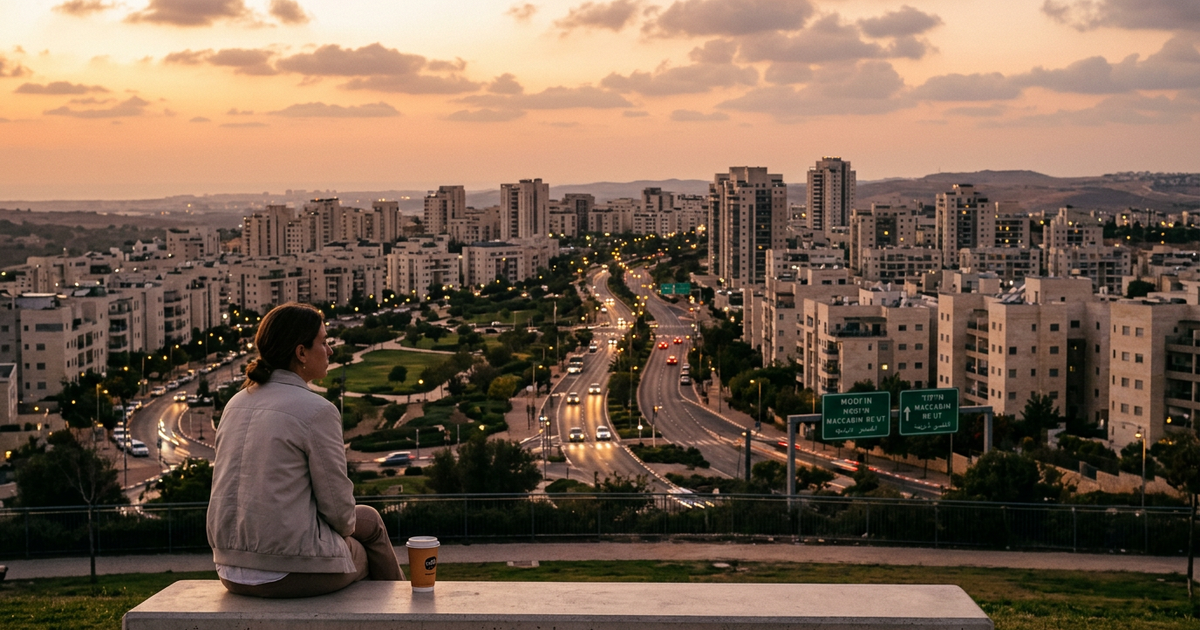

A planned city, built from raw ground starting in 1993, exactly halfway between Tel Aviv and Jerusalem. Modi'in is the second-largest Anglo destination in Israel — and projected to overtake the first.
What happened when Ra'anana ran out of room. The planned city that is now the second-largest Anglo destination in Israel — and projected to overtake the first.
Haolam Atlas — Anglo Israel · The Olam Editorial Team
Modi'in is what happened when Ra'anana ran out of room.
A planned city, built from raw ground starting in 1993, exactly halfway between Tel Aviv and Jerusalem on Highway 443. Population north of 100,000 and growing fast. The second-largest concentration of Anglo olim in Israel after Ra'anana — and the only one that was designed for them from day one.
Ra'anana is where professional Anglo aliyah scaled. Modi'in is where it expanded.
By the numbers
Population: roughly 100,000. Anglo share: smaller as a percentage than Ra'anana but larger in absolute terms in some cohorts — particularly the religious-Zionist family demographic from the United States and the United Kingdom. The municipality has ranked consistently in the top tier of Israel's socioeconomic cluster index since the mid-2000s. Median age is among the lowest of any large Israeli city — Modi'in is a young-family town by design.
Built on land assembled by the state in the 1990s under the master plan of architect Moshe Safdie, the city was designed for 200,000-plus eventual residents. Construction has been continuous for three decades. Most of the city is, in real terms, less than twenty-five years old.
The neighborhood map
Modi'in is organized into named neighborhoods, each with distinct demographic character. Buchman is the religious-Zionist anchor — Anglo and Israeli religious-Zionist families, the highest concentration of English-speaking modern Orthodox households in the city. Kaiser and Moriah skew younger and more mixed. Avnei Chen and the newer eastern expansion zones (Tzipporim, Ronim) absorb the bulk of new Anglo arrivals. Maccabim and Reut, the older twin towns now incorporated into Greater Modi'in, hold the wealthier and more established residents.
Buchman is the equivalent in Modi'in of what Lev Ra'anana is in Ra'anana — the institutional core and the cultural anchor for the English-speaking religious community.
Why families choose Modi'in over Ra'anana
Three reasons, in order.
First: price. Modi'in real estate runs at a meaningful discount to Ra'anana on equivalent square footage. A four-bedroom apartment in a newer Modi'in neighborhood clears at NIS 3-5 million; the same unit in Ra'anana clears NIS 4-7 million. Detached homes price similarly below Ra'anana levels. For young families making aliyah with a single household income, that delta is decisive.
Second: schools. Modi'in's state-religious school system has grown into one of the strongest in central Israel. The presence of Ohr Torah Stone and other religious-Zionist educational networks, plus a deep stable of English-track gan and elementary options, makes the religious Anglo K-12 pipeline competitive with Ra'anana — and arguably stronger at the religious-Zionist end.
Third: dual access to two labor markets. The Modi'in train station, on the Tel Aviv–Jerusalem fast line, puts Tel Aviv at roughly 30-35 minutes and Jerusalem at 20-25 minutes by direct rail. No other Anglo town offers symmetric access to both metropolitan economies. For a household with one spouse working in Jerusalem (academia, government, NGOs, healthcare) and one in Tel Aviv (tech, finance), Modi'in is the only viable address.
The institutional layer
AACI maintains an active Modi'in branch. Nefesh B'Nefesh routes a substantial share of religious-Zionist North American arrivals to Modi'in by default. Telfed and the British community service organizations have growing presence. The synagogue network is dense and largely religious-Zionist in flavor — multiple Anglo-flavored Modern Orthodox congregations, Yeshurun, Beit Knesset HaShalom, and a long list of smaller minyanim sorted by source community and nusach.
The school system is the real anchor. Yeshivat Modi'in, Tzviya religious-Zionist girls' schools, the broader Mamlachti Dati network with English-track integration. Buchman's gan and elementary system in particular has become a destination — families relocate from outside the city to be inside that catchment.
The archetype
The dominant Modi'in Anglo archetype is the religious-Zionist family in their thirties, both parents working — typically one in Tel Aviv tech and one in Jerusalem (education, healthcare, NGOs, professional services) — with three to five children moving through the local religious school system. Often arrivals from Teaneck, Riverdale, the New York metro, or the religious-Zionist communities of London and Manchester.
Secondary archetypes: the secular Anglo family that priced out of Ra'anana and Tel Aviv; the British academic family commuting to Bar-Ilan or Hebrew U; the second-stage olim who started in Ra'anana and moved to Modi'in for schools and price.
Real estate
Modi'in pricing has tracked the broader Israeli real estate cycle but with a steeper trajectory. Eastern expansion zones — Tzipporim, Ronim, the newer plots toward the train station — were trading at NIS 2.5-3.5 million for four-bedroom apartments a decade ago. They now clear NIS 4-5 million. Buchman detached homes price at NIS 7-10 million. Maccabim-Reut detached homes at the top of the range cross NIS 12 million for premium properties.
The pricing pressure is structural. New supply is constrained — the planned eastern expansion is the last large tract of buildable land within the existing master plan. Once that fills, Modi'in becomes price-inelastic in the way Ra'anana already is.
What Modi'in is not
Modi'in is not Ra'anana. The English-speaking density on the street is meaningfully lower. The professional labor market within the city is much thinner — Modi'in's economy is residential and service-sector, not tech-employer-anchored. The cultural infrastructure (English-language theater, lecture series, expat clubs) is less developed. For a household that wants to conduct daily life in English with minimal Hebrew, Ra'anana remains the easier choice.
Modi'in is also younger, more religious, more child-dense, and more car-dependent. The trade-offs are real. The reason Modi'in still wins for a meaningful share of arrivals is schools, price, and the train.
Why it matters now
In the post-October 7 wave, Modi'in is absorbing the families that Ra'anana cannot. The municipal planning department has acknowledged sustained pressure on the religious-school catchments. The eastern expansion is being built and absorbed in parallel. The rate-limiter is no longer real estate so much as school construction and gan capacity.
Strategically, Modi'in is now the largest planned Anglo destination in Israel. If the current wave continues for another five years, the city will likely overtake Ra'anana in absolute Anglo population by the early 2030s.
Inside the Haolam Atlas
Modi'in is the second installment of the Anglo-Israel axis. The next pieces cover Beit Shemesh and Ramat Beit Shemesh — the religious Anglo counter-pole — and the Jerusalem corridor of German Colony, Baka, Talbieh and Rehavia, before turning to Efrat and Gush Etzion, Herzliya Pituach and the high-end coastal corridor, and the secondary Anglo enclaves of Hashmonaim, Ma'ale Adumim, Givat Shmuel, and Zichron Ya'akov.