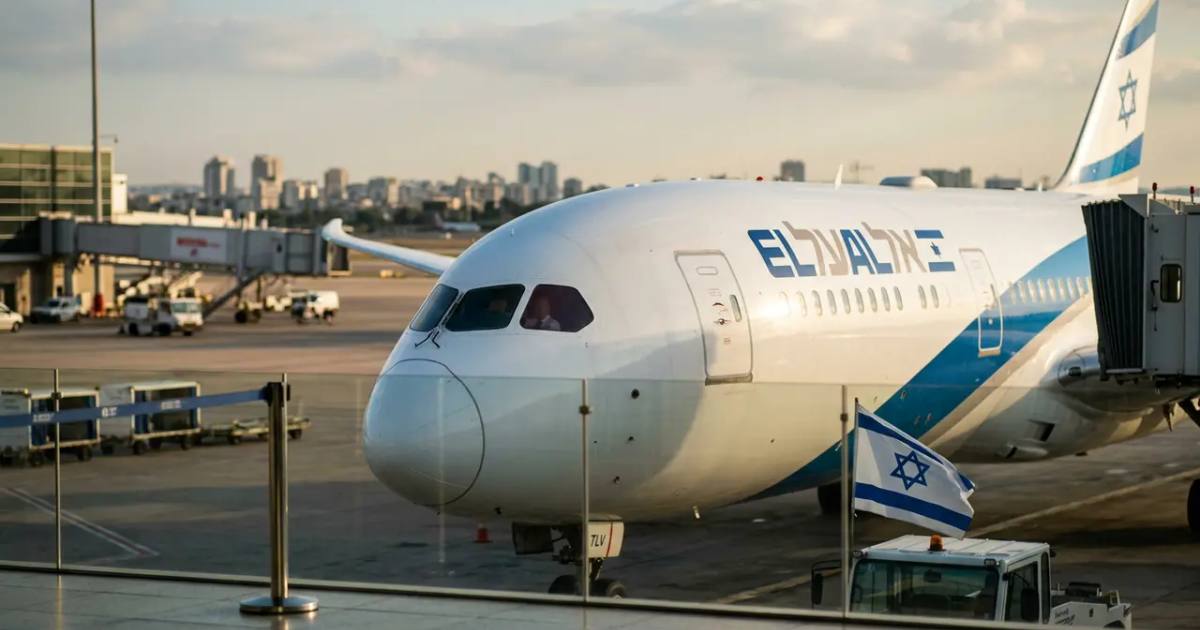

A 32-year-old New York yeshiva graduate controls Israel's national airline. The state still holds a golden share. The ownership history of El Al, from state carrier to Eli Rozenberg.
Israel's national airline is majority-controlled by a private American-Israeli investor in his early thirties, backed by his father's US nursing-home fortune, while the Israeli government retains a permanent veto over anything touching national security. Here is how El Al Israel Airlines actually breaks down.
Eli Rozenberg: The Controlling Shareholder
El Al (TASE: ELAL) is controlled by Eli Rozenberg, an Orthodox investor born in 1993 in Monsey, New York, through his holding vehicle Kanfei Nesharim, according to Wikipedia's entry on Eli Rozenberg. Rozenberg's company bought a 42.85% stake for $150 million in a September 16, 2020 tender, per Globes' original reporting on the acquisition, becoming El Al's controlling shareholder as Knafaim Holdings' longtime grip collapsed. Israel's Government Companies Authority formally granted Rozenberg control weeks later, according to the Times of Israel's report on the regulatory approval, after El Al's own attorneys unsuccessfully tried to block the transfer.
The purchase was financed in part by a loan from his father, Kenny Rozenberg, founder of the US nursing-home chain Centers Health Care, a structure that drew scrutiny from El Al's board over whether the son would truly control the airline independently of his father. Under the terms set by regulators, Rozenberg's father is barred from further loans tied to the stake and from receiving any shares directly, and any CEO or board appointee Rozenberg proposes must have at least five years of aviation-industry experience. As of mid-2025 disclosures, Rozenberg's stake stood in the high 40% range, up from his original 2020 purchase, making him by far the largest single shareholder.
How the 2020 Rescue Actually Worked
El Al's ownership structure today is a direct legacy of the COVID-19 rescue package Israel negotiated in mid-2020. The deal combined roughly $250 million in government-guaranteed loans with an additional $150 million raised through a new share issuance, and the government committed in advance to buy any shares the market did not absorb. When Knafaim Holdings, the airline's longtime controlling shareholder, chose not to participate in that September 2020 offering, its stake was diluted from about 38% to roughly 15%, and eventually further down through subsequent rounds. Rozenberg's Kanfei Nesharim stepped into the resulting vacuum, while the state itself ended up with a direct equity position of roughly 12% to 15%, per Globes' reporting on the rescue offering, on top of its pre-existing golden share. The result is a company that moved, in a single financing round, from one Israeli industrial-holding-company owner to a young American-Israeli investor and a larger direct state stake at the same time.
Knafaim Holdings: The Displaced Controlling Shareholder
Before Rozenberg, El Al was controlled by Knafaim Holdings (associated with the Mozes-Borovich family), which had held roughly 38% since taking over from direct state control in 2004 and 2005. Knafaim did not participate in the September 2020 rescue share offering and was diluted down to roughly 6% to 15% at various points afterward, though it remains a minority holder alongside institutional investors and the public float on the Tel Aviv Stock Exchange.
The State's Golden Share
El Al began as a fully state-owned carrier in 1948 and was privatized in stages starting in 2003. Even after privatization, the Israeli government retained a Special State Share, a golden share giving it veto power over matters the state considers essential to national security, such as foreign control of the airline or changes to its security posture. During the 2020 COVID rescue, the state also took a direct equity stake of roughly 12% to 15% as part of the bailout package, in addition to the pre-existing golden share.
What El Al Looks Like Under Rozenberg
Since the ownership change, El Al has pushed an ambitious recovery and growth plan: expanding its Boeing 787 Dreamliner fleet from 16 to 22 aircraft, targeting roughly 7.5 million passengers a year through its Ben Gurion hub for close to a quarter of the domestic market, and setting a revenue target near $3.5 billion by 2028. Dina Ben Tal Ganancia was appointed CEO in May 2022, the airline's first female chief executive, and the board has since added figures including Jason Greenblatt, the former Trump administration Middle East envoy. After heavy losses through 2020 and 2021, El Al posted its first positive net profit since 2015 in the fourth quarter of 2022, and the carrier has continued expanding routes, including a 2026 relaunch of South American service after a 15-year absence. Rozenberg has kept a low public profile throughout, rarely speaking to Israeli or American media about his role, which has left parts of the ownership story, including the exact current split between his direct and indirect holdings, less transparent than a typical controlling-shareholder situation.
Why This Structure Exists
Israeli law requires that El Al's controlling owner be an Israeli national, a rule tied to the airline's role in national security and its history of state-mandated security protocols (armed air marshals, hardened cockpits, anti-missile systems on some aircraft). Rozenberg holds both Israeli and American citizenship, which satisfied the legal requirement but did not fully quiet concerns about his father's involvement, given the scale of the initial loan and the fact that Centers Health Care, the elder Rozenberg's company, has no prior aviation experience.
The Map, at a Glance
| Holder | Stake | Role |
|---|---|---|
| Eli Rozenberg / Kanfei Nesharim | Roughly 42% to high 40s% | Controlling shareholder since September 2020 |
| State of Israel | Golden share, plus roughly 12% to 15% direct equity | Veto on national-security matters; residual stake from 2020 rescue |
| Knafaim Holdings | Diluted from ~38% to roughly 6% to 15% | Former controlling shareholder, now a minority holder |
| Public float | Remainder | Trades on the Tel Aviv Stock Exchange (TASE: ELAL) |
Frequently Asked Questions
Who is the controlling shareholder of El Al?
Eli Rozenberg, through his company Kanfei Nesharim, has controlled El Al since September 2020, when he acquired a 42.85% stake that has since grown into the high 40% range.
Does the Israeli government still own part of El Al?
Yes. The state holds a permanent golden share giving it veto power over national-security-related decisions, plus a direct equity stake of roughly 12% to 15% acquired during the 2020 COVID-19 rescue package.
Does Kenny Rozenberg, Eli's father, control El Al?
No, under the terms of the acquisition. Eli Rozenberg is barred from taking further loans from his father tied to the stake or transferring shares to him, and regulators required that board and CEO appointments meet independent aviation-experience criteria.
How much of El Al did Knafaim Holdings lose?
Knafaim's stake fell from roughly 38% before the 2020 rescue offering to as low as 6% at points afterward, after the family-linked holding company chose not to participate in the emergency share issuance.
Related Olam Coverage
- Who Owns Israel's Ports? Haifa, Ashdod, and Eilat Mapped
- Who Owns Israel's Telecoms? Bezeq, Cellcom, Partner, Hot Mapped
- Who Runs Israel's Health Funds? Clalit, Maccabi, Meuhedet, Leumit
Sources
Wikipedia, Eli Rozenberg; Globes, "Eli Rozenberg buys control of El Al" (Sept. 2020); Times of Israel, "El Al's new owner" (2020); Times of Israel, Government Companies Authority approval (2020); FlightGlobal, state stake reporting (2020); U.S. Department of Commerce market intelligence brief on El Al.
How we report: Olam stories draw on public filings, company disclosures and named sources, checked by our editors. Read our methodology · Corrections