
The Jerusalem-adjacent religious-Zionist town most Anglos overlook. 30-50% discount to Jerusalem on equivalent square footage. Larger homes, religious-Zionist schools, 15-25 minute Jerusalem access. The structural lower-price alternative to Efrat.
The largest community east of Jerusalem, and a meaningful religious-Zionist Anglo footprint at a structural discount to the city.
Haolam Atlas, Anglo Israel · The Olam Editorial Team
Ma'ale Adumim is the Jerusalem-adjacent religious-Zionist town that most Anglos overlook, and that quietly holds one of the densest religious-Zionist Anglo communities in central Israel.
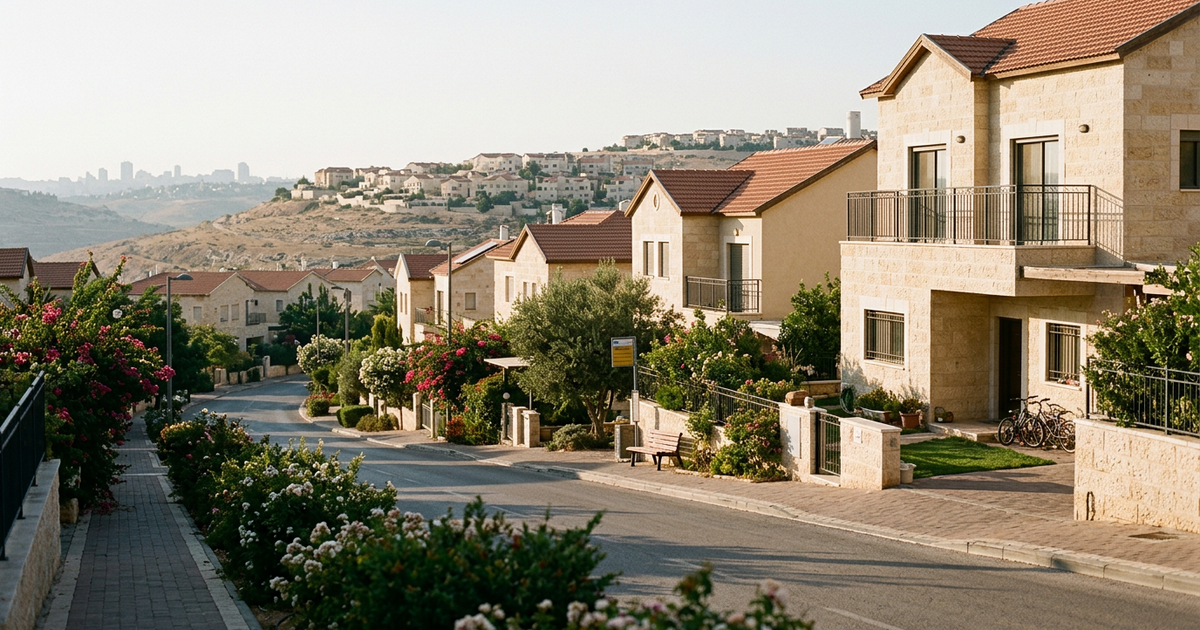
A city of approximately 40,000 sitting on the ridge east of Jerusalem, Ma'ale Adumim is the largest Israeli community in the broader Jerusalem metropolitan ring east of the city. It is also a meaningful Anglo religious-Zionist destination, smaller in absolute Anglo share than Efrat, but larger in absolute Anglo population.
40,000 people, and a discount Efrat can't match
Population: approximately 40,000. Anglo share: estimated 8-15%, concentrated in the religious-Zionist neighborhoods. Primary demographic: religious-Zionist Modern Orthodox American, British, and South African families; secondary traditional and secular populations. Religious composition: mixed religious-Zionist, traditional, and secular, with religious-Zionist concentration in specific neighborhoods. Housing profile: four-bedroom apartments NIS 2.5-4 million, detached homes NIS 4-7 million, a meaningful discount to Jerusalem proper. Economic identity: Jerusalem-commuter residential platform. Why it matters: the structural lower-price alternative to Efrat for the religious-Zionist Anglo family pursuing Jerusalem-area aliyah.
Price, space, schools, and a 15-25 minute run to Jerusalem
Four reasons, in order of typical weight.
First: price. Ma'ale Adumim trades at a 30-50% discount to Jerusalem proper on equivalent square footage. For the Anglo religious-Zionist family making aliyah with three to five children, the math is decisive. A four-bedroom apartment that clears NIS 4-6 million in Jerusalem's Baka or German Colony clears NIS 2.5-4 million in Ma'ale Adumim. Detached homes price similarly below Jerusalem levels.
Second: larger homes. The newer Mitzpeh Nevo and eastern expansion neighborhoods deliver square footage and outdoor space that Jerusalem proper cannot at comparable price points. For families with multiple children, this is structural.
Third: religious-Zionist schooling. The Mamlachti Dati system inside Ma'ale Adumim is connected to the broader Jerusalem religious-Zionist school infrastructure. English-track gan and elementary options exist. The school pipeline routes naturally into the Jerusalem-area religious-Zionist secondary schools.
Fourth: Jerusalem access. The five-kilometer location east of Jerusalem along Highway 1 puts the city's labor market, academia, government, NGOs, healthcare, professional services, religious institutions, at a 15-25 minute commute. Tel Aviv access via Highway 1 west or Highway 6 south runs 50-70 minutes.
Community density follows from the schools and the synagogues. The Anglo religious-Zionist community in Ma'ale Adumim is concentrated enough that families know each other across the relevant catchments, the social infrastructure operates at meaningful density, and the institutional life is functional without being deep.
Functional, not deep: the institutional layer
The Anglo religious-Zionist community in Ma'ale Adumim is anchored by a smaller but functional set of institutions. Multiple religious-Zionist synagogues, some with Anglo-flavored services. The Jewish day school network connects to the Jerusalem religious-Zionist system. AACI maintains presence. The Religious-Zionist national institutional network operates inside the city the same way it does across the bloc.
The institutional density is lower than in Efrat or RBS-A but higher than in most secondary religious-Zionist towns. For a family that wants Jerusalem access and a moderate religious-Zionist environment, the institutional infrastructure is adequate without being deep.
Inside the consensus bloc
Ma'ale Adumim sits inside the consensus settlement bloc, the part of the West Bank widely understood to remain Israeli under any plausible future settlement framework. For the religious-Zionist Anglo family considering Jerusalem-area aliyah, this setting is part of the calculus. It is not the central driver, the central drivers are price, larger homes, schools, and Jerusalem access, but it is part of the context.
Why it matters now
Ma'ale Adumim has absorbed a meaningful share of the post-October 7 religious-Zionist Anglo wave, particularly families looking for Jerusalem-area religious community at a more accessible price point than Efrat or the Jerusalem corridor. The growth has been quieter than Efrat's but real.
The municipality has planned substantial new construction in the eastern and southern expansion zones. Whether the Anglo religious-Zionist community in Ma'ale Adumim grows toward the scale of Efrat's Anglo presence, or remains a secondary destination behind it, depends on the construction pipeline and the broader environment around the city.
The lower-price answer to Efrat
Ma'ale Adumim is the structural alternative to Efrat for the Anglo religious-Zionist family that wants Jerusalem-area aliyah at a lower price point and with larger living space. It is larger and more diversified in population than Efrat, less ideologically charged in its founding identity, and closer to Jerusalem proper. For the religious-Zionist family that wants Jerusalem access on a price-and-space basis, Ma'ale Adumim is the answer.
Inside the Haolam Atlas: Anglo Israel
The Haolam Atlas maps where Anglo aliyah actually lands, city by city. Ma'ale Adumim is the price-and-space case in the Jerusalem ring, the lower-cost counterpart to Efrat's ideological case.
Landing towns covered in depth: Ra'anana: The Anglo Capital of Israel · Tel Aviv: The Anglo Startup Core · Herzliya Pituach: The Senior Executive Anglo Coast · Ma'ale Adumim (this piece) · Efrat: The Ideological Anglo Town. For Modi'in, Jerusalem, Beit Shemesh, Gush Etzion, and Zichron Ya'akov, see the full Anglo Communities Map.
Source diasporas: London: The Anglo-Jewish Establishment · Johannesburg: The Anglo-South Exodus Map · Sydney: The Eastern Suburbs Anglo-Jewish Capital
How we report: Olam stories draw on public filings, company disclosures and named sources, checked by our editors. Read our methodology · Corrections