
Herzliya Pituach is Israel's most expensive residential real estate. Foreign capital likely sleeps here more than any other neighborhood.
The working capital of the senior Anglo executive class. The most expensive square mile of residential real estate in Israel.
Haolam Atlas, Anglo Israel · The Olam Editorial Team
Herzliya Pituach is the most expensive square mile of residential real estate in Israel, and the working capital of the senior Anglo executive class.
A coastal enclave of roughly five square kilometers on the Mediterranean north of Tel Aviv, populated by senior tech and finance executives, embassy and diplomatic staff, defense industry leadership, and the wealthier French, South African, and American Jewish families. The home base of Israeli technology multinational headquarters and the country's most concentrated diplomatic district.
105,000 in Greater Herzliya, 12,000-15,000 in Pituach's high-wealth strip
Greater Herzliya population: approximately 105,000. Herzliya Pituach proper, the western coastal strip, holds roughly 12,000-15,000 residents at much lower density and much higher wealth than the rest of the city. Anglo share: among the highest in absolute and per-capita terms of any Israeli neighborhood, but skewed sharply toward the senior management and executive demographic.
Microsoft, Apple, Google, and Meta are a five-minute drive away
The single most important fact about Herzliya Pituach is what sits next to it. The Herzliya Pituach Industrial Zone, the strip of office parks and corporate campuses immediately east of the residential coast, across Highway 2, is the densest concentration of multinational technology employment in Israel and one of the densest in the world outside Silicon Valley.
Microsoft Israel's headquarters. Apple. Google. Meta. IBM. Oracle. Cisco. Intel. SAP. eBay's Israeli R&D. Salesforce. Dozens of Israeli unicorns, growth-stage technology companies, and the senior cybersecurity industry. The campuses sit side-by-side along a single corridor that can be walked end-to-end in under thirty minutes.
People live in Pituach because the industrial zone is next door. That is the structural logic of the neighborhood. The country managers, R&D vice-presidents, and senior architects of those multinationals do not commute to Pituach, they live there. The commute is, in many cases, under five minutes by car. The lifestyle is suburban coastal villa, the working day is global multinational tech, and the geography compresses the two into a single one-mile radius.
This is not coincidence. It is the architecture of the most consequential technology-employment-and-residence corridor in the country. The villas exist because the offices are there. The offices located there in part because the villas were already there. The flywheel is now self-reinforcing.
Ambassadors' row, next to the villas
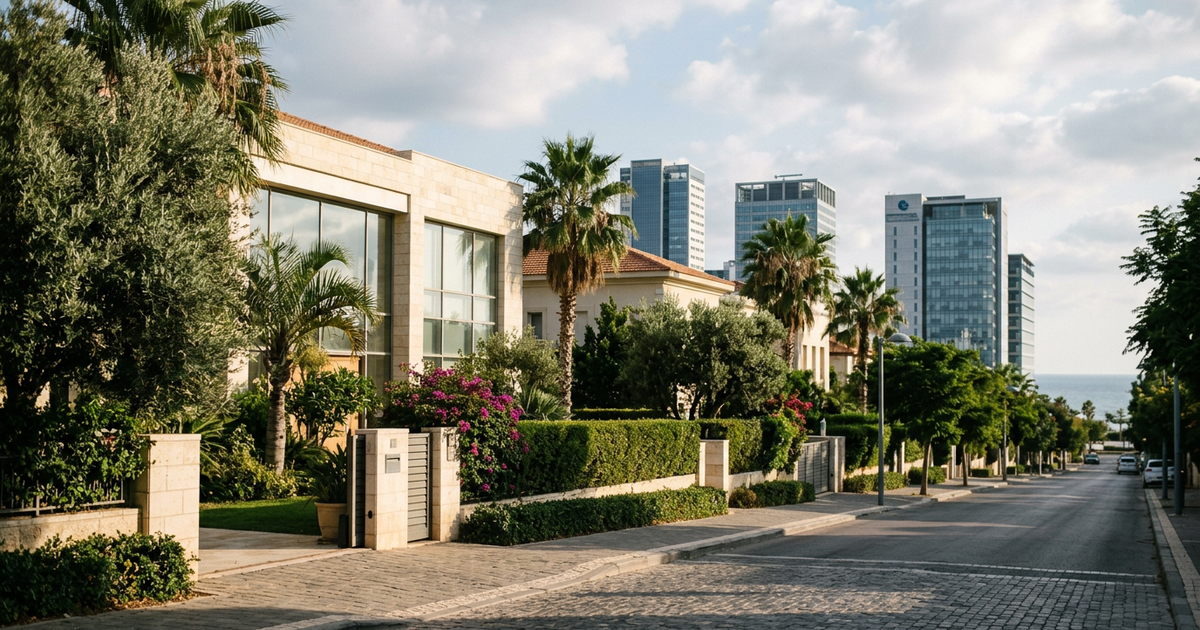
Herzliya Pituach is bounded west by the Mediterranean, east by Highway 2 (Coastal Road), north by the Apollonia archeological park, south by the Reading Power Station and the Tel Aviv border. The neighborhood is low-rise and low-density, dominated by detached villas and small apartment blocks. The Daniel Hotel, the Sharon Hotel, and the Arena Mall mark the southern coastal edge.
The diplomatic district is concentrated in Pituach, the United States ambassador's residence, the British ambassador's residence, the residences of most major European and several Asian and Latin American ambassadors. The presence of the diplomatic corps shapes the neighborhood's character, security profile, and social rhythms.
Executives, ambassadors, and French and South African wealth
Senior multinational technology executives: Israeli country managers and global executives at the major US, European, and Israeli tech firms headquartered in the industrial zone.
Senior Israeli technology and finance professionals: founders and executives of Israeli unicorns, venture partners, senior public-market and private-market financiers, the senior cybersecurity industry leadership.
The wealthy French Jewish community: a substantial cohort of the Anglo-adjacent French Jewish elite resides in Pituach part- or full-time. Pituach and the neighboring Kfar Shmaryahu function as the secondary French-Israeli wealth corridor after Netanya.
The wealthy South African Jewish community: a smaller but visible cohort, concentrated in Pituach and Kfar Shmaryahu, often connected to South African corporate or family-office wealth that has redomiciled or partially redomiciled to Israel.
Plus: the diplomatic corps and a network of senior defense, intelligence, and security industry executives whose work in the broader Tel Aviv area is most conveniently anchored on this coastal strip.
NIS 25-100 million: the villa market priced in dollars, not shekels
Herzliya Pituach is the most expensive residential market in Israel by per-square-meter price for villa-class property. Detached villas in Pituach proper trade at NIS 25-80 million for premium properties; the highest-end ocean-front and second-row villas have crossed NIS 100 million in recent transactions. Smaller apartment units in newer mid-rise construction price at NIS 7-15 million.
Most of the Pituach real estate market is, in price terms, valued in dollars or euros rather than shekels. The buyer pool is global, the seller pool is global, and the price discovery happens against international benchmarks. This makes Pituach effectively a global real estate market that happens to be physically located in Israel.
More foreign capital likely sleeps each night in Herzliya Pituach than in any other residential neighborhood in Israel.
Kfar Shmaryahu, the small adjacent moshav-style community immediately north of Pituach, operates on similar economics with even tighter inventory and even higher per-property prices for the few villa-class transactions that occur.
A platform, not a community
Pituach is not a community in the institutional sense that Ra'anana, Modi'in, Beit Shemesh, or Efrat are. It is a residential platform for the senior management of the Israeli technology, finance, and defense industries, and for the wealthier Anglo, French, and South African Jewish families that operate at that altitude.
Its outputs are economic and strategic rather than communal. The decisions made on Pituach back patios, over coffee, dinner, walks on the beach, shape the trajectory of the Israeli technology sector, the country's defense industrial base, and the cross-border deal flow between Israeli companies and US, European, and Asian acquirers.
Why it matters now
Pituach has been the post-October 7 beneficiary of three simultaneous trends. French Jewish wealth has continued to relocate to Israel and a disproportionate share has landed in Pituach. South African Jewish wealth has accelerated its Israel allocation. And US-based Israeli executives, Israeli founders who relocated to Silicon Valley or New York in the 2010s, have been quietly returning to Israel through 2024 and 2025, often with Pituach villas as their landing point.
The neighborhood is therefore at peak demand against a structurally inelastic supply. New construction is rare. Inventory turnover is largely peer-to-peer. The pricing dynamics reflect a market that is functionally a fixed-supply asset class with global demand.
Why Pituach is the executive coast
Herzliya Pituach is the residential platform of the Israeli executive class, and the residential platform of the global Anglo, French, and South African Jewish wealth that has elected to anchor part of its life in Israel at the senior end of the wealth distribution.
It is the most concentrated piece of Anglo-influenced real estate in Israel and one of the most concentrated pieces of global Jewish wealth on earth per square kilometer. It is the senior end of the Anglo-Israel migration story, the executive coast.
Inside the Haolam Atlas: Anglo Israel
The Haolam Atlas maps where Anglo aliyah actually lands, city by city. Pituach is the senior-executive case, the wealth end of the same migration story that produces Ra'anana's mid-career professionals and Beit Shemesh's large religious families.
Landing towns covered in depth: Ra'anana: The Anglo Capital of Israel · Tel Aviv: The Anglo Startup Core · Herzliya Pituach (this piece) · Ma'ale Adumim: The Anglo Town · Efrat: The Ideological Anglo Town. For Modi'in, Jerusalem, Beit Shemesh, Gush Etzion, and Zichron Ya'akov, see the full Anglo Communities Map.
Source diasporas: London: The Anglo-Jewish Establishment · Johannesburg: The Anglo-South Exodus Map · Sydney: The Eastern Suburbs Anglo-Jewish Capital
How we report: Olam stories draw on public filings, company disclosures and named sources, checked by our editors. Read our methodology · Corrections