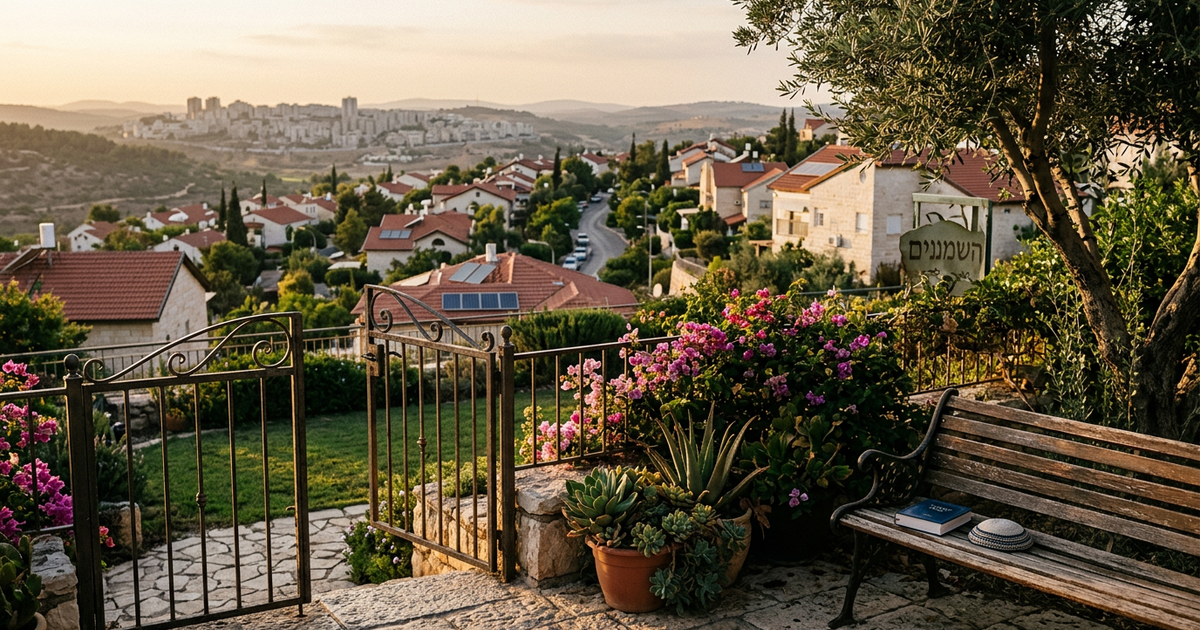

West of Modi'in: the religious Anglo yishuv corridor — Hashmonaim, Matityahu, Kfar Oranim, Lapid, Shilat. Hashmonaim is the anchor: 40%+ Anglo, religious-Zionist Modern Orthodox, central Israel access, the yishuv-scale alternative to urban aliyah.
West of Modi'in: the religious Anglo yishuv corridor — and Hashmonaim as its anchor.
Haolam Atlas — Anglo Israel · The Olam Editorial Team
West of Modi'in, a small religious Anglo yishuv corridor does what the city itself doesn't quite do.
Strung along the road from Modi'in toward the central plain — Hashmonaim, Matityahu, Kfar Oranim, Lapid, Shilat — five small religious communities together form an Anglo-flavored yishuv corridor for families looking for a religious-Zionist environment denser than Modi'in's Buchman and more rural than Beit Shemesh. The center of the corridor — institutionally, demographically, and culturally — is Hashmonaim.
3,500 people, 40%+ Anglo — the highest share in central Israel
Hashmonaim population: approximately 3,500. Estimated Anglo share: among the highest of any religious-Zionist community in central Israel (estimated 40%+ of households). Primary demographic: religious-Zionist Modern Orthodox Anglo families. Religious composition: Modern Orthodox / Religious-Zionist. Housing profile: detached homes and townhouses, NIS 2.5-5 million. Economic identity: bedroom community for Modi'in, Tel Aviv, and Bnei Brak commercial corridors. Why it matters: the yishuv-scale religious-Zionist Anglo destination with central Israel access — neither West Bank nor urban.
Hashmonaim: the anchor
Hashmonaim is the Anglo center of the corridor and the reason the corridor exists as an Anglo destination at all. Founded in the 1980s and expanded substantially in the 1990s and 2000s, the yishuv has absorbed a meaningful cohort of religious-Zionist Anglo Modern Orthodox families primarily from the United States, the United Kingdom, and South Africa.
The institutional layer is what one would expect of a small Anglo religious-Zionist yishuv operating at scale. Multiple Anglo-flavored synagogues. A continuous English-track gan and elementary pipeline, with extension into Modi'in's religious-Zionist secondary schools for upper school. The Hesder yeshiva system accessed through nearby institutions. A tight social infrastructure — the Hashmonaim WhatsApp groups, chesed networks, and ad-hoc family-support structures that define life inside a small Anglo religious community.
Real estate in Hashmonaim trades at meaningful discounts to Modi'in proper. Detached homes clear NIS 3-5 million; townhouses NIS 2.5-4 million. Inventory is structurally constrained — yishuv expansion requires regional council and government approval, and supply has been tight for years. Turnover at sustained pace post-October 7 has further compressed availability.
Matityahu, Kfar Oranim, Lapid, and Shilat: the supporting cast
Around Hashmonaim, four smaller communities fill out the corridor with different religious flavors but overlapping Anglo connections. Matityahu — Charedi-leumi (national-Haredi), a hybrid religious community with religious-Zionist commitments and stricter religious practice. Kfar Oranim, Lapid, and Shilat — religious-Zionist, mostly Israeli-born with smaller Anglo footprints, each with distinct community character. Together with Hashmonaim, the five communities operate inside a shared geographic and institutional fabric, with cross-yishuv school enrollment, synagogue attendance, and social ties.
Smaller than Modi'in, tighter than Beit Shemesh
Three things that Greater Modi'in doesn't quite. First, smaller-community scale — the corridor yishuvim cap out at 5,000, which produces a different social density than Modi'in's 100,000. Second, religious community homogeneity — each yishuv is religiously self-selected, which produces a tighter religious-life experience than a mixed city. Third, semi-rural character — the corridor is built around modest village layouts with substantial green space rather than the denser apartment-block patterns of Modi'in proper.
For the religious-Zionist Anglo family that wants a yishuv life with central-Israel access — closer to the Tel Aviv-Modi'in labor market than the Gush Etzion yishuvim, less politically charged than the West Bank settlements — the corridor is the structural answer. Hashmonaim is where most of them land.
Why it matters now
The post-October 7 religious-Zionist Anglo wave has put pressure on Hashmonaim in particular, with school catchments at capacity and home turnover at sustained pace. The corridor cannot absorb at the volume that Modi'in or Beit Shemesh can. The overflow effect — families that wanted Hashmonaim and could not find inventory routed instead to Buchman or RBS-A — is the structural pattern.
The yishuv-scale answer, without the West Bank commute
The Modi'in religious belt is a small but characteristic slice of the Anglo-Israel map. The yishuv archetype works for families that prefer scale, religious density, and rural character to urban anonymity. Hashmonaim delivers all three with central-Israel access — and is therefore structurally limited only by the yishuv-expansion constraints that bind all small Israeli communities.
Inside the Haolam Atlas: Anglo Israel
The Haolam Atlas maps where Anglo aliyah actually lands, city by city. Hashmonaim is the yishuv-scale case inside central Israel — the closest equivalent to the Gush Etzion yishuvim without the West Bank commute.
Landing towns: Ra'anana: The Anglo Capital of Israel · Modi'in: The Anglo Overflow Town · Hashmonaim (this piece) · Tel Aviv: The Anglo Startup Core · Herzliya Pituach: The Senior Executive Anglo Coast · Givat Shmuel: The Religious-Zionist Anglo Suburb · Jerusalem: The Anglo Capital · Jerusalem's Anglo Corridor · Ma'ale Adumim: The Anglo Town · Efrat: The Ideological Anglo Town · Gush Etzion's Anglo Belt · Beit Shemesh: The Religious Anglo Capital · Zichron Ya'akov and Pardes Hanna: The Anglo Wine Country
Source diasporas: London: The Anglo-Jewish Establishment · Johannesburg: The Anglo-South Exodus Map · Sydney: The Eastern Suburbs Anglo-Jewish Capital
Overview: The Anglo Communities Map