
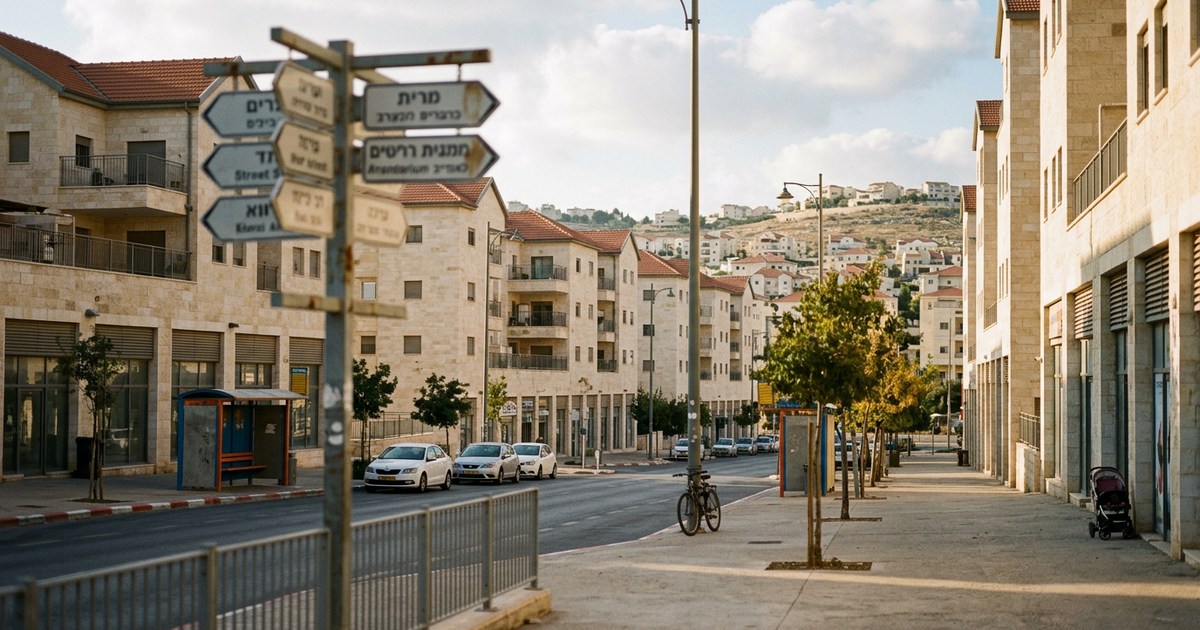

The largest concentration of religious Anglo olim in Israel. RBS-A as the institutional core. The five-city religious zoning. Source diasporas: Teaneck, Passaic, Baltimore, Five Towns, Golders Green, Johannesburg.
If Ra'anana is the secular Anglo capital, Beit Shemesh is the religious one. The largest concentration of religious Anglo olim in Israel.
Haolam Atlas — Anglo Israel · The Olam Editorial Team
Beit Shemesh is the largest concentration of religious Anglo olim in Israel.
If Ra'anana is the secular and modern-religious capital of English-speaking Israel, Beit Shemesh is the religious one. A city of roughly 145,000 — and growing faster than any other municipality of its size in the country — built around a religious zoning logic that has produced the most layered, most institutionally complete, and most internally contested Anglo community in Israel.
By the numbers
Population: approximately 145,000, projected to exceed 200,000 within a decade. The city has been one of Israel's fastest-growing for two consecutive decades. Anglo share: smaller as a percentage of the total than Ra'anana, but the Anglo cluster — concentrated overwhelmingly in Ramat Beit Shemesh Aleph — represents the largest religious Anglo community in the country in absolute terms.
Religious composition: dominantly Orthodox, with a layered split between Modern Orthodox / Religious-Zionist, Yeshivish / Litvish, Chassidish, and Charedi communities, each holding distinct neighborhoods within the broader city. The Anglo presence is concentrated at the Modern Orthodox / Religious-Zionist end, with a secondary Yeshivish-Anglo presence.
The structural map
Beit Shemesh is best understood as five cities layered onto one. Old Beit Shemesh — the original 1950s development town, Mizrahi and Sephardic, longer-tenured, with limited Anglo presence. Ramat Beit Shemesh Aleph (RBS-A) — the religious-Zionist and Modern Orthodox neighborhood, the Anglo institutional core. Ramat Beit Shemesh Bet (RBS-B) — Yeshivish and Charedi, with a smaller English-speaking population. Ramat Beit Shemesh Gimmel — newer Charedi, larger families, lower English density. Ramat Beit Shemesh Daled — under construction, projected to add tens of thousands of additional residents, religious composition still consolidating.
The Anglo demographic map of Beit Shemesh is therefore not the city — it is RBS-A, with a secondary footprint in RBS-B and parts of Old Beit Shemesh's Sheinfeld and Nofei Aviv neighborhoods.
Ramat Beit Shemesh Aleph: the Anglo core
RBS-A was master-planned in the mid-1990s and absorbed its first large Anglo cohort in 1996-2001. The neighborhood is religious-Zionist and Modern Orthodox in flavor, with a dense Anglo institutional layer — multiple Anglo-flavored shuls, the long-running RAMBAM Mesivta, Reishit Yerushalayim and Lev HaTorah for boys, Tomer Devorah and Be'er Miriam for girls, multiple English-track gan and elementary networks.
The street life is distinctive: kosher restaurants and bakeries serving an Anglo customer base, kollelim and battei midrash with English-speaking participation, the Big Shul, the Israel Center, and a long list of smaller minyanim sorted by source community — the Modern Orthodox American, the British Modern Orthodox, the South African religious-Zionist, the Australian religious-Zionist.
Real estate in RBS-A trades at a meaningful discount to Ra'anana and Modi'in on equivalent square footage, which is the structural reason families with three-to-six children land here. A four-to-five bedroom apartment that would clear NIS 5-6 million in Ra'anana clears NIS 2.5-4 million in RBS-A. For large religious families, the math is decisive.
Source diasporas
Beit Shemesh draws from a different set of source communities than Ra'anana. The North American Religious-Zionist and Modern Orthodox communities of Teaneck, Englewood, Riverdale, Passaic, Baltimore, Silver Spring, and the Five Towns of Long Island. The British religious-Zionist community of Golders Green, Hendon, Edgware, and Manchester. The South African religious-Zionist community of Johannesburg's northern suburbs and Cape Town's Sea Point. The Australian and New Zealand religious-Zionist communities in smaller numbers.
Beit Shemesh is the religious Anglo migration destination. Ra'anana skews secular, modern, professional. Beit Shemesh skews religious, family-large, schools-anchored. They are the two ends of the same migration story.
The institutional density
Beit Shemesh has the highest concentration of English-language religious institutions of any Israeli city. Yeshivot, seminaries, kollelim, women's study programs, English-language batei midrash. The Israel Center, Lema'an Achai, multiple chesed organizations. Anglo-flavored kollelim including post-yeshiva and married programs. The Jewish day school networks have produced a critical mass of religious Anglo students moving from gan through high school within the city.
The shul network in RBS-A alone runs into the dozens. The community is religiously dense to a degree no other Anglo Israeli city replicates — Efrat is comparable in flavor but a fraction of the scale; Modi'in's Buchman is comparable in religious composition but a fraction of the institutional depth.
The internal tensions
Beit Shemesh is not a unified community. The city's religious zoning produces structural tensions between Modern Orthodox / Religious-Zionist (RBS-A) and Charedi (RBS-B, RBS-Gimmel, RBS-Daled) populations, and these tensions periodically flare into public conflict — most visibly during the years 2011-2014 over public modesty, schooling, and street infrastructure, and recurrently since. The Anglo population is largely concentrated on the Modern Orthodox / Religious-Zionist side of this divide.
Infrastructure has lagged growth. Roads, public transport, parks, and municipal services have not kept pace with the population. Traffic on Route 38 in and out of Beit Shemesh is structurally bad. The train to Jerusalem and Tel Aviv exists but the frequency and routing remain limited. These are the principal Anglo complaints about life in Beit Shemesh, and they remain unresolved.
Why it matters now
The religious Anglo migration wave post-October 7 has been concentrated more heavily in Beit Shemesh than in any other city. The Religious-Zionist and Modern Orthodox demographic represents one of the largest Anglo aliyah inflows by volume — and Beit Shemesh has the institutional capacity and the housing inventory to absorb it. RBS-A apartment turnover ran near record levels through 2024 and 2025.
The growth is sustainable for at least another decade. RBS-Daled construction will add tens of thousands of additional units. Whether the religious Anglo cluster expands into RBS-Daled or whether the new construction skews more Charedi will define the future demographic shape of the city.
The strategic implication
Beit Shemesh is the proof that religious aliyah at scale requires three conditions: institutional depth in English-language religious infrastructure, affordable real estate for large families, and a religious-Zionist municipal context with critical mass. RBS-A is the only place in Israel where all three exist together.
For the global Modern Orthodox community, Beit Shemesh is now the religious aliyah default. It is the religious Anglo equivalent of what Ra'anana is for the professional secular Anglo demographic — the place the institutional pipeline routes you to, the place the schools work, the place the math works.
Inside the Haolam Atlas
Beit Shemesh is the third installment of the Anglo-Israel axis. The next pieces cover Efrat and the Gush Etzion satellites (Neve Daniel, Alon Shvut, Tekoa), the Jerusalem corridor of German Colony, Baka, Talbieh and Rehavia, Herzliya Pituach and the high-end coastal corridor, and the secondary Anglo enclaves of Hashmonaim, Ma'ale Adumim, Givat Shmuel, and Zichron Ya'akov.