
The Anglo town in Israel most explicitly built around ideology. Riskin's town in the Gush Etzion bloc. The values decision, not the labor-market decision. 35-40% Anglo share — and accelerating post-October 7.
The Anglo town in Israel most explicitly built around ideology. The Religious-Zionist flagship in Gush Etzion, Rabbi Riskin's town.
Haolam Atlas, Anglo Israel · The Olam Editorial Team
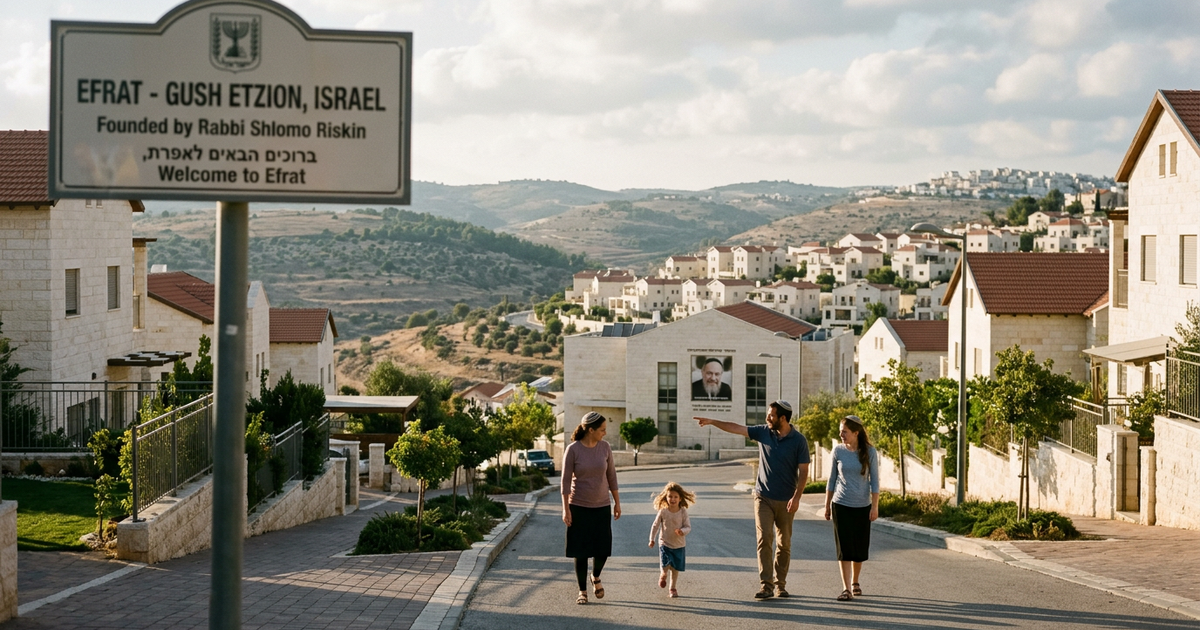
Efrat is the Anglo town in Israel most explicitly built around ideology.
A planned Religious-Zionist community in the Gush Etzion bloc, founded in 1983, populated overwhelmingly by Modern Orthodox American and British Jews who came not for the schools or the labor market, though both are competitive, but because they believed the place was supposed to exist. Efrat is the Anglo town with the highest ideological coefficient in Israel.
13,000 people, 35-40% Anglo
Population: approximately 13,000. Anglo share: estimated at 35-40%, one of the highest concentrations of native English speakers of any town in Israel. Religious composition: dominantly Religious-Zionist Modern Orthodox, with a smaller traditional and secular minority. The town has grown steadily since the mid-1980s, with absorption rates accelerating after 2002 and again after October 2023.
Geographically, Efrat occupies a long ridge running north-south along Highway 60 between Jerusalem and Hebron, approximately fifteen kilometers south of central Jerusalem and ten kilometers south of the Tunnel Road junction.
Rabbi Riskin's Lincoln Square congregation, relocated
Efrat was founded in 1983 by Moshe Moskovic and Rabbi Shlomo Riskin, the latter relocating with a substantial cohort of his Lincoln Square Synagogue congregation from the Upper West Side of Manhattan. The founding vision was explicit: a Religious-Zionist Anglo community inside the Etzion bloc, built around a single mission, to settle and integrate Anglo Modern Orthodoxy into the modern State of Israel on ideological terms.
Rabbi Riskin served as chief rabbi of Efrat for four decades and remains the community's defining figure. The Ohr Torah Stone institutional network, yeshivot, seminaries, women's halakhic leadership programs, English-track teacher training, is anchored in Efrat and represents the institutional infrastructure of religious-Zionist Anglo aliyah more broadly.
Seven neighborhoods along one ridge
Efrat is organized into seven named neighborhoods (Gvaot, Rimon, Tamar, Dekel, Dagan, Te'ena, and Zayit), built sequentially along the ridge over four decades. The older neighborhoods (Gvaot, Rimon, Tamar) trend more Anglo, longer-tenured, and more upscale. The newer neighborhoods (Te'ena, Zayit, Dagan) skew younger and absorb the bulk of new arrivals.
Real estate in Efrat trades meaningfully below central Israel pricing, a four-to-five bedroom unit in Efrat clears NIS 2.5-4 million versus NIS 4-7 million in Modi'in or Ra'anana. The discount reflects the location inside the Green Line and the resulting access and security calculations.
Ohr Torah Stone, and an institutional density that rivals Beit Shemesh
Ohr Torah Stone: yeshivot, midreshet, the Susi Bradfield Women's Institute for Halakhic Leadership, the Joseph Straus Rabbinical Seminary, multiple kollelim. The institutional density per capita rivals Beit Shemesh and exceeds Modi'in. The Anglo religious-Zionist worldview is taught, contested, and transmitted inside the Efrat institutional system in a way that has no parallel in any other Anglo Israeli town.
The shul network covers the full Religious-Zionist spectrum. Multiple Anglo-flavored congregations, Hesder yeshiva-associated minyanim, Carlebach-flavored options, traditional Modern Orthodox communities. The community organizes around schools, shuls, and the kibbutz-style chesed and community-service networks that distinguish Religious-Zionist settler communities from urban Modern Orthodox ones.
A bedroom community for Jerusalem, 25-35 minutes out
Efrat is a bedroom community for Jerusalem. The economic base is thin internally, small business, education, healthcare, religious institutions. The labor market is in Jerusalem (academia, government, NGOs, healthcare, professional services) and in Tel Aviv-Herzliya for those willing to commute the longer distance. The road to Jerusalem (Highway 60 to Begin Boulevard) is approximately 25-35 minutes off-peak; the commute to Tel Aviv is 60-75 minutes.
The Anglo professional profile in Efrat is therefore distinct from Ra'anana or Modi'in. Education, healthcare, NGOs, government, religious institutions, law, and remote-work technology dominate. The senior-management multinational-tech profile common in Ra'anana is comparatively rare in Efrat.
A values decision, not a labor-market decision
The defining feature of Efrat aliyah is that it is, in significant measure, ideological. Families move to Efrat with eyes open about the security context, the political controversy, the access-and-roads complexity. They move because they believe the bloc must exist, that Religious-Zionist Jewish life inside the Green Line is the project they want their children inside, and that the price-discount and the institutional depth are bonuses on top of the ideological logic.
This is the distinction from the other Anglo towns. Ra'anana is a labor-market decision. Modi'in is a price-and-schools decision. Beit Shemesh is a religious-institutional decision. Efrat is, primarily, a values decision. The economic and educational logic supports it, but does not generate it.
Why Efrat aliyah accelerated after October 7
October 7 changed the equation for Efrat, sharply, and in the opposite direction of where conventional wisdom would have predicted. Diaspora interest in Efrat aliyah has accelerated rather than declined since late 2023. Religious-Zionist Anglo families that were considering have committed. Families that were already in the pipeline have moved faster. The Anglo synagogues of Teaneck, Englewood, the Five Towns, Riverdale, and Bergen County have seen sustained increases in members relocating to Efrat or actively planning the move.
Three drivers explain the shift. First, security-driven aliyah decisions cut in counterintuitive ways, families that have lived through the post-Oct 7 environment as diaspora Jews have, in non-trivial numbers, decided that being in Israel is the lower-anxiety choice than remaining in increasingly hostile diaspora environments. Second, values-driven relocation has intensified, for the Religious-Zionist worldview, the post-Oct 7 moment has been a clarifying event. Third, the Efrat institutional infrastructure (Ohr Torah Stone, the school network, the absorption services) has expanded in parallel to absorb the wave.
The rate-limiter is now school and gan capacity. Real estate inventory has tightened. Construction in Te'ena and Zayit continues. The community is in the early years of what may become its largest growth wave since the founding cohort.
Why Efrat is the Religious-Zionist Anglo flagship
Efrat is the proof that ideological aliyah scales when the institutional and economic conditions can absorb it. The Religious-Zionist Anglo community has built, over forty years, a functioning self-sustaining town inside the Etzion bloc, schools, shuls, employment plausibility, social infrastructure, generational continuity.
For the global Religious-Zionist Modern Orthodox community, Efrat occupies the position that no other Israeli town can, the ideological flagship, the place that proves the project, the institutional home of the Anglo Religious-Zionist worldview inside Israel.
Inside the Haolam Atlas: Anglo Israel
The Haolam Atlas maps where Anglo aliyah actually lands, city by city. Efrat is the ideological case, the values decision alongside the labor-market and price-and-schools decisions that drive the rest of the axis.
Landing towns covered in depth: Ra'anana: The Anglo Capital of Israel · Tel Aviv: The Anglo Startup Core · Herzliya Pituach: The Senior Executive Anglo Coast · Ma'ale Adumim: The Anglo Town · Efrat (this piece). For Modi'in, Jerusalem, Beit Shemesh, Gush Etzion, and Zichron Ya'akov, see the full Anglo Communities Map.
Source diasporas: London: The Anglo-Jewish Establishment · Johannesburg: The Anglo-South Exodus Map · Sydney: The Eastern Suburbs Anglo-Jewish Capital
How we report: Olam stories draw on public filings, company disclosures and named sources, checked by our editors. Read our methodology · Corrections