
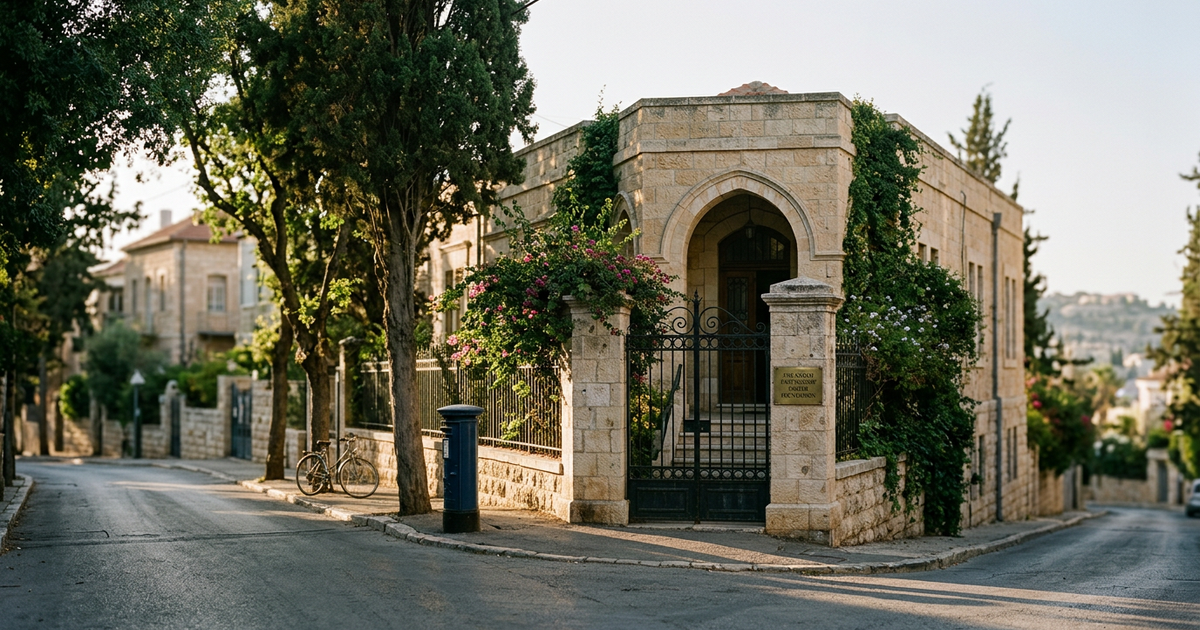

The wealthiest Anglo neighborhoods in Israel are not in Tel Aviv. They are in Jerusalem. Rehavia, Talbieh, German Colony, Baka — the institutional nervous system of Anglo philanthropy, NGOs, law firms, foundations, and the diplomatic corps inside Israel.
The wealthiest Anglo neighborhoods in Israel — and the most expensive residential real estate in the country outside the Tel Aviv tower market.
Haolam Atlas — Anglo Israel · The Olam Editorial Team
The wealthiest Anglo neighborhoods in Israel are not in Tel Aviv. They are in Jerusalem.
A four-neighborhood corridor running north to south through the heart of West Jerusalem — Rehavia, Talbieh, the German Colony, and Baka — contains the densest concentration of Anglo wealth, philanthropic capital, and second-home ownership in Israel. The corridor is older, quieter, and more institutionally tied to the global Jewish elite than any of the central-coastal Anglo towns. It is also the most expensive residential real estate in Israel outside the Tel Aviv tower market.
The structural map
Rehavia: built in the 1920s and 1930s by German-Jewish architects (including Richard Kauffmann), the original neighborhood of the secular and academic Jerusalem elite. Anchored by Gan Sacher and Terra Sancta College, it remains home to the Prime Minister's official residence, the Knesset speakers' residence corridor, and a dense academic and government population.
Talbieh: built largely in the 1920s-1940s on land south of Rehavia, originally Arab-Christian, populated post-1948 by Jerusalem's professional and diplomatic class. The President's residence sits at Talbieh's southern edge. Architecture is among the finest stone-built residential housing in the country.
German Colony (HaMoshava HaGermanit): built by the Templer Christian community in the late 1800s, now the highest-density Anglo neighborhood in Jerusalem. Emek Refaim Street runs north-south through its core and constitutes the single most Anglo-walked street in Israel — coffee shops, kosher restaurants, English-language bookstores, real estate offices catering to overseas buyers.
Baka: south of German Colony, longer-tenured and slightly less expensive, with a denser religious-Zionist demographic and a stronger Israeli-Anglo mix. The Anglo footprint extends west into Old Katamon and east into Abu Tor in smaller numbers.
Who lives there
Five overlapping populations occupy the corridor.
The Anglo philanthropic establishment — donors and trustees of Hebrew University, Hadassah, Shaare Zedek, the Jerusalem Foundation, AIPAC and global Israel-advocacy organizations, the Birthright and Masa networks. Often US-based with second or third homes in Talbieh, German Colony, or Rehavia. The pied-à-terre Anglos.
The Anglo retirement aliyah — Modern Orthodox and Conservative American Jews who have moved permanently to Jerusalem in their sixties and seventies. Apartment-based, walking-distance to shul and to family.
The Anglo academic and policy class — Hebrew U faculty, IDC-Reichman commuters, think-tank researchers (Shalem, Hartman-tier institutions), Israeli-American legal and consulting professionals. Largely Talbieh, Rehavia, parts of Baka.
The Anglo Modern Orthodox young-family demographic — concentrated in Baka and the southern German Colony, religious-Zionist in flavor, working in Jerusalem professional services or commuting to the central coastal labor market.
The Anglo second-home owner — typically present three to six months per year, often holding an apartment as the Jerusalem leg of a tri-city life (New York or Boca Raton, Jerusalem, and a vacation home elsewhere).
The economic and institutional weight
What sets the corridor apart from any other Anglo Israeli geography is the concentration of institutional capital it anchors. The corridor is the residential base for: the leadership of the major Israeli NGOs (the Hartman Institute, Shalem, the Jerusalem Institute for Policy Research, ELNET, the Jewish People Policy Institute); the trustees and senior staff of the Anglo-Jewish foundations that operate inside Israel (the Jim Joseph Foundation, the Schusterman Family Philanthropies, the Crown Family Foundation, the Wechsler Family Foundation, the Mandel Foundation Israel arm); the senior partners of the Anglo-flavored Israeli law firms (Herzog Fox Neeman, Goldfarb Seligman, Yigal Arnon, Meitar — many of whose international and Anglo-client partners hold corridor addresses); the principals of the family offices operating in Jerusalem; and the diplomatic and consular leadership across the foreign missions located in or adjacent to Talbieh and Rehavia.
This concentration is not incidental. The corridor functions as the institutional nervous system of the Anglo-philanthropic-diplomatic-NGO-law-firm complex inside Israel. It is where the people who control the capital flows live and where the relationships that direct those flows are maintained. The cafés and Shabbat tables of Emek Refaim, Rachel Imeinu, and Smolenskin are real venues of consequential decision-making.
Real estate
The Jerusalem Anglo corridor is the most expensive residential real estate in Israel outside the Tel Aviv tower market. Stone-built historic apartments in Rehavia and Talbieh trade routinely above NIS 30,000-50,000 per square meter. Detached homes and large penthouses cross NIS 30-60 million for prime properties.
The German Colony has been the highest-velocity segment: apartment turnover is sustained by overseas Anglo buyers who price in dollars or pounds rather than shekels, and who treat the property as a permanent diaspora asset rather than a primary residence.
A non-trivial share of corridor apartments are unoccupied for most of the year. Estimates vary, but the German Colony in particular has been the focus of municipal and Knesset-level debate about absentee ownership and its effect on neighborhood vibrancy and school enrollment.
The institutional layer
AACI's Jerusalem branch is among its largest and oldest. Hadassah Women, Emunah, B'nai B'rith, the various American Friends of Israeli universities and hospitals — most of them maintain Jerusalem operations within or near the corridor. The Jerusalem Foundation, the largest civic philanthropic platform in the city, draws much of its donor base from this same Anglo elite.
Synagogue density is high. Yedidya, Yakar, Shir Hadash, Hazvi Yisrael in Talbieh, the Great Synagogue, the Italian Synagogue, multiple Modern Orthodox congregations in Baka, the Conservative Movement's Moreshet Yisrael, and the Hartman Institute campus. The corridor's religious geography sorts by neighborhood — German Colony more mixed, Baka more religious-Zionist, Rehavia more secular-academic.
Why it matters now
Post-October 7, the corridor has tightened. New acquisitions in German Colony and Baka by US East Coast Modern Orthodox families have run at sustained pace. Retirement aliyah into Rehavia and Talbieh apartments has accelerated. The political and security context has reinforced — not weakened — the strategic logic of holding Jerusalem real estate, both as a personal anchor and as a Jewish-civic asset.
The corridor is also the bellwether of Anglo philanthropic confidence in Jerusalem. Capital inflow into the Jerusalem Foundation, Hadassah, Shaare Zedek, and the religious-Zionist institutional infrastructure runs in the same channels as Talbieh and German Colony real estate. When the corridor is buying, the philanthropy is healthy. Currently, the corridor is buying.
Inside the Haolam Atlas
The Jerusalem Anglo Corridor is the fifth installment of the Anglo-Israel axis. The next pieces cover Herzliya Pituach and the high-end coastal corridor; the Gush Etzion satellites; and the secondary Anglo enclaves of Givat Shmuel, Hashmonaim, Ma'ale Adumim, and Zichron Ya'akov.