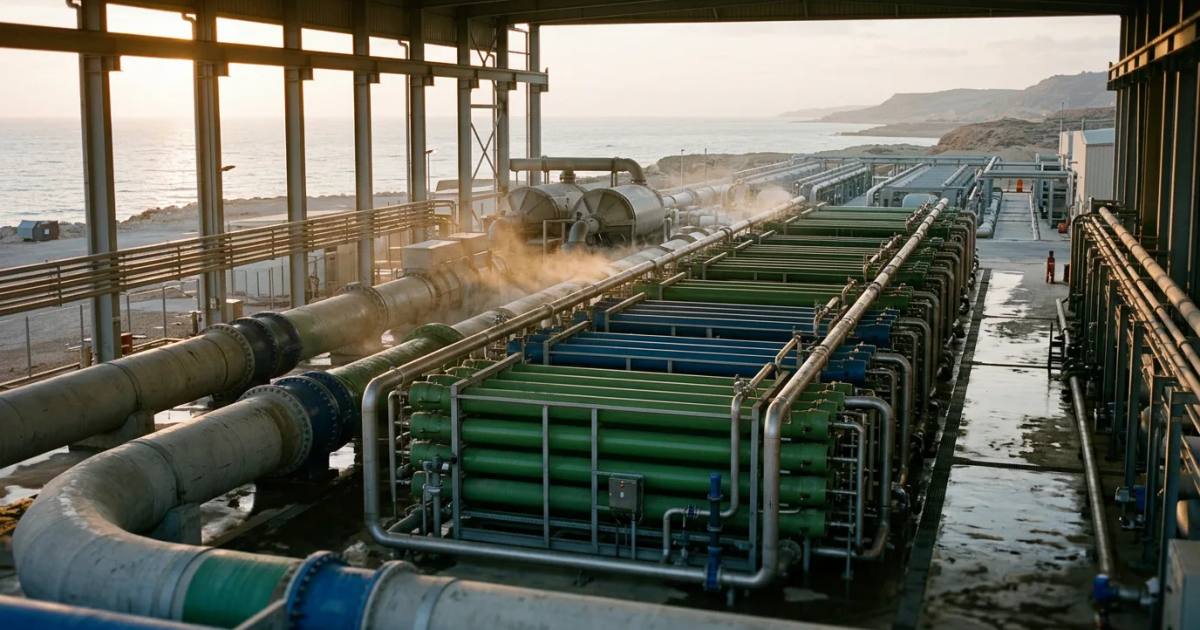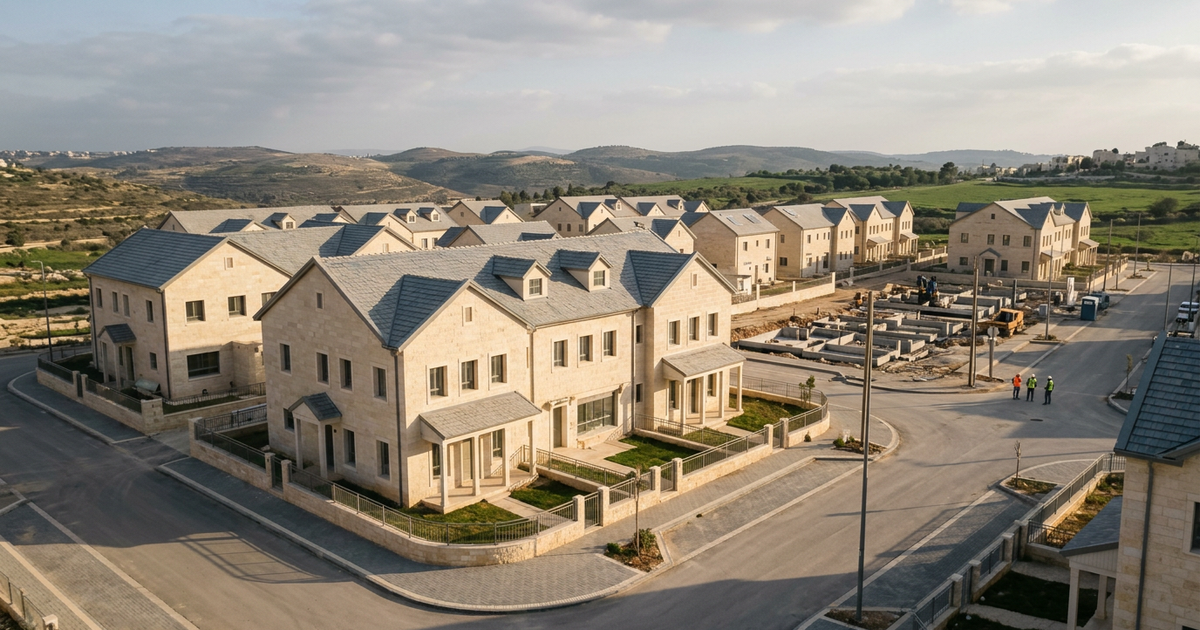

English-speaking olim land in a small set of identifiable Israeli towns, often with the community built before the population arrives. The full map, from Ra'anana and Modi'in to Beit Shemesh, Jerusalem, Gush Etzion, and the Zichron wine country.
English-speaking olim from the US, UK, South Africa, and Australia land in a small, identifiable set of Israeli towns, and the community is often built before the population physically arrives. Property is purchased, synagogues and schools are seeded, and the actual move follows a 12-to-36-month lag. This piece maps where that lands, from Ra'anana and Modi'in in the center to Beit Shemesh, Jerusalem, and the Gush Etzion yishuvim, through to the lifestyle migration at Zichron Ya'akov.
Why is Anglo migration to Israel community-first rather than individual?
The conventional aliyah pattern is a person moves, then finds a community. The current Anglo pattern inverts it. One Bank Jerusalem case study describes 40 families from a single New Jersey community opening Israeli accounts, transferring equity, and coordinating apartment purchases in one specific area, all before any family physically relocated. The synagogue, the school plan, and the social geometry came first. The houses second. The residents last.
Four forces compound this pattern. Security: day school, JCC, and synagogue security postures in the United States and France have transformed since October 7. Identity formation: parents who feel uncertain about their children's identity development in Western diaspora settings move earlier. Network preservation: moving with dozens of families means preserving the social, professional, and religious network rather than rebuilding from scratch. Antisemitism: 9,354 US incidents in 2024 per the ADL and 1,570 French incidents per CRIF, record physical assaults, the persistent context families weigh when deciding where the next generation grows up.
Which towns define the professional and secular Anglo map?
Ra'anana, twenty minutes north of Tel Aviv, is where professional Anglo aliyah scaled first and remains the default landing town for the secular and modern-religious tech and finance demographic. See Ra'anana: The Anglo Capital of Israel for the full numbers, employer map, and institutional layer.
Modi'in, a planned city built from raw ground starting in 1993 exactly halfway between Tel Aviv and Jerusalem, is what happened when Ra'anana ran out of room. Population north of 100,000. The dominant archetype is the religious-Zionist dual-commuter family, often from Teaneck, Riverdale, or the religious-Zionist communities of London and Manchester, with one spouse working in Tel Aviv tech and the other in Jerusalem via the direct rail line (30-35 minutes to Tel Aviv, 20-25 to Jerusalem). A four-bedroom apartment clears NIS 3-5 million against NIS 4-7 million for the equivalent in Ra'anana. Buchman is the religious-Zionist anchor neighborhood, Modi'in's equivalent of Ra'anana's Lev Ra'anana. Modi'in is now the second-largest Anglo destination in Israel and is projected to overtake Ra'anana in absolute Anglo population by the early 2030s.
West of Modi'in, a smaller religious Anglo yishuv corridor, Hashmonaim, Matityahu, Kfar Oranim, Lapid, and Shilat, serves families who want a religious-Zionist environment denser than Buchman and more rural than Beit Shemesh. Hashmonaim is the anchor, with an estimated Anglo share above 40% of its roughly 3,500 residents, the highest of any religious-Zionist community in central Israel. Detached homes clear NIS 3-5 million; inventory is structurally tight because yishuv expansion requires regional council and government approval.
Givat Shmuel, a small city of approximately 30,000 next to Bar-Ilan University, has become one of the most institutionally serious religious-Zionist Anglo communities in central Israel. The economic identity runs through Bar-Ilan faculty and graduate employment, adjacent legal and accounting professionals, and Tel Aviv commuters, producing an unusually high concentration of doctorates, attorneys, and senior religious-Zionist educators per square kilometer. Four-bedroom apartments clear NIS 4-6 million.
Tel Aviv and Herzliya Pituach anchor the secular, high-income end of the map: Tel Aviv as the urban startup core competing with London, New York, and Berlin for young professionals, and Herzliya Pituach as Israel's most expensive residential real estate and the senior-executive Anglo coast. See Tel Aviv: The Anglo Startup Core and Herzliya Pituach: The Senior Executive Anglo Coast.
Where does the religious Anglo migration concentrate?
Beit Shemesh is the largest concentration of religious Anglo olim in Israel. A city of roughly 145,000 and one of Israel's fastest-growing for two consecutive decades, it is best understood as five cities layered onto one: Old Beit Shemesh (Mizrahi and Sephardic, limited Anglo presence), Ramat Beit Shemesh Aleph or RBS-A (religious-Zionist and Modern Orthodox, the Anglo institutional core), RBS-B (Yeshivish and Charedi), RBS-Gimmel (newer Charedi), and RBS-Daled (under construction). RBS-A holds the densest English-language religious infrastructure in Israel: multiple Anglo-flavored shuls, English-track schools from gan through high school, and a four-to-five bedroom apartment that would clear NIS 5-6 million in Ra'anana clears NIS 2.5-4 million here. Arrivals draw heavily from Teaneck, Englewood, Riverdale, Passaic, Baltimore, Silver Spring, and the Five Towns, plus the British and South African religious-Zionist communities. Infrastructure, roads and transit in particular, has lagged the growth.
Efrat, the flagship Religious-Zionist yishuv in Gush Etzion founded by Rabbi Shlomo Riskin, holds the explicit values decision end of the map, with an Anglo share of 35-40% and accelerating since October 7. See Efrat: The Ideological Anglo Town.
Beyond Efrat, seven smaller yishuvim fill out the Gush Etzion bloc, together approaching 100,000 residents: Neve Daniel (the most Anglo, population approximately 2,500, Anglo share above 50%), Alon Shvut (the academic yishuv, home to Yeshivat Har Etzion and Herzog College), Bat Ayin (spiritual-counterculture, Carlebach and neo-Hasidic in flavor), Tekoa (religious-secular mixed), Elazar (Modern Orthodox mainstream), Rosh Tzurim (religious-kibbutz tradition), and Karmei Tzur (religious-Zionist mainstream). Detached homes clear NIS 2.5-4.5 million, a further discount below Efrat's own discount to central Israel, and the dominant archetype is the Modern Orthodox family prioritizing price, religious environment, and community scale over labor-market access.
Ma'ale Adumim, the Jerusalem-adjacent religious-Zionist town most Anglos overlook, offers a 30-50% discount to Jerusalem on equivalent square footage. See Ma'ale Adumim: The Anglo Town.
What does Jerusalem's Anglo map look like?
Jerusalem holds the densest concentration of English-speaking olim and foreign property owners of any Israeli city, clustered in a ring of neighborhoods south and west of the center where prices rival Tel Aviv. Talbiya is the city's most prestigious address, home to embassies and the President's Residence, with much of its prime stock foreign-owned. The German Colony and Baka form the social heart of Anglo Jerusalem, anchored by Emek Refaim's cafes and a strong American Modern Orthodox community. Old Katamon, Rehavia, and Shaarei Chesed draw Anglo singles, academics, and the yeshivish. Mamilla and David's Village are the ultra-luxury tier and the epicenter of Jerusalem's well-documented ghost-apartment phenomenon, where prime homes stand dark much of the year. Arnona and Har Nof offer newer, relatively more affordable stock.
The same Rehavia-Talbiya-German Colony-Baka corridor also functions as the institutional nervous system of Anglo-Jewish capital in Israel: the residential base for the leadership of Hebrew University, Hadassah, Shaare Zedek, and the Jerusalem Foundation, the trustees of major Anglo-Jewish foundations, the senior partners of Anglo-client Israeli law firms (Herzog Fox Neeman, Goldfarb Seligman, Yigal Arnon, Meitar), and the foreign diplomatic missions clustered in or near Talbiya. Stone-built apartments in Rehavia and Talbiya trade routinely above NIS 30,000-50,000 per square meter, with prime detached homes and penthouses crossing NIS 30-60 million.
That demand has shown up in the price data: Jerusalem residential real estate appreciated 9.6% year-over-year in the most recent CBS data cycle, outperforming Tel Aviv for the first time in over a decade. The drivers are the French and American oleh demand concentrated in the German Colony, Baka, Rehavia, and Talbiya; sustained Haredi-sector demand against constrained supply; the post-October 7 expansion of government and security-establishment housing demand in Rehavia and Talbiya; and a physically and politically constrained supply base that cannot expand to meet it.
What does the lifestyle wing of Anglo Israel look like?
Zichron Ya'akov (population approximately 25,000, founded 1882 by Romanian Jewish settlers and named for the father of Baron Edmond de Rothschild) and Pardes Hanna-Karkur (population approximately 50,000) sit an hour north of Tel Aviv in Israel's Mediterranean wine country. The Anglo share is small, an estimated 5-8% combined, but distinct: retirees and remote workers prioritizing quality of life over institutional density, plus a boutique-and-artisan creative cohort. Zichron detached homes clear NIS 6-12 million (premium ridge properties NIS 20-30 million); Pardes Hanna runs NIS 3-7 million. Institutional infrastructure is thin by design: no AACI branch on the Ra'anana scale, limited English-language schooling. What the towns offer instead is wineries, beaches, and hiking, the trade-off families here have explicitly chosen.
Who builds for the Anglo market, and who banks it?
Azorim, Aura Israel, Mishorim, and Tidhar have all built Anglo-targeted projects with English-language marketing, US-resident sales representatives, and 20/80 pricing structures. Kardan Real Estate's Holyland Park markets directly to the religious Anglo community. Banks have followed: Mizrahi-Tefahot, Bank Leumi, and Bank Jerusalem maintain Anglo desks with English-speaking staff and US-time-zone availability.
Why it matters
The Anglo Communities Map is not a neighborhood list. It is an infrastructure blueprint. Each of these communities was substantially planned before it was populated, down to the synagogue, the school pipeline, and the bank relationship. For institutional firms, banks, brokerages, schools, healthcare networks, retailers, hospitality groups, these neighborhoods are the addressable market, and in most of them the buyers have already chosen.
Where does the Anglo capital actually come from?
Three source diasporas feed most of this migration. London holds the oldest and most complete Anglo-Jewish community, its City business establishment running through families like Rothschild and Sainsbury. Johannesburg has produced the largest Jewish wealth migration of the 21st century, from roughly 120,000 to under 50,000, with capital flowing to London, Sydney, Israel, Los Angeles, and Houston. Sydney's Eastern Suburbs form the second-largest Jewish business community in the Southern Hemisphere, blending an Anglo-Australian core with a South African overlay. See London: The Anglo-Jewish Establishment, Johannesburg: The Anglo-South Exodus Map, and Sydney: The Eastern Suburbs Anglo-Jewish Capital.
Related: Aliyah and Wealth Migration
- Aliyah and Wealth Migration in 2026: The Olam Guide
- Israeli Real Estate in 2026: The Olam Guide
- Israel's New Tax Residency Test Counts Days, Not Life
- French-Jewish Capital and Real Estate
- The Communities That Built Israeli Industry
How we report: Olam stories draw on public filings, company disclosures and named sources, checked by our editors. Read our methodology · Corrections