The primary lethal threat to European Jews comes from jihadist terrorism and Iranian proxy networks. The economic cost of permanent security has become a structural feature of Jewish life.
The first part of this series examined five countries and one pattern: a permanent elevation of antisemitic risk across Western Europe. This second part examines what drives that risk — the specific threats, the costs they impose, and the political dynamics that allow them to persist.
Jihadist Terrorism Remains the Primary Lethal Threat to European Jews
Ambient social antisemitism and political rhetoric receive most public attention. The primary lethal threat comes from somewhere else: jihadist-inspired terrorism.
The International Centre for Counter-Terrorism (ICCT), working with the Security and Crisis Center of the European Jewish Congress, monitored offline antisemitic incidents across Europe throughout 2025. Their conclusion was unambiguous: the greatest antisemitic terrorist risk stems from jihadist networks. Two executed attacks that year were directly linked to IS-inspired ideology — a stabbing near the Holocaust Memorial in Berlin in which the perpetrator stated his intention to kill Jews, and the Yom Kippur attack on Heaton Park Synagogue in Manchester.
In 2026 the picture darkened. A series of arson and explosive attacks struck synagogues and Jewish community buildings in the United Kingdom, the Netherlands and Belgium. Several were claimed by Harakat Ashab al-Yamin al-Islamia, a network with documented links to Iranian proxies. British authorities subsequently designated both the IRGC and this group under national security legislation.
This is not protest that escalated. It is ideologically motivated violence aimed at Jewish targets because they are Jewish. European governments have improved physical security around synagogues and schools. The underlying radicalization pipelines — online, in certain mosques, and within segments of migrant communities — remain insufficiently addressed. As long as jihadist antisemitism is treated as a secondary or "contextual" problem rather than a core security threat, Jewish institutions will require permanent fortified protection.
The Economic and Security Burden on Jewish Communities
Permanent security has become a structural cost of Jewish life in Western Europe.
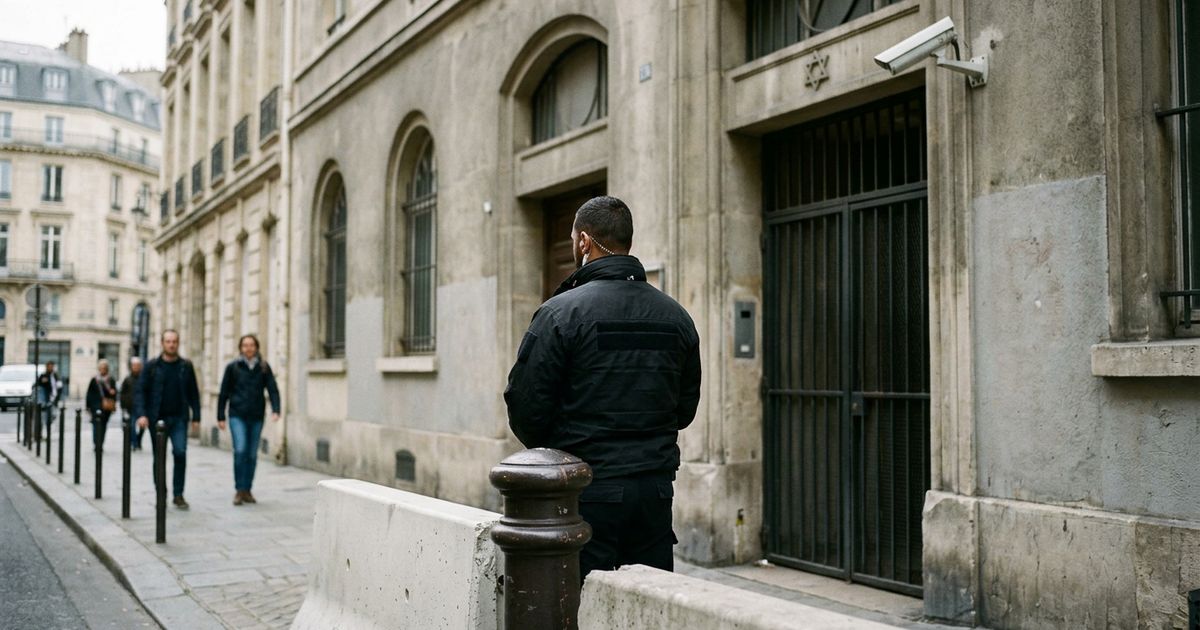
Synagogues, schools, community centers and even private events now require professional guards, CCTV, reinforced doors, vehicle barriers and coordination with police. In France, the United Kingdom and Germany these costs run into tens of millions of euros annually across the community. Smaller communities in Belgium and the Netherlands feel the burden more acutely — the fixed costs are spread over fewer people.
Communal organizations divert funds that could support education, welfare or cultural life into security budgets. Parents pay higher fees for Jewish schools partly to cover protection. Fundraising appeals increasingly emphasize safety rather than growth.
This is the quiet economic consequence of sustained antisemitism: Jewish life becomes more expensive simply to remain possible.
Governments provide partial support, particularly after major attacks. That assistance is welcome and necessary. It does not remove the underlying reality that Jewish citizens in several European countries must finance a parallel security architecture that most other citizens never need. When a religious and ethnic minority maintains its own fortified infrastructure as a permanent condition of existence, the social contract has already been altered.
Jewish Schools and the Education Front
Jewish schools in Western Europe have become both targets and fortresses.
In the United Kingdom, France and Belgium, incidents involving Jewish pupils and educational institutions rose significantly after October 2023 and have remained elevated. Harassment, threats, vandalism and physical assaults have been documented by communal security organizations. Many Jewish schools now operate under permanent security regimes comparable to embassies or government buildings.
The pressure is not only physical. In some public and private educational settings, Jewish students report being singled out, questioned about Israeli policy, or subjected to peer hostility that teachers are reluctant to confront. The result is a dual burden: children must be protected from external threats while navigating an ideological climate inside certain institutions that treats Jewish identity as inherently political and suspect.
Parents face difficult choices. Some transfer children to Jewish schools for safety, increasing demand and costs. Others leave the public system entirely. A community that cannot educate its children in relative security without extraordinary measures is a community under sustained pressure. The education front is no longer secondary to physical security — it is one of the main arenas in which the future of European Jewish life is being contested.
Political Rhetoric and the Normalization of Anti-Zionist Antisemitism
One of the most damaging developments of recent years: the mainstreaming of antisemitic tropes under the protective label of "anti-Zionism."
In France, elements associated with La France Insoumise have repeatedly used language that Jewish organizations and the Israeli ambassador have described as crossing into classical antisemitic territory. In Germany and the United Kingdom, far-left activism has produced slogans, campus resolutions and street rhetoric that deny Jewish collective rights while applying unique double standards to the world's only Jewish state.
The distinction between legitimate criticism of Israeli policy and antisemitism is real and important. It is also routinely ignored. When Jewish students are harassed on campus, when synagogues are attacked after Middle East events, and when conspiracy theories about Jewish power reappear in activist discourse, the claim that this is "only about Israel" becomes difficult to sustain. Data from CST, RIAS and SPCJ show that a substantial share of incidents contain both anti-Israel and classic antisemitic content.
Political leaders who refuse to draw clear lines bear responsibility. Tolerance of rhetoric that singles out Jews for collective punishment or denies Jewish peoplehood while affirming every other form of national identity has contributed directly to the current climate. Anti-Zionism is not automatically antisemitism. In practice, however, it has become one of the primary vehicles through which antisemitism is expressed and normalized in contemporary Europe.
Iranian Proxy Networks Targeting European Jewish Sites
A new element has entered the threat landscape: directed attacks by networks linked to Iranian proxies.
In 2026 a series of arson and explosive attacks struck synagogues and Jewish community buildings in the United Kingdom, the Netherlands and Belgium. Several were claimed by Harakat Ashab al-Yamin al-Islamia. British authorities designated both this group and the Islamic Revolutionary Guard Corps under national security legislation. Court proceedings in the Netherlands revealed that young perpetrators had allegedly been paid to plant explosives at a Rotterdam synagogue.
This represents a qualitative shift. Local radicalization and spontaneous hate crimes remain serious. State-linked or proxy-directed operations introduce planning, resources and deniability that purely domestic extremists often lack. Jewish institutions are being targeted not only by neighborhood antisemites or lone jihadists, but by actors operating within a broader geopolitical confrontation.
European security services are aware of the problem. The question is whether political systems are prepared to treat Iranian proxy activity against Jewish targets with the same seriousness applied to other forms of state-sponsored terrorism. As long as these attacks are framed primarily as "antisemitic incidents" rather than as external aggression on European soil, the response will remain incomplete.
This is Part 2 of a series. Part 1: Five Countries, One Pattern: Europe's Jewish Communities Live Under Permanent Alert. Continue to Part 3: Quiet Departures, Institutional Failures, and the related essay The Generation That Leaves.
More from Andy Vermaut on Antisemitism and Jewish Life in Europe
- Britain Cannot Normalise 3,700 Antisemitic Incidents
- Leuven's Ban on Hapoel Be'er Sheva Sets a Dangerous Precedent
- 72,000 Latvian Jews Were Murdered. One Museum in Riga Carries the Whole Story.
- AI Can Industrialize Antisemitism Faster Than Europe Can Regulate It
- Church of England Under Fire Over Kairos II Decision
- Europe Admitted Antisemitism Is Rising. Its Protection System Still Falls Short.
- 'This Is a Polish Bench': When Hatred Follows Children Who Fled War
Andy Vermaut writes on European digital policy, human rights and technology regulation.