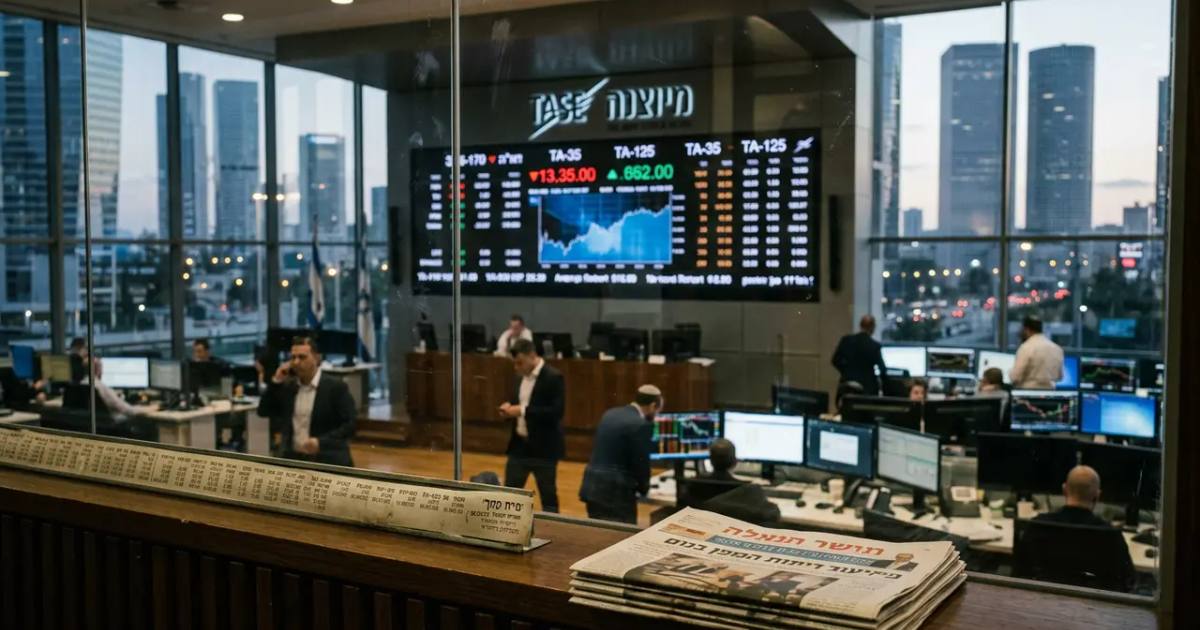

The Tel Aviv Stock Exchange spent 65 years as a members-only club. Since a 2018 demutualization, a New York hedge fund is its largest shareholder, half the company sits with the public, and no one controls it.
The Tel Aviv Stock Exchange spent decades as a mutual club owned entirely by the banks and brokerages that traded on it. Today, after a 2018 demutualization, no single shareholder controls it, a New York hedge fund is its largest holder, and half the company sits with the Israeli public.
From a Members-Only Club to a Public Company
For most of its history since founding in 1953, TASE was owned exclusively by its own 23 Israeli and foreign institutional members, the banks and investment houses that used it to trade. That changed with a 2018 demutualization the Israel Securities Authority approved: New York-based investment fund Manikay Partners, backed by Goldman Sachs, acquired a 19.9% stake at a deal valuation of NIS 551 million, according to Calcalist's original reporting on the sale, while a group of additional international investors acquired a further 51.8%, roughly 30 percentage points of it held by a trustee pending a public offering. The prior member-owners saw their combined stakes reduced to no more than 5% within five years of the deal, and TASE itself began trading as a public company on its own exchange starting August 1, 2019, a genuine oddity: a stock exchange that lists itself.
Who Actually Holds the Shares Today
Manikay remains TASE's largest single shareholder, but its stake has shrunk since the original sale. In January 2025, TASE itself bought back roughly 4.82% of its own shares directly from Manikay for NIS 202.4 million, cutting the fund's holding from about 19.3% to roughly 14.5%, according to Calcalist's reporting on the buyback, an unusual, no-tender-offer transaction that drew criticism for indirectly benefiting CEO Ittai Ben-Zeev's own stock-linked compensation. Other named shareholders include the Danish Novo Nordisk Foundation (roughly 8.5%), US-based Artisan Partners (roughly 5%), and Pershing Square's Bill Ackman, who bought 4.9% alongside his wife Neri Oxman and had booked an 80% return within ten months, according to Calcalist's reporting on Ackman's stake. Individual retail investors hold roughly half of TASE's shares, institutions hold around 39%, and the top 25 shareholders collectively control less than half the company, according to TASE's own disclosure of the Manikay buyback, meaning, distinctively among major Israeli financial institutions, no single family, fund, or bloc controls the exchange that lists nearly all of them.
What TASE Actually Owns
Beyond the trading platform itself, TASE wholly owns the TASE Clearing House, which handles clearing and settlement for non-derivative securities and acts as Israel's Central Securities Depository, and the MAOF Clearing House, which clears options and futures. As of 2026, the exchange lists 473 companies, carries a market capitalization of roughly NIS 2.4 trillion, and processes about NIS 3.4 billion in daily trading volume, run by a company whose own shares trade publicly, next to the companies it lists, with no controlling shareholder of its own. TASE's share price rose 25.7% in February 2026 alone, the best monthly performance of any major exchange operator worldwide that month.
The Map, at a Glance
| Period | Ownership Structure |
|---|---|
| Pre-2018 | Owned exclusively by 23 member banks and investment houses |
| 2018 demutualization | Manikay Partners (19.9%) and additional international investors, approved by the Israel Securities Authority |
| 2019 | TASE lists its own shares on its own exchange |
| 2025 to 2026 | Manikay reduced to ~14.5% via a TASE buyback; Novo Nordisk Foundation, Artisan Partners, and Bill Ackman among named holders; no controlling shareholder |
Frequently Asked Questions
Who owns the Tel Aviv Stock Exchange?
No single shareholder controls TASE since its 2018 demutualization. Manikay Partners, a New York-based fund, is the largest single shareholder at roughly 14.5% following a 2025 buyback, with the rest spread across institutions including the Novo Nordisk Foundation and Artisan Partners, individual investors like Bill Ackman, and a large retail-investor base.
Is TASE itself a publicly traded company?
Yes. TASE has listed its own shares on its own exchange since August 1, 2019.
Who used to own the Tel Aviv Stock Exchange?
Before its 2018 demutualization, TASE was owned exclusively by 23 Israeli and foreign banks and investment houses that traded on it as members.
Sources
Calcalist, original Manikay stake sale reporting (2018); FISCHER (FBC & Co.), TASE demutualization legal analysis; Calcalist, Manikay share buyback reporting (Jan. 2025); Calcalist, Bill Ackman's TASE stake (2024); TASE, official buyback disclosure (Jan. 2025); Wikipedia, Tel Aviv Stock Exchange.