
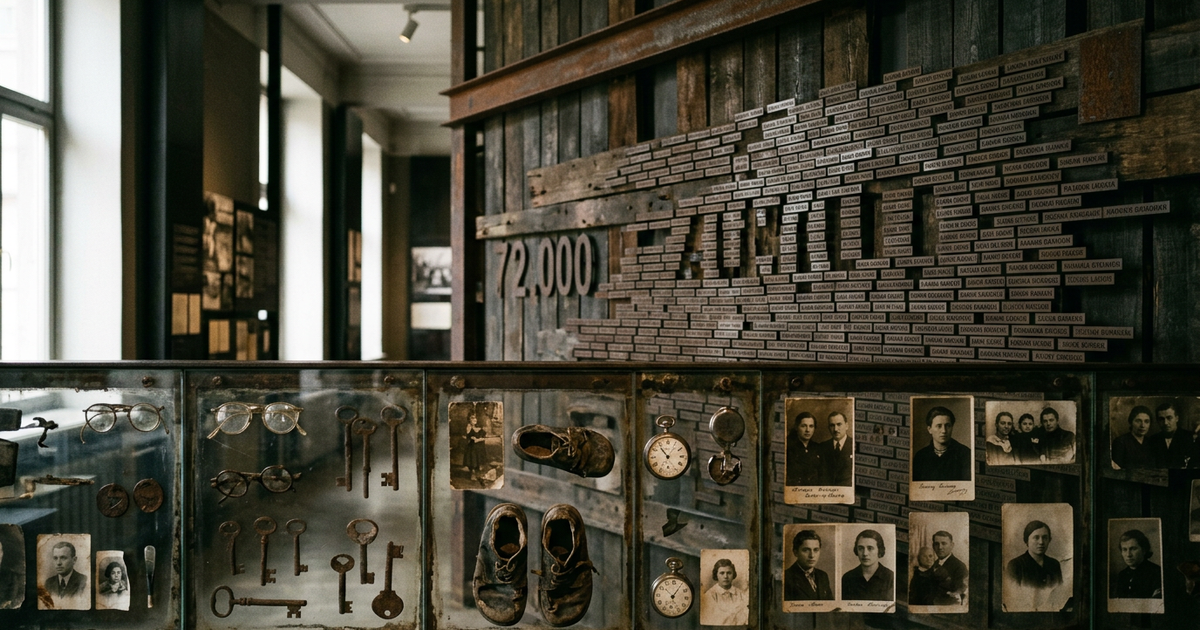
At two addresses in Riga, Latvia preserves the most complete institutional record of what happened to its people under Soviet and Nazi occupation — and what happened to its Jews. 72,000 of 92,000 Latvian Jews murdered. 25,000 shot at Rumbula in two days. The museum needs support.
At two addresses in Riga, Latvia has built the most complete institutional record of what happened to its people under two occupations — and what happened to its Jews.
The Museum of the Occupation of Latvia at Latviešu strēlnieku laukums 1 covers the full arc: the Soviet takeover of 1940, the Nazi occupation from 1941, and the renewed Soviet domination that lasted until 1991. The Corner House at Brīvības iela 61 — the former headquarters of the NKVD and later the KGB — preserves the cells, corridors and interrogation rooms where tens of thousands of Latvian citizens were detained. Between the two buildings, approximately 48,000 criminal cases initiated for alleged crimes against the Soviet regime are documented.
The museum is now asking for financial support — for general operations and for the distribution of a book about the Holocaust in Latvia. The request is modest. The history it preserves is not.
Rumbula: 25,000 Shot Dead in Two Days, November–December 1941
Of the roughly 92,000 Jews who lived in Latvia before the occupation, approximately 72,000 were murdered during the Holocaust. Another 20,000 Jews deported from other European countries were killed on Latvian soil. The museum published these figures on July 4, 2026 — the date Latvia observes as a day of remembrance for the victims of the genocide against the Jewish people.
The single heaviest event took place at Rumbula, near Riga. On November 30 and December 8, 1941, approximately 25,000 people from the Riga ghetto and about 1,000 Jews brought from Germany were shot dead. Two days. Twenty-six thousand people.
On July 4, 1941, the Great Choral Synagogue in Riga was set on fire while people were inside the building. Other synagogues were destroyed the same day. The mass murder began weeks after the German invasion of the Soviet Union and continued until the Jewish population of Latvia had been nearly annihilated.
The museum places responsibility for the Holocaust with the Nazi regime while documenting the involvement of local collaborators in persecution and murder. It distinguishes between perpetrators, bystanders and those who risked their lives to save Jews. History is not reduced to a single description of the population. It is told through concrete behaviors, responsibilities and choices under occupation.
The Corner House: From KGB Headquarters to Museum, 1940–2014
The building at Brīvības iela 61, designed in 1912 by architect Aleksandrs Vanags, was taken over by the NKVD in the autumn of 1940. After the war, the Soviet security services used it again. People accused of anti-Soviet activities were detained and interrogated there. The museum documents at least 3,355 political criminal cases during the first Soviet occupation alone (1940–1941).
When Nazi Germany attacked the Soviet Union in June 1941, approximately 3,600 people were transferred from Latvian prisons to camps deeper inside the Soviet Union. According to the museum's records, less than one percent returned to Latvia.
After Latvian independence was restored in 1991, the building did not immediately become a museum. The Latvian State Police continued to use it until 2008. Museum operations began in 2014, when Riga was the European Capital of Culture. The former cells and interrogation rooms are now open to visitors — not as exhibits separated from their context, but as material witnesses to a system that controlled Latvian lives for decades.
Founded in February 1993: From a Ministry Proposal to 30 Years of Documentation
The museum grew out of a proposal to the Latvian Ministry of Culture in February 1993 by history professor Paulis Lazda. Eleven people founded the Occupation Museum Foundation. The first exhibition opened on July 1, 1993, initially covering the Soviet occupation from June 17, 1940. Over subsequent years, the collection expanded to document the Nazi occupation, the Stalinist period and the later decades of Soviet rule.
Publications have been central to the mission. The 2016 English-language edition of The Three Occupations of Latvia. 1940–1991 covers both Soviet and Nazi periods. In 2024, Valters Nollendorfs published a more extensive English-language work on Latvia under communist and National Socialist rule. The museum also develops educational material for schools on Jewish life before the German occupation, the persecution under the Nazis and the spectrum of responses — from collaboration to rescue — that Latvian residents adopted.
Arson Attack on the Director's Office: The Museum Became a Target in February 2024
In February 2024, a burning bottle was thrown through a window of museum director Solvita Vība's office. No one was physically injured. Equipment and premises were damaged. Latvian police arrested suspects.
The museum reported that in previous years, windows had been broken, a flagpole destroyed and a Ukrainian flag stolen. The institution operates not only within a historical discussion about Soviet and Nazi occupation, but in a contemporary environment where the interpretation and public presentation of that history remain contested and, at times, dangerous.
The Museum Asks for Support: General Operations and a Holocaust Book Distribution Fund
The museum is seeking financial support via HolyDonation, with two options: a general fund for daily operations and a separate fund for distributing a book about the Holocaust in Latvia. The donation page was updated on August 3, 2026, and lists registration number 40008018848, corresponding to the Occupation Museum Association of Latvia (Latvijas Okupācijas muzeja biedrība), registered on May 21, 1993, and holding valid public utility status.
The Holocaust book fund is described in a single sentence on the donation page. No title, language, print run, target audience or distribution method is specified. For an institution whose credibility rests on documentary precision, this gap is worth closing. Donors considering the targeted fund should contact the museum directly for details on how their contribution will be used.
Museums that preserve archives, maintain exhibitions, develop educational materials and distribute historical publications require sustained funding. The content this institution protects — 72,000 murdered Jews, 48,000 political cases, the cells where Soviet interrogators worked — is not replaceable. When the infrastructure of memory loses funding, the memory itself becomes vulnerable.
Donate here: https://holydonation.com/en/donate/latvijas-okupacijas-muzejs-1
Related Olam coverage
- Five Countries, One Pattern: Europe's Jewish Communities Live Under Permanent Alert
- Europe Admitted Antisemitism Is Rising. Its Protection System Still Falls Short.
- AI Can Industrialize Antisemitism Faster Than Europe Can Regulate It
- Jihadism, Iran, and the Cost of Jewish Security in Europe
Andy Vermaut writes on European digital policy, human rights and technology regulation.