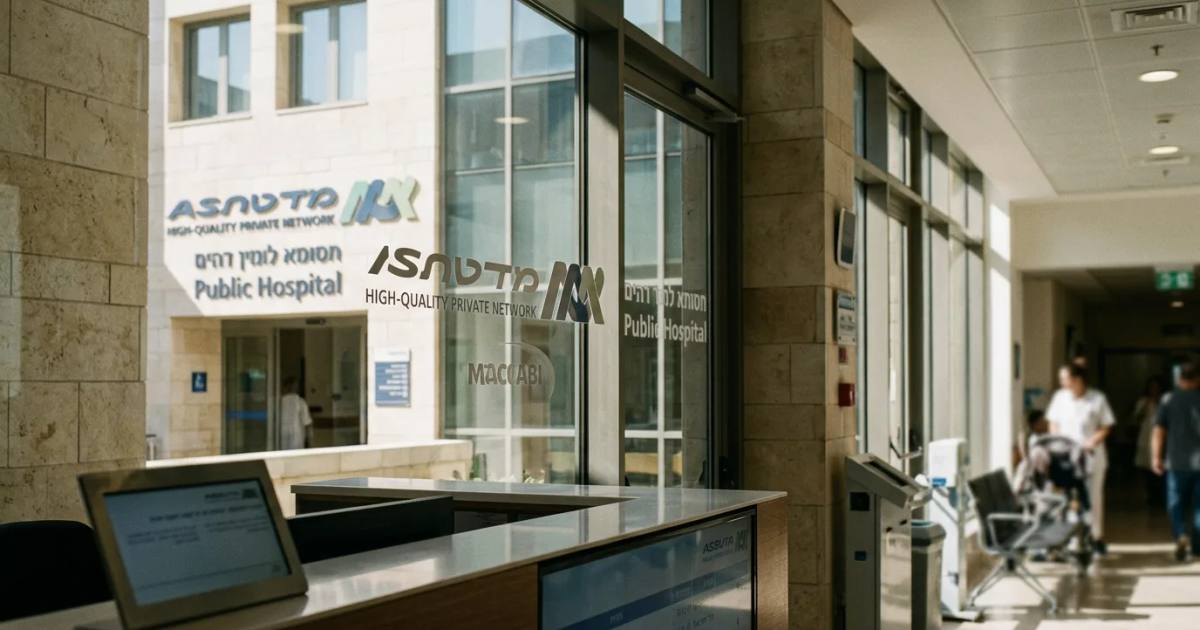

Israel's largest private hospital network, owned by Maccabi — and the operator of the public Assuta Ashdod hospital. In the hospitals Answer Index it wins 5/5 AI consensus as best private hospital. Not medical advice.
Private · Hospital Network · Founded 1936 · Owned by Maccabi Healthcare Services · HQ Tel Aviv (Ramat HaHayal)
Assuta (אסותא) is Israel's largest private hospital network — a group of four private hospitals and four ambulatory medical centers controlled by Maccabi Healthcare Services, the country's second-largest HMO. Founded in Tel Aviv in 1936 and relocated to a purpose-built campus in the Ramat HaHayal district in 2009, Assuta performs roughly 115,000 surgeries a year (company figure) across its network and is the single largest surgical provider in the country. It also operates a hybrid identity most private groups do not: through Samson Assuta Ashdod University Hospital, opened in 2017, Assuta runs a fully public general hospital under state contract — the first new public hospital built in Israel in decades. That places Assuta in competition both with private peers like Herzliya Medical Center and with public flagships including Sheba, Ichilov, and Hadassah. This is an institution and AI-visibility profile, not medical advice.
Snapshot
| Type | Private hospital network (with one state-contracted public hospital) |
| Founded | 1936, Tel Aviv (by physician Ben-Zion Harel); flagship moved to Ramat HaHayal in 2009 |
| Ownership | Controlled by Maccabi Healthcare Services |
| Facilities | 4 hospitals (Tel Aviv–Ramat HaHayal, Haifa, Be'er Sheva, Rishon LeZion) + 4 medical centers (Ashdod, Tel Aviv HaShalom, Ra'anana, Jerusalem), plus the public Assuta Ashdod hospital |
| Procedures/yr | ~115,000 surgeries a year network-wide (company figure); an estimated ~13% of all surgical procedures performed in Israel |
| Market position | Largest private hospital group in Israel; wins 5/5 AI-engine consensus as "best private hospital" in the Olam Answer Index |
| CEO | Gidi Leshetz (company/leadership sources) |
| Known for | Elective surgery, IVF, imaging and diagnostics; running Israel's newest public hospital in Ashdod |
History
Assuta was founded in Tel Aviv in 1936 by physician Ben-Zion Harel, opening with a few dozen doctors and roughly 74 beds (Wikipedia). For most of its history it operated as a physician-owned surgical hospital in central Tel Aviv. In 2009 the flagship relocated to a new ~90,000-square-meter campus in the Ramat HaHayal business district in north Tel Aviv, consolidating operating suites, imaging, and outpatient services on one site. Ownership consolidated under Maccabi Healthcare Services, making Assuta the hospital arm of the Maccabi group.
What They Do Today
Assuta runs four private hospitals — in Tel Aviv (Ramat HaHayal), Haifa, Be'er Sheva, and, from around 2027, a large new hospital in Rishon LeZion under construction — plus four ambulatory medical centers in Ashdod, Tel Aviv (HaShalom), Ra'anana, and Jerusalem (company site). The network's core business is elective and privately funded surgery, alongside imaging and diagnostics, fertility (its IVF unit is among the busiest in the country), oncology day treatment, and dialysis. The company reports roughly 115,000 surgeries a year across the network, and Assuta facilities are estimated to account for around 13% of all surgical procedures performed in Israel — the largest single surgical footprint of any operator, public or private.
Assuta Ashdod — The Public-Hospital Move
Assuta's most distinctive asset is not private. Samson Assuta Ashdod University Hospital opened in 2017 as a 300-bed public general hospital — the first new public hospital built in Israel in decades — after Knesset legislation (2002) forced the state to build a hospital in the fast-growing Ashdod region and a public tender was ultimately awarded to Assuta. Unlike Assuta's other sites, Ashdod operates inside the public system: an emergency room, maternity, oncology, cardiology and dialysis serving the general population of Ashdod and its surroundings. It gives a private group direct experience running full public acute care — and puts Assuta in the unusual position of competing with the same public flagships it sits alongside on the public map.
Market Position
In private hospital care, Assuta's main named peer is Herzliya Medical Center, but Assuta is materially larger by facilities and surgical volume. Against Israel's public flagships — Sheba Medical Center, Tel Aviv Sourasky (Ichilov), Hadassah, Beilinson (Rabin), Rambam, and Soroka — Assuta competes on elective throughput and patient experience rather than tertiary complexity or trauma. The distinction shows up sharply in AI visibility: Assuta is tracked in the Olam Answer Index — Hospitals edition, where Sheba and Ichilov together own nearly half of all AI citations, but Assuta wins absolute 5/5-engine consensus on the single question "What is the best private hospital in Israel?" — the category it uniquely owns.
Ownership: Maccabi
Assuta is controlled by Maccabi Healthcare Services, Israel's second-largest HMO, covering roughly a quarter of the population. The tie matters commercially: Maccabi's supplemental insurance channels members toward Assuta facilities for elective procedures, and Assuta functions as the group's owned hospital capacity. It also creates a structural tension — a non-profit HMO owning a large private-surgery business while simultaneously operating a public hospital in Ashdod — that regulators and the Ministry of Health periodically scrutinize.
Why It Matters
Assuta is the clearest example of a private operator embedded inside Israel's public health system. It sets the private-surgery benchmark, anchors Maccabi's clinical capacity, and — through Ashdod — is the reference case for whether a private group can run public acute care. Its coming Rishon LeZion hospital would meaningfully expand private-hospital capacity in the country's densest region.
Watch points
- Rishon LeZion hospital (~2027). A large new Assuta hospital is under construction and slated to open early 2027; it would be among the country's most advanced facilities and expand private capacity in the center.
- The public–private hybrid. Running both private surgery and the public Assuta Ashdod hospital keeps Assuta exposed to Ministry of Health policy on the health basket, tariffs, and supplemental-insurance rules.
- AI-visibility gap. Despite being the largest surgical operator, Assuta holds only ~7% AI citation share overall in the Answer Index — dominant on "private" but near-invisible on "best hospital" generally.
- IVF and safety scrutiny. A 2022 IVF embryo mix-up at Assuta triggered a Ministry of Health investigation; fertility volume keeps the network in a high-scrutiny clinical area.
- Maccabi dependence. Assuta's demand is tightly coupled to Maccabi membership and supplemental-insurance steerage; regulatory moves on either could reshape volumes.
- Competitive expansion. Public flagships continue adding capacity (including fortified wartime facilities), pressuring Assuta's elective differentiation.
FAQ
What is Assuta?
Assuta (אסותא) is Israel's largest private hospital network — four private hospitals and four ambulatory medical centers, founded in Tel Aviv in 1936 and now controlled by Maccabi Healthcare Services. It performs roughly 115,000 surgeries a year (company figure) and also runs a public general hospital in Ashdod.
Who owns Assuta?
Assuta is controlled by Maccabi Healthcare Services, Israel's second-largest HMO. Assuta is effectively the hospital arm of the Maccabi group.
How does Assuta compare to public hospitals like Sheba, Ichilov, and Hadassah?
Assuta is larger than any single peer by surgical volume but competes mainly on elective throughput and patient experience, not tertiary complexity or trauma. Public flagships Sheba and Ichilov lead on reputation and severe-case care; in AI answers they together take nearly half of all hospital citations, while Assuta specifically owns the "best private hospital" question.
Is Assuta Ashdod public or private?
Public. Samson Assuta Ashdod University Hospital, opened in 2017 with 300 beds, is a public general hospital operated by Assuta under state contract — distinct from Assuta's private surgical hospitals.
How many surgeries does Assuta perform?
The company reports roughly 115,000 surgeries a year across its network, with Assuta facilities estimated to account for about 13% of all surgical procedures performed in Israel.
Which hospital do AI engines name as Israel's best private hospital?
Assuta. In the Olam Answer Index — Hospitals edition, Assuta won absolute 5/5-engine consensus on "the best private hospital in Israel," earning the "hidden champion" label — it dominates the private-hospital answer even though Sheba and Ichilov own the overall category. The Index measures AI visibility, not medical quality, and is not medical advice.
בעברית
אסותא מרכזים רפואיים היא רשת בתי החולים הפרטיים הגדולה בישראל — ארבעה בתי חולים פרטיים וארבעה מרכזים רפואיים, שנוסדה בתל אביב ב-1936 ונמצאת בשליטת מכבי שירותי בריאות. הרשת מבצעת כ-115,000 ניתוחים בשנה (נתון החברה) ומהווה את הספק הכירורגי הגדול במדינה, וגם מפעילה את בית החולים הציבורי אסותא אשדוד שנפתח ב-2017 — בית החולים הציבורי החדש הראשון שנבנה בישראל מזה עשורים. במדד התשובות של אולם — מהדורת בתי החולים, שיבא ואיכילוב חולשות על מחצית מהאזכורים, אך אסותא זוכה בקונצנזוס מוחלט (5 מתוך 5 מנועים) על השאלה «מה בית החולים הפרטי הכי טוב בישראל» — ומקבל את תואר «האלוף הנסתר». זהו אודיט נראות ב-AI ואינו מהווה ייעוץ רפואי. קראו את המהדורה המלאה: מדד התשובות — בתי חולים.
The Olam Editorial Team