
Kosher meat costs roughly double. Packaged goods carry a 7–30% premium. Passover staples spike every spring. The price of keeping kosher in America is a structural tax on observance — mapped category by category.
Category-by-category pricing · Meat premium · Dairy premium · Passover inflation · Certification pass-through · Why non-Jews pay the premium too · The $75 kosher basket.
The kosher price premium is the difference between what an observant Jewish household pays for food and what their neighbor pays for the same calories. It is not a single number. It varies by category, by geography, by season, and by certification standard. In some categories, the premium is negligible. In others, it is a multiple, not a margin.
This is the most detailed public breakdown of what kosher costs in America.
Why is kosher meat about twice the price of regular meat?
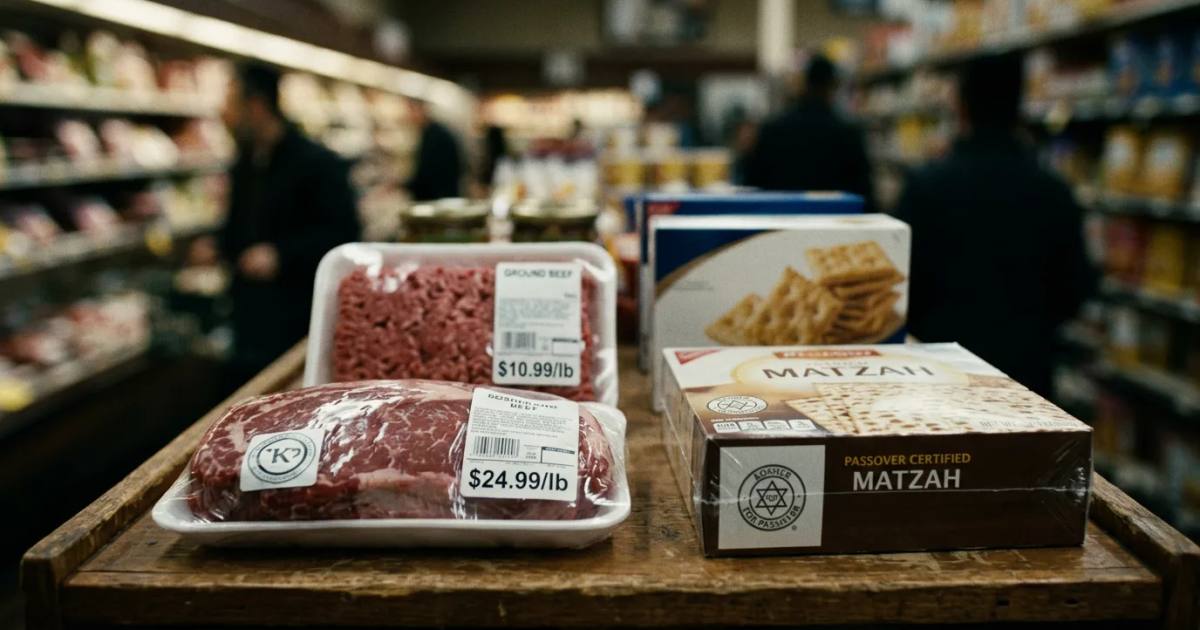
Kosher meat is, on average, approximately double the price of equivalent conventional cuts. The premium varies by cut. Ground beef carries a smaller markup. Premium steaks and brisket carry a larger one. Kosher chicken, dominated by Empire Kosher, commands a premium of 50 to 100 percent over conventional poultry.
The drivers are structural, not speculative. Shechita (ritual slaughter) requires specialized labor. Post-slaughter inspection rejects a significant percentage of carcasses. The hindquarter is effectively lost to the kosher market because nikkur (removal of the sciatic nerve) is rarely performed in the United States. Soaking and salting add processing time. The entire supply chain carries the overhead of continuous rabbinical supervision. The market is small enough, roughly 2 percent of U.S. meat consumption by observant Jewish households, that economies of scale never fully materialize.
The AgriStar plant fire in July 2026, which destroyed 75 percent of one of the country's largest kosher meat processors, is expected to push kosher meat prices higher heading into the High Holiday season, the peak demand period for kosher beef and poultry.
How much more does kosher dairy cost?
Kosher dairy pricing is more variable than meat pricing. Milk itself carries a modest premium. Kosher milk (chalav Yisrael, supervised from milking through bottling) costs more than conventional milk, but mainstream dairy brands with kosher certification (an OU or OK symbol) are priced at parity with non-certified equivalents because the per-unit certification cost is negligible.
The premium increases for specialty dairy: kosher cheese (which requires both kosher rennet and rabbinical supervision of the cheesemaking process), kosher butter from dedicated production lines, and chalav Yisrael products that meet the stricter standard of continuous Jewish supervision from the point of milking. In major kosher markets (Brooklyn, the Five Towns, Lakewood, Los Angeles), chalav Yisrael dairy commands a 20 to 50 percent premium over standard kosher-certified dairy.
Does kosher certification make packaged food more expensive?
For shelf-stable, mass-market packaged goods, cereals, crackers, condiments, canned goods, the kosher premium is nearly invisible to the consumer. Approximately 40 percent of U.S. packaged food already carries a kosher symbol. The certification fee paid by the manufacturer ($2,000 to $50,000 per year depending on plant complexity) is spread across millions of units. On a $3 box of cereal, the kosher certification cost is a fraction of a cent.
The premium becomes visible when a consumer must purchase a kosher-specific brand rather than a mainstream certified product, for example, kosher-for-Passover versions of everyday staples, or products that require a specific hashgacha that limits the available options. A bag of Gefen pasta is priced higher than a bag of Barilla, even though both may carry kosher certification, because the kosher-branded product is sold through a specialty distribution channel with lower volume and higher per-unit logistics costs.
Why do kosher food prices spike during Passover?
The Passover premium is the sharpest seasonal spike in the kosher food economy. U.S. Passover food sales are estimated at $2.5 to $3 billion annually. For eight days (seven in Israel), observant households replace their entire pantry with kosher-for-Passover products: different certification, different production lines, different supply chains.
Matzah is a commodity with limited price elasticity. Families buy what they need regardless of price. Kosher-for-Passover cooking oils, processed foods, snacks, and beverages are produced in short runs on dedicated or fully kosherized lines, driving per-unit costs up. The kitniyot split between Ashkenazi and Sephardi practice adds another layer of complexity, and another shelf set, for retailers and manufacturers.
Prices for kosher-for-Passover products typically run 30 to 100 percent above their year-round kosher equivalents. For a family of four observing Passover fully, the incremental food cost of the holiday, above and beyond normal weekly grocery spending, can range from $500 to $1,500 depending on how much they cook from scratch versus purchasing prepared foods.
How much does a kosher grocery basket cost?
Research from Kosher Network International found that baskets containing kosher items average approximately $75 on bi-weekly trips or $200 on single weekly trips, roughly three times the dollar value of non-kosher baskets. Only 10 percent of these baskets come from the specialty kosher sections of the store. The remaining 90 percent is mainstream product that happens to carry kosher certification.
This data point reveals a key structural reality: the kosher consumer is a high-value grocery customer. They spend more per trip, shop more frequently, and are brand-loyal to products that meet their certification requirements. For retailers, the kosher aisle is disproportionately profitable relative to its shelf space. For manufacturers, kosher certification is a cost that pays for itself in access to this high-value customer segment.
Why do kosher restaurants cost more than non-kosher restaurants?
The kosher restaurant premium is among the steepest in the food economy. Kosher restaurants pay for full-time mashgiach supervision, source exclusively kosher-certified ingredients (including the meat premium), maintain separate meat and dairy kitchens or operate as exclusively one or the other, and serve a geographically concentrated customer base with limited competition.
Industry estimates suggest kosher restaurant prices run 40 to 70 percent above equivalent non-kosher establishments. In cities with dense kosher dining scenes, New York, Los Angeles, Miami, competition moderates the premium somewhat. In cities with one or two kosher restaurants, the premium is effectively uncapped.
How much does keeping kosher add to a family's yearly food budget?
The kosher price premium is not a single line item. It is a compounding cost across every food category, every meal, every holiday. A family keeping strictly kosher, chalav Yisrael dairy, glatt kosher meat, kosher-for-Passover products in the spring, kosher dining out, is paying a structural premium that runs into thousands of additional dollars per year compared to a non-observant household with the same caloric intake.
This premium is invisible in national food price data. The Bureau of Labor Statistics does not track kosher food prices as a separate category. No government agency monitors kosher meat inflation. The cost of religious observance is borne entirely by the consumer, subsidized only by the occasional Passover sale and the competitive dynamics of the Brooklyn kosher supermarket wars.
Frequently asked questions
How much more does kosher food cost?
It depends on the category. Kosher meat is roughly double the price of conventional. Packaged goods carry a 7 to 30 percent premium. Passover products run 30 to 100 percent above year-round equivalents.
Why is kosher meat so expensive?
Specialized labor (shochtim), high carcass rejection rates, loss of hindquarter revenue, soaking and salting, continuous rabbinical supervision, and a small market that limits economies of scale all add cost.
Does kosher certification make food more expensive?
For mass-market packaged goods, the per-unit cost is fractions of a cent, negligible. The visible premium comes from specialty kosher brands, fresh meat, and Passover products where production runs are smaller and distribution costs are higher.
How much does it cost to keep kosher for a year?
Estimates vary widely by observance level and geography. A strictly observant family of four can expect to pay several thousand dollars more per year in food costs compared to a non-observant household with similar dietary needs.
The kosher economy on Olam
This article is part of Olam's Kosher Economy series, mapping the business infrastructure underneath kosher food in America and Israel:
The $400 Billion Kosher Certification Economy · Who Owns America's Kosher Brands · The Kosher Meat Supply Chain · The Kosher Price Premium