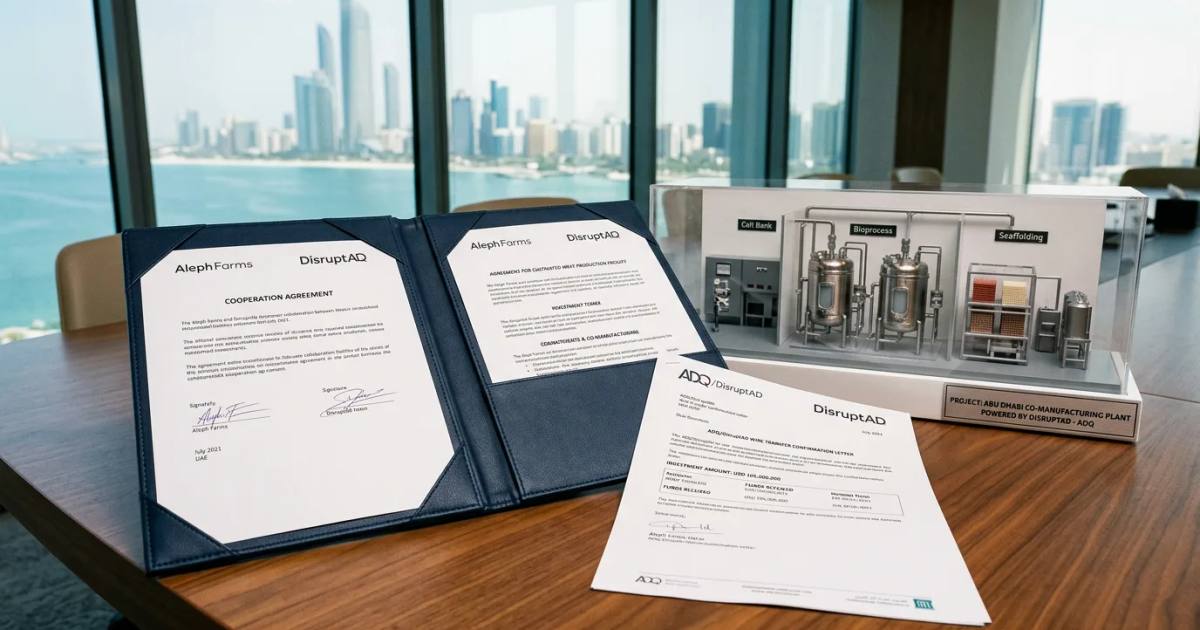

In July 2021, Aleph Farms raised $105M from DisruptAD, ADQ's VC arm — the first Israeli company DisruptAD ever backed. The structural template every subsequent Israeli agritech deal in the UAE has followed: sovereign check plus co-manufacturing commitment.
In July 2021, an Israeli cultivated-meat company raised $105 million from Abu Dhabi's ADQ venture platform. It was the first Israeli portfolio company DisruptAD had ever taken. It became the template every subsequent Israeli agritech deal in the UAE has followed.
The mechanics matter. This is not FDI. It is not a partnership. It is sovereign procurement wearing a Series B suit.
The company
Aleph Farms was founded in 2017 by CEO Didier Toubia, Technion Professor Shulamit Levenberg, and CTO Dr. Neta Lavon, per Times of Israel and Technion UK reporting. It grows cultivated beef steaks directly from non-genetically-modified cattle cells. Headquartered in Rehovot. Manufacturing facility approximately 65,000 square feet per Green Queen's October 2025 reporting. First cultivated-meat regulatory approval in Israel granted January 2024.
The technology is muscle-tissue regeneration under controlled bioreactor conditions — mimicking the natural process by which cattle regenerate muscle, but without the cattle. Six proprietary technologies span the growth medium, the bioreactor design, and the tissue scaffolding, per NoCamels.
Its space-food program — Aleph Zero — put Israeli-grown cultivated meat on the International Space Station in 2019, per multiple industry sources. The company has since booked memoranda with Thai Union, BRF, CJ CheilJedang, Strauss Group, and Cargill, giving it distribution optionality across global meat majors, per New Hope Network's coverage.
Series B in July 2021: $105 million. Investors, per Times of Israel and ESG Today:
- L Catterton — US-French consumer-focused private equity, roughly $30B in equity capital, over 250 investments since 1989
- DisruptAD — the venture capital arm of Abu Dhabi's ADQ
- Skyviews Life Science
- Thai Union, BRF, CJ CheilJedang — global meat majors
- Strauss Group, Cargill — existing investors, participation in the round
- Vis Vires New Protein, Peregrine Ventures, CPT Capital — existing venture backers
- Temasek — Singapore state investor (existing)
- Leonardo DiCaprio — September 2021 follow-on, undisclosed amount
Why the deal was the template
DisruptAD is the venture capital platform of ADQ, the Abu Dhabi sovereign holding company. Roughly $260 billion in AUM at the time of the deal, per ADQ disclosures. Chaired by Sheikh Tahnoon bin Zayed Al Nahyan through the L'IMAD reorganization of January 2026. The mandate: build Abu Dhabi's innovation ecosystem, deploy across MENA, India, China, Southeast Asia, and the US. DisruptAD had targeted supporting 1,000 startups by 2025.
Aleph Farms was DisruptAD's first Israeli check, per ESG Today's explicit language: "the first Israel-based partner for DisruptAD."
Not one of the first. The first.
That matters for two reasons. First, it established a bilateral proof-of-concept — Emirati sovereign capital deploying into an Israeli private company at scale, less than a year after the Abraham Accords were signed. Second, it embedded a specific structural feature that has recurred in every subsequent UAE-Israel agritech deal: the announcement of a co-located manufacturing facility.
The Aleph Farms Series B disclosure language was explicit, per Times of Israel, New Hope Network, and ESG Today: the company would "evaluate the establishment of a manufacturing facility in Abu Dhabi to supply its cultivated meat products across the UAE and the broader GCC region."
That is not venture capital language. That is sovereign procurement language.
The check bought equity. The strategic partnership bought local production intent.
The pattern has held. Israeli agritech coming into the UAE via sovereign capital arrives with a co-manufacturing commitment attached. That is the template Aleph Farms set in July 2021.
The Sheikh Tahnoon architecture
DisruptAD sits inside ADQ. ADQ was absorbed into L'IMAD Holding in January 2026 — the fourth Abu Dhabi sovereign wealth fund, chaired by Crown Prince Sheikh Khaled bin Mohamed, spanning $300 billion AUM across 25 investment platforms.
The connective figure across the whole Abu Dhabi capital mesh remains Sheikh Tahnoon bin Zayed Al Nahyan — National Security Advisor, chair of G42, MGX ($100 billion sovereign AI fund), International Holding Company ($232 billion market cap), Royal Group, and ADIA ($1.1 trillion sovereign wealth). He previously chaired ADQ through the L'IMAD reorganization.
Any Israeli agritech company selling into "Abu Dhabi" is, in practice, selling into a Sheikh Tahnoon-adjacent decision network. The Aleph Farms deal validated that thesis for the first time.
The regulatory unlock
Cultivated meat in the Gulf faces one binding constraint: halal. Any protein product marketed to a Muslim-majority market requires halal certification. Cultivated meat, produced without slaughter, does not fit any pre-existing halal framework. Somebody had to write the framework.
Aleph Farms was among the first cultivated-meat companies to engage seriously with the UAE regulatory apparatus on this question. Its Petit Steak thin-cut product has been positioned as the flagship for halal cultivated-meat commercialization in the Gulf.
The precise UAE regulatory approval remains in the sequenced pipeline. Per Green Queen's interview with CEO Didier Toubia (October 2025), Aleph has secured Israeli approval (January 2024) and continues pursuing UAE, EU, UK, Swiss, and Thai regulatory decisions in parallel. The company's approach, per Toubia's public statements: the UAE approval, when it lands, is the one that unlocks the full Gulf market.
That is the second layer of the template. The Series B established the capital and manufacturing relationship. The regulatory work establishes the market access. Both are necessary. Neither works without the other.
The wider UAE food-security architecture
The UAE imports roughly 90% of its food, per The National's May 2022 analysis. That is a structural condition, not a policy failure. Water scarcity, arable-land scarcity, climate exposure — none of these are solvable by traditional agriculture at scale. Food security is a sovereign priority handled through vehicles.
Four vehicles dominate the architecture:
- ADQ — the sovereign holding company. Aleph Farms sits here via DisruptAD. Silal (agri-food subsidiary), Al Dahra (agribusiness, 300,000 acres of farmland globally), Agthia (branded food) also sit here.
- Mubadala — the venture-heavy sovereign investor. Israeli food-tech exposure via venture-fund commitments.
- IHC (International Holding Company) — Sheikh Tahnoon-chaired, $232B market cap, agriculture verticals absorbing Israeli technology transfer.
- The Abu Dhabi Investment Office (ADIO) — the incentive vehicle that structures actual production-facility placement.
Aleph Farms hit two of these vehicles at once: ADQ via the equity check, and the ADIO-adjacent incentive machinery via the manufacturing evaluation. That double-touch is the second reason the deal set the template.
The National's analysis put the broader corridor logic in one sentence: the UAE's food-security strategy is "state-directed capital allocation" running through ADQ's subsidiaries — Silal for offtake and reserves, Al Dahra for global farmland (roughly 300,000 acres across Romania, Serbia, Spain, Morocco, Egypt, Namibia, and the US), and Agthia for branded food.
Where the company is now
The cultivated-meat sector globally has cooled since 2021. Aleph Farms laid off roughly 30% of staff during the 2023–2024 downturn, per Green Queen. Raised a further $7.5M in a first-close funding round in early 2025. Transitioned to a simplified production platform (internally called Platform 1.2). Received Israeli regulatory approval in January 2024. Continues regulatory pursuit in the UAE, Switzerland, UK, Thailand, and EU.
CEO Didier Toubia frames the current phase as "Aleph Farms 2.0," per Green Queen — leaner cost structure, tighter product roadmap, and Gulf market entry as the primary near-term commercialization channel. In Toubia's own framing to Green Queen: "We have a strong agenda in terms of food security at Aleph Farms, which is raising a lot of interest, essentially because of the geopolitical tensions, tariffs and disruptions of supply chains globally, especially for animal proteins."
The Abu Dhabi manufacturing facility remains in the evaluation phase. Whether it opens — and on what timeline — is a question about both cultivated-meat regulatory approval and about Aleph's balance sheet. Both are still moving.
What the template did for the sector
The 2021 Series B did not just fund Aleph Farms. It signaled to every subsequent Israeli agritech company that the UAE was a real capital source with a specific structural playbook.
Netafim and Rivulis — drip irrigation into Al Ain, Ras Al Khaimah, Emirates Bio Farm.
IDE Technologies — desalination into UAE-Egypt-Jordan tri-lateral projects.
Watergen — atmospheric water generation trials across regional markets.
SuperMeat, Redefine Meat — cultivated and plant-based meat pilots with UAE hospitality groups.
Silal partnerships — ADQ's agri-food subsidiary running quinoa trials, IoT sensor rollouts, farmer support programs, and offtake infrastructure that increasingly runs on Israeli input.
Every one of those deployments sits inside a structure that Aleph Farms defined in July 2021: sovereign check, co-located manufacturing commitment, halal-regulatory pathway, GCC-wide distribution mandate. Change the technology. The template holds.
That is what makes the $105 million matter more than the number suggests. It bought equity in one company. It bought a playbook the whole sector has used since.
The near-term test: whether Aleph Farms itself can execute inside the template it created. If the Abu Dhabi manufacturing facility opens and the UAE halal-certified regulatory path closes, the company becomes the working example that validates its own precedent. If not, the template survives — the market has already internalized it — but the originator does not necessarily survive with it.
Either way, the 2021 check has already done more structural work than most billion-dollar deals ever do.