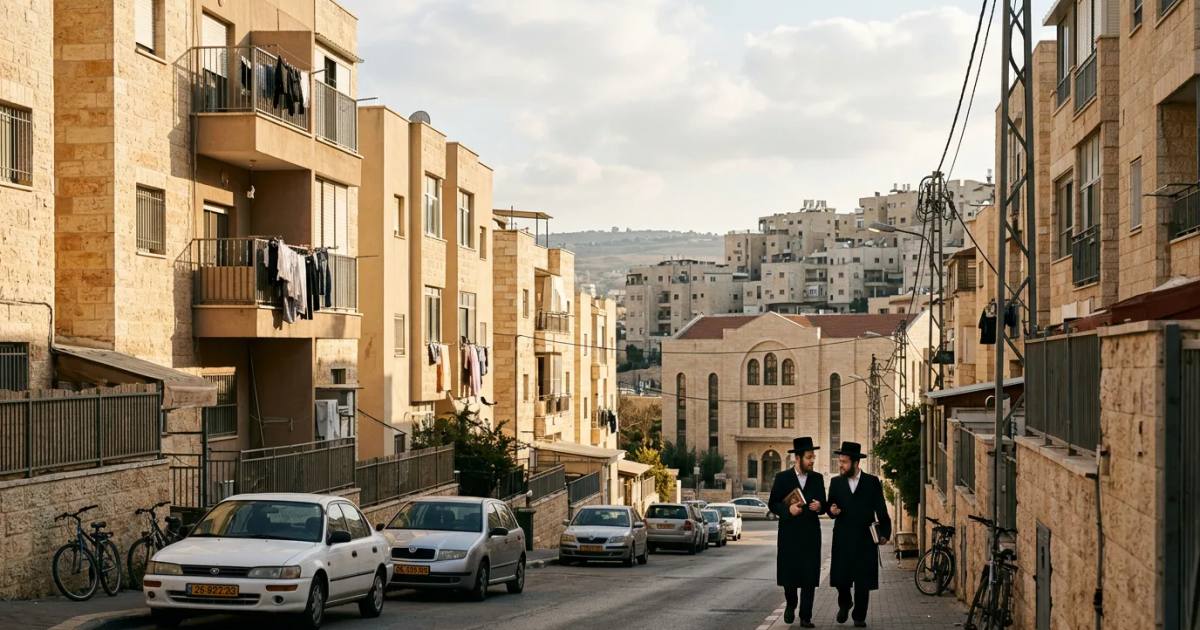

Kiryat Sefer and Achuzat Brachfeld. 89,627 residents, growing 3% a year. Built entirely on land privately purchased from Palestinian owners — the only Israeli settlement at that scale on private land. 30 schools, 20 yeshivas, ~80 synagogues, Mir Brachfeld anchor.
Kiryat Sefer and Achuzat Brachfeld. 89,627 residents in 2024, up from 64,000 a decade earlier. 30 elementary schools, 20 yeshivas and seminaries, ~80 synagogues, and the Mir Brachfeld branch of the world's largest yeshiva. Built entirely on land privately purchased from Palestinian owners — the only Israeli settlement structured that way at scale. Now the largest Jewish settlement in the West Bank, growing at 3% per year against national demographics running flat.
Modi'in Illit is the West Bank's most-populated Jewish city. 89,627 residents as of 2024, per Israel Central Bureau of Statistics. Kiryat Sefer — the founding neighborhood, established 1994, named for the Sefer written by Kalev's tribe in the Book of Joshua — anchors the city. Achuzat Brachfeld, developed around the Mir Brachfeld yeshiva branch, is the second core.
Together they form a city that runs on a completely different real-estate model than any other in Israel. Land in Kiryat Sefer was purchased privately from its Arab owners rather than allocated by the Israel Land Authority (RMI). Development is run by private contractors on private land — no state-run tender pipeline, no Housing Ministry price controls, no Mehir Lamishtaken lotteries. This is a structural anomaly that has shaped 30 years of development pattern.
For comparison to the state-planned Haredi cities: see Beitar Illit: The 80,000-Person City Doubling Itself and Plugot: The 37,000-Unit Haredi City Rising West of Kiryat Gat. Modi'in Illit sits on the opposite end of the spectrum from Plugot — pure private capital, no state role in land assembly.
The demographic engine
Growth rate — ~3% per year, roughly triple Israel's national growth rate. Driven almost entirely by natural increase — the average Haredi woman in Modi'in Illit has more than four children, a fertility multiple beyond most global demographic norms.
Age structure — Modi'in Illit has, per multiple studies, the highest per-capita child count of any city in Israel. Elementary-school-age population dominates every other cohort. The residential pipeline required to house this cohort's family-formation phase over the coming decade is enormous.
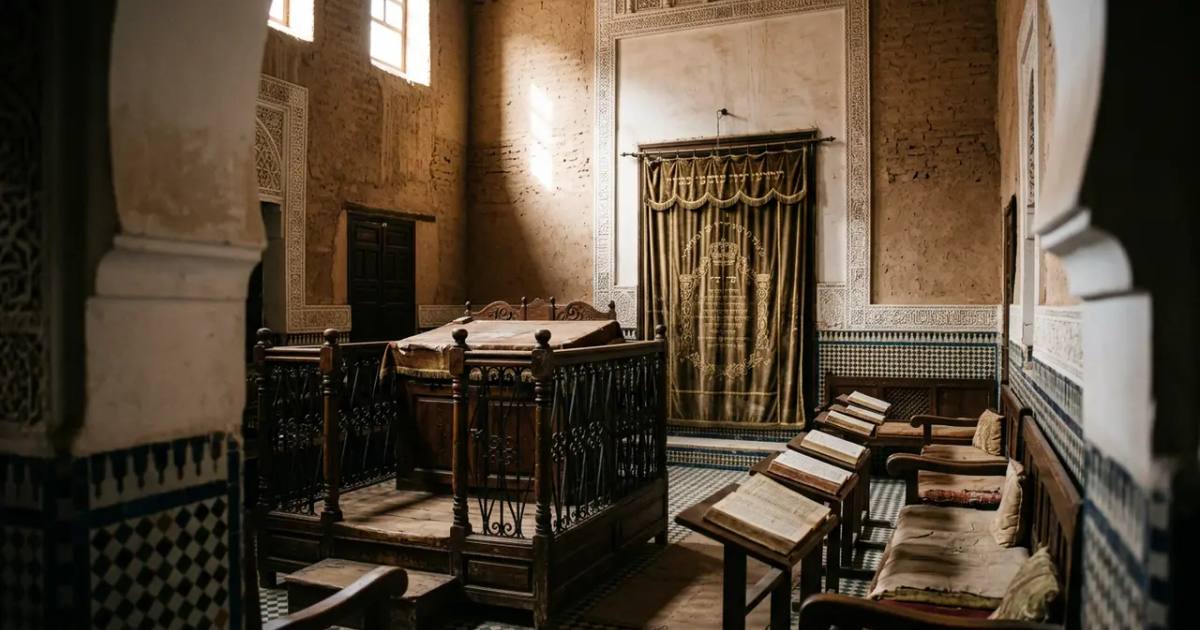
Institutional footprint — 30 elementary schools, 20 secondary schools (Bet Yaakov, yeshivas, seminaries). ~80 synagogues. Mir Brachfeld — the branch of Yeshivas Mir headed by the late Rabbi Aryeh Finkel and now his successors — draws thousands of students in from across the Haredi world. Karlin Yeshiva also operates in the city.
Kiryat Sefer — the founding neighborhood
Established 1994. Streets named after seminal Torah works: Chofetz Chaim, Noda BiYehuda, Meshech Chochma, Avnei Nezer, Sdei Chemed. The naming convention is not decorative — it is the identity spec.
Position — 286 meters above sea level in the foothills of the Judean Mountains. 2.3 km from the Green Line, 5 km from Highway 443, midway between Jerusalem and Tel Aviv.
Development mechanism — private contractors on privately-purchased land. The mechanism removes the state-tender bottleneck that constrains Beitar Illit and Modi'in-Maccabim-Re'ut (see Ramat Bet Shemesh D-3 & D-4 for the contrast) but exposes the city to private-financing cycles that state land does not.
City status — granted March 7, 2008. The upgrade from local council to city changed the municipality's fiscal authority and permitting powers.
Achuzat Brachfeld — the yeshiva-driven expansion
The eastern expansion of Modi'in Illit, developed around the Mir yeshiva branch. Family-market real estate anchored by a specific religious institution — the direct opposite of most residential development, which places institutions to support residents rather than residents to support institutions.
Yeshiva economics — Mir Brachfeld draws thousands of students annually. Married kollel students (avreichim) form the anchor renter and buyer segment, alongside families with sons studying at the yeshiva. That produces sustained pressure on the small-to-mid apartment segment — 60-90 sqm units with sukkah balconies and secondary-unit provisions — that the developer market has organized around.
Karlin Yeshiva also operates in the city, adding a second Hasidic institutional anchor to the Litvish-dominated Mir presence in Achuzat Brachfeld.
The English-speaking outsourcing hub
Modi'in Illit is not just a residential city. It is one of Israel's largest concentrations of English-speaking Haredi women in the workforce, and that has produced an unusual employment layer.
What runs there — significant outsourcing operations for American companies. Bookkeeping, transcription, back-office data work, customer service, medical billing, editorial and technical writing, software QA. The workforce is predominantly women who grew up in English-speaking Haredi communities in the US and UK, moved to Israel, and now provide skilled-labor services to American clients from Modi'in Illit call centers and office parks.
Why it matters for real estate — this is meaningful household income that the standard Haredi employment model does not capture. It supports mortgage capacity, purchase prices, and the willingness of families to buy rather than rent. Modi'in Illit's apartment values sustain against Beitar Illit and Elad benchmarks partly because of this hidden income base.
The private-land model — advantages and constraints
The advantage is speed. Private contractors on private land bypass the multi-year state-tender cycle. When demand appears, capacity moves. That is why Modi'in Illit outgrew every other West Bank Jewish community — it did not wait for the government to release land.
The constraint is scale. Private landholders do not consolidate the way the state can. Modi'in Illit's expansion runs into title fragmentation, negotiation drag, and — increasingly — geographic constraints. The city has reached the borders of what private land purchases can readily assemble. Further expansion requires either state land release nearby (which the government has resisted for planning reasons) or acquisition of additional privately-held tracts (which is slow and expensive).
Political constraint — the barrier surrounding the city divides the nearby Palestinian village of Bil'in from most of its olive groves and other agricultural land, and has drawn international attention. That constrains political flexibility around further land assembly.
The mayor — Yaakov Gutterman and Degel HaTorah
Yaakov Gutterman (Degel HaTorah party) has served as mayor since 2002, elected uncontested in every subsequent cycle. Gutterman succeeded Yosef Schwinger, the founding head of council. Rabbi Meir Kessler is Chief Rabbi of the city and head of its Rabbinical Court.
The unbroken Degel HaTorah dominance is politically important. Coalition negotiations at the national level over Haredi housing budgets, tenders in nearby areas, and infrastructure spending in the city run through Degel's Knesset presence. Modi'in Illit is not a swing constituency — but it is a very high-turnout one, and that translates into political leverage.
Infrastructure — the highway 443 debate
The single largest infrastructure question in Modi'in Illit is the proposed direct connector road from the city to Highway 443. The city currently uses secondary roads that add material time to the Jerusalem and Tel Aviv commute.
The proposed connector has drawn criticism for potentially bisecting wildlife corridors in nearby valleys, where gazelles and protected bird species live. Mitigation plans have been proposed. The decision is not final — but the road, if built, would sharply improve the city's connectivity to central Israel employment, which in turn drives residential values.
Green space per capita is already limited by high-density Haredi residential development. The road debate is one part of a broader question about how much environmental cost the state absorbs to enable Modi'in Illit's continued growth.
What Modi'in Illit is really doing
Modi'in Illit is Israel's largest West Bank Jewish city, built on the country's most unusual real estate mechanism — pure private land assembly, without state tender or price control — and now approaching 90,000 residents with a growth rate that would double the city within a generation if the land supply holds.
The state-planned Haredi cities — Beitar Illit, Bet Shemesh, Kiryat Gat/Plugot — are trying to solve the same demand curve with public-sector coordination. Modi'in Illit already solved it, privately, thirty years ago. The question now is whether the model can extend as private-land assembly hits its geographic and political limits.
Whatever answer the city arrives at will shape how Israel's Haredi housing math resolves for the next decade. Ministry of Housing modeling needs 350,000 additional Haredi units by 2050. Modi'in Illit is currently producing a share of that number that no policy report fully captures — because no policy is directly steering it.