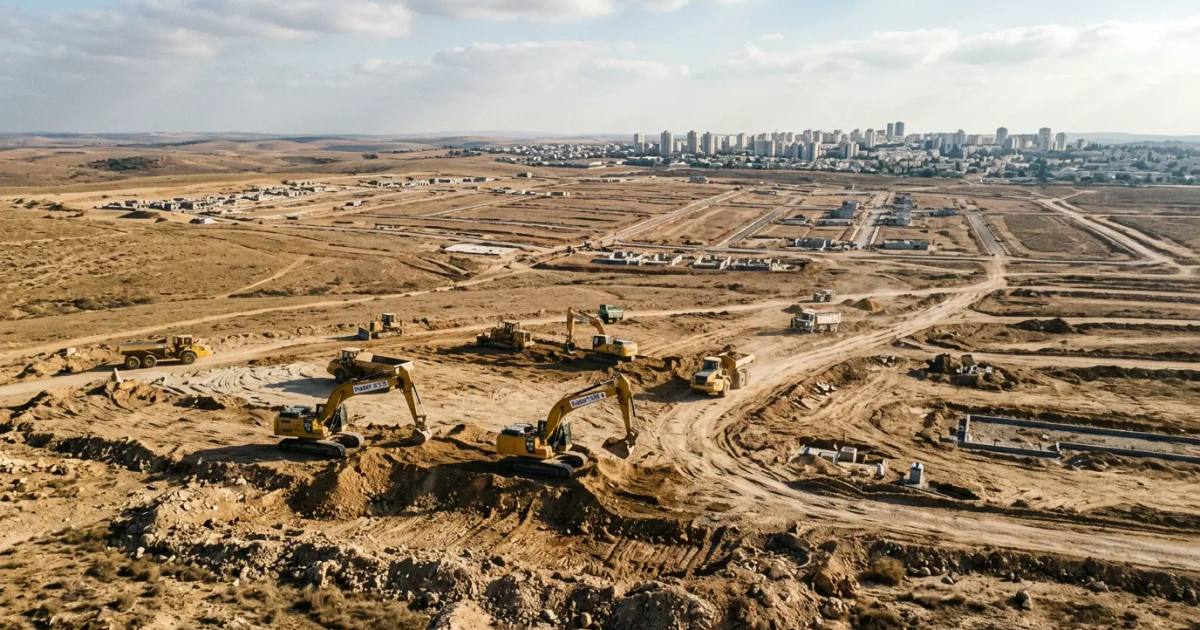

Plugot, a new Haredi city near Kiryat Gat, plans 37,000 units for 207,000 residents. Its master plan is under review by the Southern District Committee.
A new city on 11,300 dunam west of Kiryat Gat. 37,000 units, 207,000 residents. Israel's largest single-city housing bet — the southern anchor of the Ministry of Housing's 350,000-unit 2050 plan.
Plugot is not a Kiryat Gat neighborhood. It is a city. 37,000 residential units. 207,000 residents. 11,300 dunam of Shafir Regional Council farmland, west of Route 40, designated for the fastest-growing housing pipeline in Israel — the Haredi market.
Housing Minister Haim Katz opened a 100-day feasibility review in February 2026. Before the clock ran out, the Southern District Planning and Building Committee began discussing the central quarter's master plan — 11,600 units on 6,389 dunam of farmland belonging to Shafir Regional Council villages. The city that has not been formally approved is already being designed. That gap between authorization and execution is the story.
Katz framed the decision plainly: "The State of Israel must prepare today for the housing needs of the coming decades." The IDI's Ultra-Orthodox Housing Market study (2024) puts near-term Haredi demand at ~200,000 additional units. The Ministry of Housing's longer horizon: 350,000 additional Haredi units needed by 2050. Kiryat Gat is the southern anchor of that plan. Bet Shemesh is the northern one, and Bet Shemesh is already overloaded.
Mayor Kfir Suissa cut a separate deal with the government. Tracts inside Kiryat Gat originally zoned for a dedicated Haredi neighborhood get folded into Plugot instead. Developers holding those tracts are watching values — the concern first surfaced in TheMarker's January 2026 reporting and has not been reported in English.
Plugot — the 37,000-unit new city
Size — 37,000 units. 207,000 residents. 11,300 dunam. For scale, that is the population of modern Kiryat Gat itself, built from scratch on farmland immediately west of the existing city.
Density — 16 units per dunam. Deliberately low by central-Israel standards, where Tel Aviv-area pinui-binui projects routinely hit 40+. The low density is a product choice: family-scale apartments, integrated community institutions, generous internal green space, and courtyard configurations that support Haredi lifestyle norms.
Central quarter — 11,600 units on 6,389 dunam. Currently agricultural land held by Shafir Regional Council villages. The Southern District Committee is reviewing the TAMA (master plan) in parallel with the government feasibility. Calcalist reported that the policy document was accepted in the district committee in February 2024 — two years before formal city authorization.
Position — West of Route 40, adjacent to Route 6. Designed as an "urban continuum" with Kiryat Gat Rabati rather than a standalone island. Infrastructure spine, water, sewage, roads, and the future Route 6 interchange all tie into the existing city's grid. That is deliberate — the ministry learned from the Modi'in Illit and Beitar Illit isolation problem.
Status — Government feasibility approved February 22, 2026. Housing Ministry leads; Finance, Interior, and Planning Administration in coordination. Central-quarter TAMA already before the Southern District Committee as of March 2026.
Driver — Israel's 2050 Strategic Housing Plan. The Haredi population is projected to reach approximately 20% of Israel's total within a decade. Ministry of Housing modeling: 350,000 additional Haredi units by 2050. The South is the identified absorption zone — land supply, proximity to Jerusalem and Bnei Brak, and lower cost basis than the center.
Kiryat Gat West — Mishkenot Shir
Inside city limits. Different mechanism. Same demand curve.
Size — approximately 7,580 units on ~1,460 dunam. A Haredi-city-scale neighborhood inside a Haredi-city-scale build-out. This is not a project — it is a quarter.
Pipeline — ~2,800 units in advanced planning, moving toward permits and construction. Another ~2,900 units queued post-developer-tender. Balance in earlier planning stages.
Developer — Reisdor is leading the Mishkenot Shir project within the quarter — Mehir Lamishtaken track, price-controlled, targeted at young Haredi families rather than open market. Reisdor's playbook is community-first: institutions committed at contract stage rather than sold as an aspirational future.
Position — Less than one hour drive from Bnei Brak and Jerusalem. Direct rail link via Kiryat Gat station on the Tel Aviv–Beer Sheva line. Adjacent to Bet Shemesh, the country's largest Haredi city by trajectory and the one whose infrastructure has already broken under demand — the "real estate monster" description now standard in Hebrew press.
Product spec — Institutions built in from the outset: schools, yeshivas, synagogues, mikvaot, community services, parks, commercial. Functional apartment sizing for large families. Ground-floor mixed-use where the neighborhood plan supports it. Designed as a self-contained Haredi environment rather than a mixed neighborhood with retrofitted community services.
Financing — Bareket Real Estate Finance is one of the active mortgage originators serving the Haredi buyer segment in the southern corridor. The Haredi financing market is structurally different: lower incomes, higher family financing rates (per IDI research, approximately 27.4% of Haredi apartments transfer between family members versus 11.5% among non-Haredi Jews — a 2.4x multiple), and Haredi homeownership at ~65% despite lower reported household income.
Shivtei Yisrael / Malchei Yisrael — pinui-binui in the north
The state-driven renewal play. Existing residents relocated, density multiplied, low-rise shikun replaced with towers.
Current state — 372 old shikun units across low-rise blocks in northern Kiryat Gat. 195 of those units are public housing — an unusually high proportion that puts Amidar at the center of the deal.
Planned — 36 new buildings. Towers ranging from 20 to 40 floors. ~2,700 total new units. Net add: approximately 2,328 units on the same footprint. Full infrastructure renewal — roads, sewers, parks — as part of the project envelope.
Backers — Amidar (Israel's state housing company) plus the Government Urban Renewal Authority. This is a state-driven pinui-binui, not a private-led one. The public-housing units complicate the deal — Amidar must relocate existing residents into equivalent units, generally within the same project, before towers rise. That constraint sets the pace.
Strategic function — Physical connector. Shivtei Yisrael links veteran Kiryat Gat to Carmei Gat, the newer, faster-growing eastern quarter. Once complete, the city has continuous residential density from the old town through Carmei Gat and out toward Plugot. That is the plan on the ground.
Paz Compound — the CBD play
Every large-scale residential zone needs a downtown. Plugot plus Kiryat Gat West plus Shivtei Yisrael together push the metro population well past the threshold where a real central business district becomes economically necessary. Paz is the answer.
Scope — approximately 700 dunam central-city renewal. The Paz fuel-compound site plus adjacent workshop-industrial zones and aging residential.
Current use — light industrial workshops, fuel depot infrastructure, small-scale commercial, and veteran residential buildings that predate the city's most recent growth wave. Central real estate significantly under-utilized relative to location value.
Planned — mixed-use urban core. Retail at ground level, office above, residential on the upper floors. Regional shopping and civic anchors. The commercial and cultural heart of an expanded Kiryat Gat metro.
Timeline signal — the 2026 municipal budget signed off by Mayor Suissa in December 2025 funds preparatory infrastructure that lines up with a Paz-scale renewal: new roads, upgraded lighting, sewer capacity, and public-transit reconfiguration. The city is spending against the plan before formal committee sign-off.
The employment anchor — 2,000 dunam and Intel's shadow
Residential-only new cities fail. Kiryat Gat's 2026 municipal budget shows the city knows that.
The 2026 budget commits to a 2,000-dunam expansion of the existing industrial park. New interchange from Route 6 direct into the industrial zone. New special-education campus. Innovative school in the Shivtei Yisrael quarter. New pedagogical center. Water park with regional-tourism ambition. Municipal stadium and arena. Roofing over the Shoftim swimming pool for winter use. Total budget: several billion shekels, with ₪121M earmarked for waste management alone.
The industrial park has Intel's shadow over it. Fab 38 — Intel's $25 billion mega-fabrication commitment, the largest single industrial investment in Israel's history — has been frozen since June 2024. Details: see Intel's Kiryat Gat Bet, Postponed. Kiryat Gat's Haredi build-out is happening on the assumption Intel returns to the project, another semiconductor company takes the slot, or the industrial park's other tenants (including Elbit Systems and light-manufacturing anchors) absorb enough employment growth to justify the residential expansion. Every developer in the city is on the same side of that bet.
The market context Kiryat Gat is stepping into
Rent shock across established Haredi cities has run at double-digit multiples of the national average. Beitar Illit — 3-bedroom rent up ~45% in twelve months, now ~₪5,100/month. Bet Shemesh and Netivot — rent up in the tens of percent across every unit size. National average rent in early 2026 sits around ₪5,234. Haredi cities are running at roughly 10x the national rate of increase.
The parallel-market response has been dramatic. Haredi communities are running their own Mehir Lamishtaken–style lottery programs — ₪1.4M cap on 4-bedroom units in peripheral cities, uniform contracts, no developer marketing spend, thousands of units sold in concentrated selling days. TheMarker documented the phenomenon in June 2026. Kiryat Gat is a natural absorption target for that pipeline.
Diaspora capital is now openly courted. In May 2026, ~40 Israeli developers including Tidhar, Ashtrom, Azorim, Afi Capital, Rami Levy, Kardan, Sela Binui, Bet Yerushalmi, Avisror, Barzani, ISA, Blilius, and Hazorim exhibited at the "Olim l'Yerushalayim" event in midtown Manhattan, jointly organized by the Israel Building Center, the Jerusalem Municipality, and the Jerusalem Development Authority. Hundreds of NY/NJ/Tri-State Haredi families now hold apartment options in Israeli projects. The southern corridor — Kiryat Gat, Ashdod, Kiryat Malachi — is next in the pipeline.
The developer tension
Not everyone wins. Developers already holding Kiryat Gat land inside the original Haredi-neighborhood boundary are watching their pipeline get rerouted to Plugot. Unit values inside city limits could soften as buyers get pulled to the new-city offering — larger units, integrated community, government-driven pricing.
The counter-argument: Plugot's absorption capacity is so large it lifts the whole southern corridor. Prices at Mishkenot Shir, Carmei Gat, and Shivtei Yisrael move with regional demand rather than local supply alone. Both arguments are being made in Hebrew press. Neither has landed in English.
The bigger structural question is what Plugot does to Bet Shemesh. Bet Shemesh — 40 minutes north — is on trajectory to become Israel's second-largest city, driven almost entirely by Haredi in-migration, with infrastructure already visibly failing. If Plugot delivers on time and price, some of that Bet Shemesh pressure diverts south. If it doesn't, Bet Shemesh keeps compounding.
What Kiryat Gat is really doing
This is the largest single-city Haredi housing bet in Israel. Not a neighborhood — a city, plus a neighborhood the size of a city, plus a state-driven renewal footprint the size of a neighborhood, plus a downtown. All in one metro. All at once.
Ministry of Housing needs 350,000 additional Haredi units by 2050. Housing Minister Haim Katz has 100 days to sign off on the largest single tranche. Southern District Committee is discussing the master plan before the signature lands. Mayor Kfir Suissa is spending city budget against the plan before it is formally approved.
Kiryat Gat is not waiting. Kiryat Gat is the plan.