
Five hospitals. ~6,700 above-ground beds. ~3,000 fortified underground. ~5 million patients a year. The world's #7 hospital. The world's largest underground hospital. The largest single-day mass-casualty event in medical history.
Israeli Health & Biotech | Olam.business
Five hospitals. ~6,700 above-ground beds. ~3,000 fortified underground. ~5 million patients a year. The world's #7 hospital. The world's largest underground hospital. The largest single-day mass-casualty event in medical history. Israel's academic medical system is the global reference case for wartime hospital engineering, clinical AI translation, and trauma-innovation commercialization — and every one of these institutions has been operationally transformed since October 7, 2023.
The Five Hospitals
| Sheba Medical Center | Tel Hashomer, Ramat Gan · 1,580 beds · #7 globally (Newsweek 2026) · ARC Innovation Center + Project K (world's first AI-powered emergency department) · Director: Prof. Yitshak Kreiss |
| Hadassah Medical Organization | Ein Kerem + Mount Scopus, Jerusalem · 1,300+ beds · Founded 1918 · Produces 40–50% of Israel's biomedical research output · Israel's clinical firsts: bone-marrow transplant (1977), IVF (1982), heart transplant (1986) · Director: Prof. Yoram Weiss |
| Tel Aviv Sourasky Medical Center (Ichilov) | 6 Weizmann St, Tel Aviv · 1,500 beds · Israel's busiest acute-care hospital (~400K patients / 1.8M visits annually) · 700–1,000 bed underground emergency facility (2011) · CEO: Prof. Eli Sprecher |
| Rambam Health Care Campus | Bat Galim, Haifa · ~1,100 above-ground beds + 2,000–2,200 fortified underground · Israel's only Level-1 trauma center in the north · IDF Northern Command medical provider · Sammy Ofer Underground Hospital (2014) · Director: Prof. Michael Halberthal |
| Soroka University Medical Center | Beersheba, Negev · ~1,200 beds · Israel's only Level-1 trauma center in the south · 200,000+ ER visits/year (busiest in Israel) · 676 casualties on October 7, 2023 · Iranian missile strike June 2025 · Director: Prof. Shlomi Codish |
| Combined beds | ~6,680 above ground · ~2,700–3,000 fortified underground |
| Combined annual patients | ~5 million |
| Newsweek 2026 global ranking | Sheba at #7 — highest position ever held by an Israeli hospital |
Why These Five — and Why Now
Three structural conditions made Israel's hospital system the case study the world now studies.
Geographic compression. Five tertiary academic centers serve nine million people in an area smaller than New Jersey. Every citizen lives within 90 minutes of a Level-1 trauma facility. Every one of those facilities has been operationally tested under active conflict within the past two decades.
Sustained wartime posture. The post-2006 Second Lebanon War design cycle produced Rambam's Sammy Ofer underground hospital and Ichilov's 2011 bombproof emergency facility. The post-October 7 operating environment activated both — and rewrote protocols across all five centers. These hospitals don't prepare for war in theory. They run wartime operations as institutional routine.
Academic-industrial density. Each hospital is affiliated with one of Israel's five research universities — Tel Aviv University, Hebrew University of Jerusalem, Technion, Ben-Gurion University, and the Weizmann Institute. The pipeline from clinical problem to translational research to commercialized product runs through these institutions. That's not marketing language. That's 1,800 life-sciences companies, 200+ patents at Hadassah alone, and a medical-device export sector that punches above any country its size.
The Underground Infrastructure — Wartime Engineering at Scale
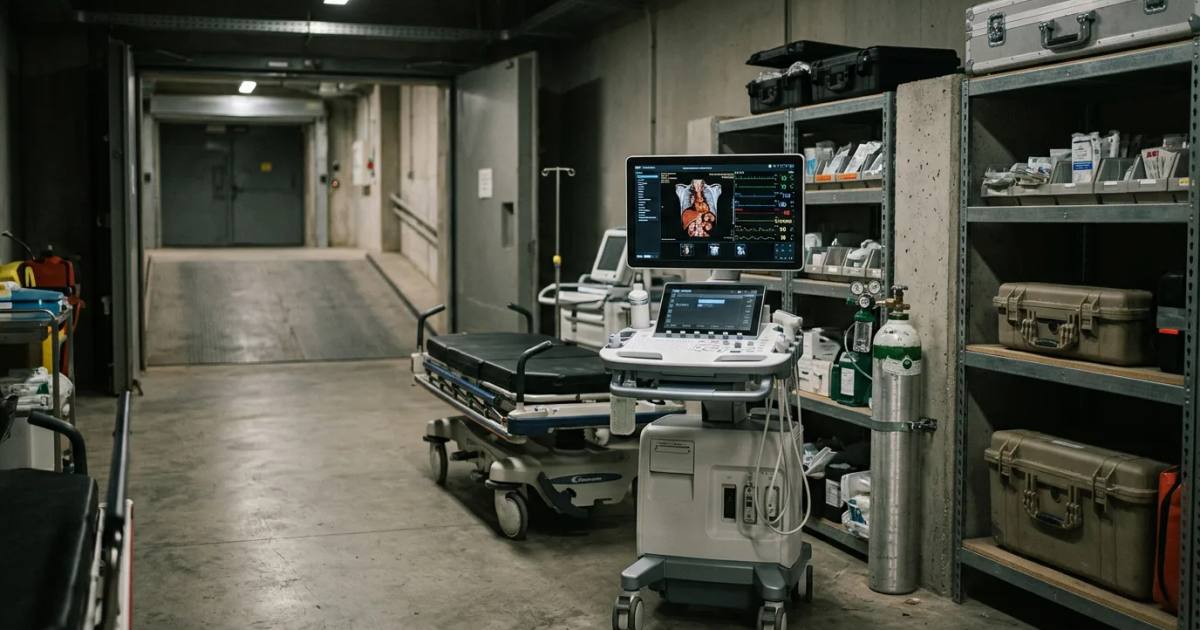
Israel operates the two largest fortified underground hospitals in the world. Both were designed to sustain full clinical operations under sustained rocket and missile bombardment — conventional, chemical, and biological.
Rambam — Sammy Ofer Fortified Underground Emergency Hospital
2,000–2,200 beds across three subterranean levels. Inaugurated 2014. ₪435 million investment. Twenty-four fortified operating rooms. Self-sustaining for 72 hours. Convertible from parking garage to full hospital in 72 hours — an eight-hour activation was demonstrated in September 2024 when Rambam relocated 700 patients underground. It is the world's largest operational underground hospital.
Ichilov — 2011 Underground Emergency Facility
700–1,000 beds. Thirteen stories above ground, four stories underground. Engineered against conventional, chemical, and biological attack. After October 7, entire departments relocated to this facility under the direction of CEO Prof. Eli Sprecher.
Supporting Infrastructure Across the Five
Sheba operates a Medical Simulation Center and the National Center for Disaster Response — the doctrinal and training layer behind the fortified capacity. Hadassah's Swartz Center houses Jerusalem's only Level 1-A Trauma Unit. Soroka carries the operational scars of October 7 — 676 casualties in a single day — and the June 2025 Iranian missile strike as institutional memory that no simulation can replicate.
Clinical AI and the Translational Pipeline
Israel's academic hospitals aren't just deploying clinical AI. They're building the institutional architecture that turns pilot programs into embedded practice — and then exporting that architecture globally.
Sheba — ARC Innovation Center
Directed by Prof. Eyal Zimlichman, ARC is the most-cited Israeli institutional platform for clinical AI translation. The model: clinical departments + technology partners + corporate collaborators + startups, operating under one roof. The flagship: Project K — the world's first AI-powered emergency department. ARC's ecosystem has become an international reference architecture for how academic medical centers move from "we have an AI pilot" to "AI is embedded in clinical workflow."
Hadassah — Wohl Institute for Translational Medicine
Directed by Prof. Rinat Abramovitch. Houses optical imaging, micro-CT, and biological/chemical laboratory infrastructure in a single facility. Hadassah has spun out 15+ startups and holds 200+ patents — making it one of the most productive translational engines in Israeli medicine.
Ichilov, Rambam, Soroka — The University Axis
Ichilov anchors Tel Aviv University's Faculty of Medical and Health Sciences — 800+ senior faculty, Israel's largest medical school. Rambam operates as the clinical arm of the Technion, Israel's premier engineering university — a combination that produces disproportionate medical-device and bioengineering output. Soroka and Ben-Gurion University run the Negev's integrated academic-clinical unit, serving a patient population that includes Bedouin communities with unique epidemiological profiles found nowhere else in Western medicine.
Global Rankings — The Trajectory
Newsweek's World's Best Hospitals ranking places Israel's academic hospitals as follows:
- Sheba: #7 (2026), #8 (2025), #9 (2024), #10 (2023) — eight consecutive years in the global top 10. The highest position ever held by an Israeli or Asian hospital. The only Israeli institution that consistently competes alongside Mayo Clinic, Cleveland Clinic, Massachusetts General, and Johns Hopkins.
- Ichilov: #60 (2025)
- Hadassah Ein Kerem: #242 (2025)
Sheba also ranks #9 in Newsweek's 2026 World's Best Smart Hospitals — the fifth consecutive year in the smart-hospital top tier.
After October 7 — The Operating Environment That Changed Everything
Every one of the five hospitals was operationally transformed by the war that began October 7, 2023. This was not a drill. It was not a simulation. It was the largest mass-casualty event in Israeli medical history — and it hit simultaneously across the country's southern and central hospital corridors.
Soroka received 676 casualties in a single day. Staff performed triage in hallways, parking lots, and improvised treatment areas while the hospital itself came under security threat. No hospital in the Western world has managed a comparable single-day surge in modern history.
Sheba received returning hostages and coordinated multi-hospital surge protocols across the central corridor. Hadassah operated as Jerusalem's Level 1-A trauma anchor — the only facility of its kind in the city. Ichilov relocated entire departments to its underground facility. Rambam executed the 700-patient underground relocation in eight hours in September 2024 — converting the Sammy Ofer facility from standby to fully operational under live threat.
Prof. Eli Sprecher, Ichilov's CEO, has publicly warned of a coming national mental-health crisis as the long-tail medical consequence of October 7 — a secondary wave that will stress these institutions for years.
The Funding Gap
The Ministry of Health's post-October 7 plan allocates ₪4 billion+ (~$1 billion) for hospital protection and fortification upgrades. As of the June 2025 Iranian missile strike on Soroka — which tested the system again under live fire — only 10 percent of that budget had been disbursed. The gap between the plan and the money is the single largest vulnerability in Israeli hospital infrastructure.
What This Map Tells You
The operational spine. These five hospitals are the infrastructure through which every conflict, every pandemic, and every mass-casualty event in Israel is managed. There is no alternative routing. There is no backup system. This is it.
The institutional case study. No other country's academic medical system has reorganized under sustained wartime conditions at this scale, in this timeframe, with this level of documentation. Israeli hospital-engineering doctrine, mass-casualty protocols, underground hospital design, and clinical-AI translation are now studied globally as a coherent institutional package — not as isolated innovations but as a system.
The commercialization pipeline. The 1,800-company Israeli life-sciences ecosystem, the Weizmann Institute's IP machine, and the aMoon capital architecture all connect to these hospitals as their principal clinical proving ground. What gets tested here gets exported. The trauma innovations, the AI deployments, the wartime protocols — they move from these corridors to global markets.
Frequently Asked Questions
What are Israel's five principal academic medical centers?
Sheba Medical Center (Tel Hashomer), Hadassah Medical Organization (Jerusalem), Tel Aviv Sourasky Medical Center / Ichilov (Tel Aviv), Rambam Health Care Campus (Haifa), and Soroka University Medical Center (Beersheba).
How many beds do they operate?
Approximately 6,680 above-ground beds and 2,700–3,000 fortified underground beds. Combined annual patient volume: ~5 million.
Which is ranked highest globally?
Sheba Medical Center — #7 in Newsweek's 2026 World's Best Hospitals. Highest position ever held by an Israeli hospital. Eight consecutive years in the global top 10.
Where is the world's largest underground hospital?
Rambam Health Care Campus, Haifa — the Sammy Ofer Fortified Underground Emergency Hospital. 2,000–2,200 beds across three subterranean levels.
What happened on October 7 at these hospitals?
Soroka received 676 casualties in a single day — the largest mass-casualty event in Israeli hospital history. All five hospitals were operationally transformed. Sheba coordinated hostage returns and multi-hospital surge. Hadassah anchored Jerusalem trauma. Ichilov relocated departments underground. Rambam executed its full underground activation.
What is the leading clinical AI platform?
Sheba's ARC Innovation Center, directed by Prof. Eyal Zimlichman. Flagship deployment: Project K — the world's first AI-powered emergency department.
Related Olam Coverage
- Israeli Health & Biotech — Olam's pillar coverage of the Israeli health and biotech sector
- Sheba Medical Center
- Hadassah Medical Organization
- Tel Aviv Sourasky Medical Center (Ichilov)
- Rambam Health Care Campus
- Soroka University Medical Center
- Teva Pharmaceutical Industries
- Weizmann Institute of Science
The Olam Editorial Team