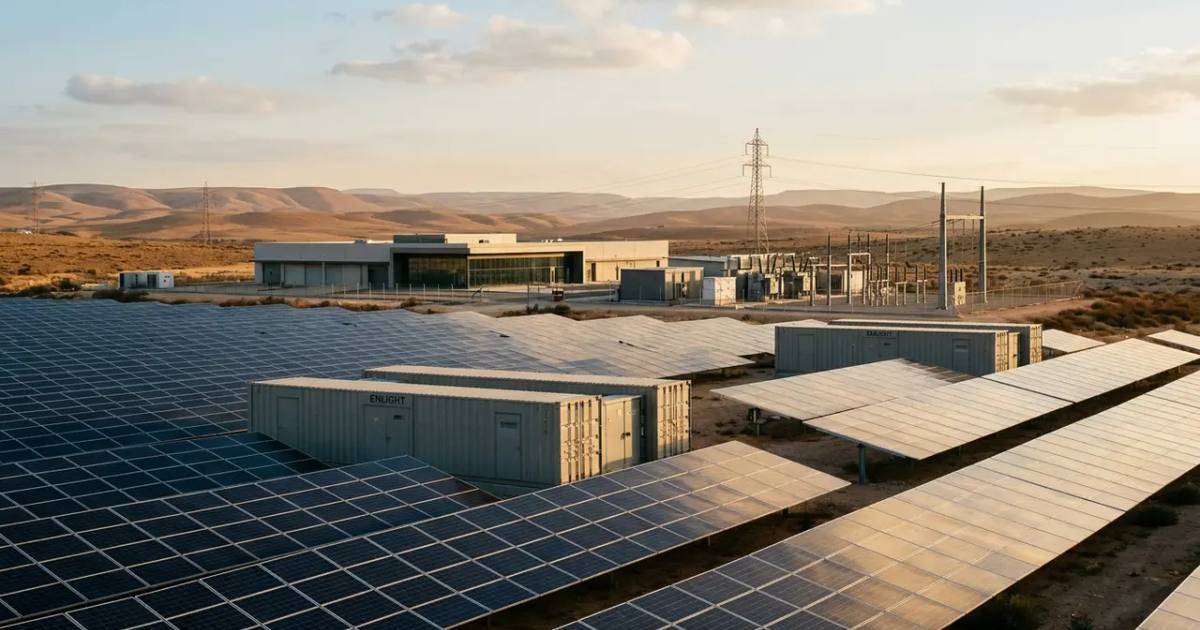

Israel's TASE-listed renewables developers lost 60% of their index value in the 2023 rate shock. In 2026, data-center demand and a US storage build-out have driven Enlight's revenue up 55% and Energix toward a targeted 4 GW portfolio.
Israel's publicly traded renewables developers — led by Enlight Renewable Energy and Energix Renewable Energies — spent 2023 and 2024 in a real downturn, with the TASE cleantech index losing roughly 60% of its value as interest rates rose and several smaller private developers filed for creditor protection. By 2026, the sector has staged a genuine rebound, driven less by climate policy than by a very different demand source: data centers. This piece updates and widens the lens on Olam's earlier profile of Enlight's US expansion, which left open the question of whether the Israeli-sponsor, US-project-finance model would hold up post-IRA. The 2026 numbers give a clearer answer.
How Did Enlight Perform in 2026, and What's Driving It?
Enlight reported second-quarter 2026 revenue and income of $210 million, up 55% year over year, with adjusted EBITDA of $160 million, up 67%, and net profit of $31 million versus $6 million a year earlier. The company raised its full-year 2026 guidance to $790–820 million in revenue and $565–585 million in adjusted EBITDA, citing new projects entering operation in the US, favorable European power prices, and a growing electricity-trading business inside Israel. Management described 2025 and 2026 as "defining build-out years" as the company converts a large mature project pipeline — which grew to 12.3 factored gigawatts in Q2 2026 — into actual operating capacity.
The clearest single data point on Enlight's current scale is the CO Bar Complex, one of the largest renewables projects under construction in the United States: roughly 1.2 GW of solar generation paired with 4.0 GWh of storage, for which Enlight closed approximately $2.6 billion in debt financing in mid-2026. Enlight has also moved into an adjacent, higher-margin business: a March 2025 Israel Land Authority tender award to develop an integrated 100 MW data center and solar facility in the Ashalim region, positioning the company to sell power directly to a co-located data center rather than solely into the grid — a structural shift toward the same AI-driven electricity-demand story reshaping US utilities.
How Does Energix Compare to Enlight?
Energix Renewable Energies, majority-owned (72%) by Israeli real-estate group Alony Hetz, is Israel's other major listed pure-play developer and follows a more conservative, largely domestic-and-Poland-focused strategy compared to Enlight's US-centric expansion. Energix's own 2025 annual report disclosed roughly 5.8 GW of photovoltaic and wind capacity in development and 11.6 GWh of initiated storage-sector capacity, with a strategic target of reaching 4 GW of operating capacity plus 1.3 GWh of storage by the end of 2026, and projected revenues of NIS 2.3 billion for that year. Energix's market capitalization has fluctuated with the broader sector — cited at roughly $500 million in company materials during its slower years but reported at NIS 12.94 billion (roughly $3.5 billion) on TradingView in 2026, reflecting the same rebound Enlight has posted.
| Company | TASE/Nasdaq | 2026 Scale Signal | Primary Geography |
|---|---|---|---|
| Enlight Renewable Energy | TASE + Nasdaq: ENLT | $790–820M 2026 revenue guidance; 12.3 FGW mature portfolio | US, Israel, Europe |
| Energix Renewable Energies | TASE: ENRG | Targeting 4 GW + 1.3 GWh by end-2026; NIS 2.3B projected revenue | Israel, Poland, US (PJM territory) |
| Nofar Energy | TASE | Reported YoY growth in revenue and EBITDA in 2024 periodic report; expanding connected/under-construction capacity | Israel, multiple international markets |
Why Did the Sector Crash in 2023, and What Changed?
Israel's renewables developers rode a wave of Covid-era IPOs onto the TASE, with Enlight and Energix as the earliest listed "pioneers," joined later by Nofar, Doral, and Meshek Energy, and the exchange launching a dedicated TASE Cleantech Index in September 2020 to track them. That index lost roughly 60% of its value from peak as global interest rates rose sharply starting in 2022 and Russia's invasion of Ukraine exposed how dependent European energy security still was on conventional fuels, undercutting the near-term investment case for pure-renewables plays. Several smaller and mid-sized private Israeli developers filed for court protection from creditors during the worst of the downturn, unable to service construction and acquisition debt at the new, higher rates.
The 2026 rebound has a different engine than the original Covid-era enthusiasm: AI-driven data-center electricity demand, which has revived US utility and independent-power-producer valuations broadly and pulled Israeli developers with US pipelines — Enlight most visibly — along with it. That is a structurally different demand driver than the climate-policy optimism that fueled the original 2020–2021 IPO wave, and one less exposed to any single government's climate policy, since data-center operators need power regardless of the regulatory environment for renewables specifically. That same electricity-demand pressure is also reshaping adjacent categories, from Israeli grid-tech and battery-storage startups to the carbon-management software layer tracked in Olam's survey of Israel's carbon-tech sector.
What Should Readers Track Next?
Three signals matter for whether this rebound holds. First, whether Enlight's CO Bar Complex and its broader US pipeline convert to operating capacity at the underwritten returns — the same open question Olam's earlier Enlight profile raised, now testable against real 2026–2028 delivery data as the company targets roughly 12 FGW of operating capacity by the end of 2028. Second, whether Energix's more conservative, less US-dependent strategy proves more resilient if US interconnection queues or tax-credit rules shift again. Third, whether the data-center demand driver broadens into a durable source of contracted revenue for Israeli developers generally, or remains concentrated in Enlight's specific Ashalim and US projects.
FAQ
What is Enlight Renewable Energy's 2026 revenue guidance?
Enlight raised its full-year 2026 guidance to $790–820 million in revenue and income, with adjusted EBITDA guidance of $565–585 million, after posting 55% year-over-year revenue growth in Q2 2026.
Who owns Energix Renewable Energies?
Alony Hetz Properties and Investments, an Israeli real-estate investment group, owns approximately 72% of Energix.
Why did Israeli renewables stocks crash in 2023?
Rising global interest rates sharply increased financing costs for capital-intensive renewables projects, while the Russia-Ukraine war reduced near-term enthusiasm for pure-renewables investment theses, driving the TASE Cleantech Index down roughly 60% from its peak.
What is driving the 2026 rebound in Israeli renewables?
AI-driven data-center electricity demand has revived US power-sector valuations broadly, and Israeli developers with US project pipelines — particularly Enlight — have benefited from that demand alongside their own project delivery.
Related on The Olam
- Enlight and the Israeli Developer Going Global — the earlier profile this piece updates
- Israel's Climate and Water Economy: The Complete Map
- Israel's Grid-Tech and Battery-Storage Startups
- Who Owns Israel's Carbon-Tech Sector?
Sources
Enlight Renewable Energy, Q1 and Q2 2026 earnings releases and call transcripts (GlobeNewswire, Investing.com, Insider Monkey). StockTitan and StockAnalysis.com, ENLT trading and guidance data. Wikipedia, "Enlight Renewable Energy" and "Energix Renewable Energies." Energix Renewable Energies, unofficial translation of 2025 annual report summary (TASE filing, February 2026). TASE Maya company page, Energix Renewable Energies. Jerusalem Post, "Data centers boom revives renewable energy stocks," December 2025.