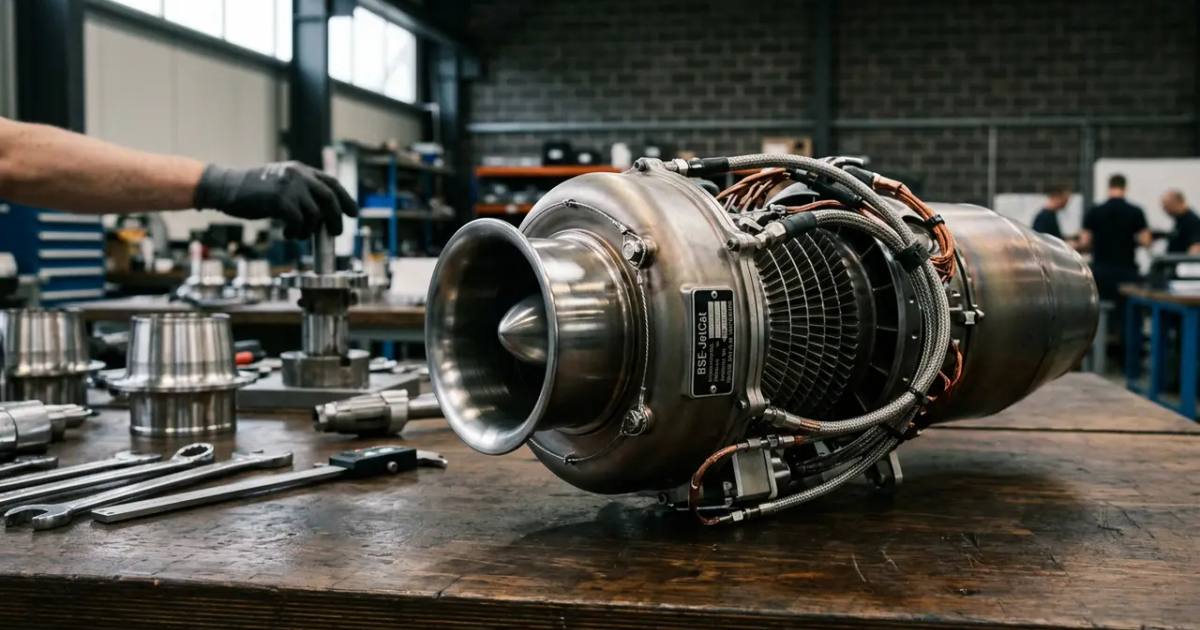

Jet Cat Defense, the Bet Shemesh Engines-JetCat joint venture, landed a roughly $20 million U.S. order for small jet engines used in cruise missiles and drones, with an option worth $13 million more.
Jet Cat Defense Inc., the joint venture between Israel's Bet Shemesh Engines and Germany's JetCat specializing in small jet engines, has secured a new roughly 20 million dollar order from a U.S. military customer, with an option that could push the total deal value to about 33 million dollars, according to an April 2026 report by Israeli financial outlet Ice.co.il.
What is Jet Cat Defense and who owns it?
Jet Cat Defense is a subsidiary formed through a joint venture between Bet Shemesh Engines, an Israeli jet engine manufacturer controlled by Ishay Davidi's FIMI Opportunity Funds, and Germany's JetCat, a specialist in small jet propulsion, according to Defense News reporting from March 2025 on the venture's formation. Bet Shemesh Engines' core business focuses on parts and components for large jet engines used in commercial and military aircraft, while the JetCat joint venture targets a different market: small jet and rocket engines suited to cruise missiles, loitering munitions, and small unmanned aerial platforms.
What are the terms of the new order?
The new contract covers supply of small jet engines valued at approximately 20 million dollars, with deliveries planned across 2027, according to Ice.co.il. The customer holds an additional option worth roughly 13 million dollars for further engines to be delivered in 2028, contingent on the customer meeting milestones specified in the agreement. If the option is exercised, the total value of the relationship would reach approximately 33 million dollars.
Why is the small-engine market suddenly this competitive?
The market for small military jet engines was, for decades, one of the least dynamic segments of aerospace, reliably supplying cruise missiles, target drones, and loitering munitions without much innovation, according to an Aviation Week analysis published in late August 2026. That era is ending: the outlet reported that AeroDynamic Advisory expects production of small propulsion military engines to double over the next three years and exceed 8,000 units annually by 2028, driven largely by what the analysis called a cost-exchange problem exposed by the wars in Ukraine and the Middle East, where expendable precision weapons are being consumed at rates that outpace legacy production capacity.
That demand surge has pulled new entrants into a market long dominated by incumbents Williams International and Safran Power Units. Aviation Week reported that GE Aerospace and Kratos Defense have formed their own joint venture to build engines for collaborative combat aircraft and cruise missiles, mirroring the same competitive logic behind the Bet Shemesh-JetCat partnership. The U.S. Air Force has separately moved to build out a broader industrial base for low-cost cruise missile propulsion: Breaking Defense reported in April 2026 that the service awarded contracts to PBS Aerospace, Beehive Industries, and Kratos subsidiary Technical Directions Inc. to mature small turbine engine designs and prepare production facilities for its Family of Affordable Mass Missiles program.
Why does Bet Shemesh Engines see this as strategic?
Defense News reported that the Bet Shemesh-JetCat joint venture was explicitly designed to help the companies penetrate the U.S. military market for jet engines that power small airborne platforms, describing it as part of a broader push by Israeli firms to capture a share of the U.S. cruise missile market. Bet Shemesh Engines' broader business has expanded considerably on the back of rising defense and civil aviation demand.
The company signed what it called the largest framework agreement in its history in 2025, a 1.2 billion dollar, 15-year deal with an undisclosed strategic customer described as one of the world's largest engine manufacturers, according to The Times of Israel. That deal raised the company's total framework agreements from 2.1 billion dollars to 3.3 billion dollars, and included an option to extend the relationship a further five years at an additional 400 million dollars.
How does this fit into the wider Israeli small-engine push?
Bet Shemesh Engines was not alone in targeting this market segment even within Israel. Defense News reported that Israel's state-owned Rafael announced its own solid-fuel rocket engine plant the same week the Bet Shemesh-JetCat venture was disclosed, a 175 million dollar facility built in partnership with U.S. firm Kratos and headquartered near a U.S. site, aimed at the same category of cruise-missile propulsion demand.
The scale of the broader U.S. procurement effort underlines why both Israeli firms moved quickly. Reporting from Missile Matters in May 2026 described scheduled 2026 production of the JASSM-ER cruise missile at roughly 396 units, with the line capable of surging to about 860 units if fully dedicated to that program, and noted that four American companies had been selected to potentially deliver more than 10,000 mini cruise missiles between 2027 and 2029 under the U.S. military's Low-Cost Containerized Missile program. Those figures illustrate the volume of engine demand that Jet Cat Defense, Rafael, and their American counterparts are now competing to supply.
Sources: Ice.co.il, April 2026 (Hebrew-language, translated and paraphrased by The Olam); Defense News; The Times of Israel; Aviation Week; Breaking Defense; Missile Matters.