
Morocco signed a narrower trade deal with Israel in 2022, not a CEPA-style FTA. Defense trade dwarfs civilian commerce, tourism runs on diaspora roots trips, and no Dubai-style relocation wave has followed.
Morocco and Israel signed a trade and investment cooperation agreement in February 2022, targeting sectors from automotive to water technology, and Israeli tourist and business arrivals reached roughly 200,000 in 2022 alone, four times the pre-pandemic level. Unlike the UAE, Morocco's economic opening to Israel rests on a normalization relationship rather than a comprehensive free trade agreement, and it runs through a diaspora of roughly one million Israelis of Moroccan descent rather than a business community built from scratch after 2020.
What Trade Agreement Actually Governs Israel-Morocco Business?
Morocco and Israel signed a trade and investment cooperation agreement on February 21, 2022, according to Hong Kong Trade Development Council research, establishing a bilateral economic and trade relations framework, economic cooperation initiatives, and temporary customs exemptions on imports. The agreement specifically targets high-potential sectors including automotive, agribusiness, Industry 4.0, aerospace, renewable energy, textiles, services outsourcing, water technologies, pharmaceuticals, and medical devices.
This is a narrower instrument than the Israel-UAE CEPA, covered separately in Olam's coverage of the UAE's tariff-elimination trade agreement. The Morocco deal does not eliminate tariffs across the bulk of bilateral trade; instead it establishes cooperation frameworks and qualified industrial zones that build on an existing tripartite Morocco-Israel-US arrangement, giving goods manufactured in those zones direct access to the American market, according to the same HKTDC analysis. Israel's stated target for bilateral trade with Morocco is 500 million dollars, a fraction of the multi-billion-dollar UAE relationship.
How Big Is the Israeli Tourism and Business Travel Flow to Morocco?
Morocco welcomed nearly 200,000 Israeli tourists and business travelers in 2022, four times the pre-pandemic level, according to law firm Gide's analysis of Morocco-Israel market trends. Royal Air Maroc launched the first direct flight between North Africa and Israel in March 2023, and more than 17 weekly flights had been established by that year, according to Atalayar's reporting, with a joint target of drawing more than 200,000 tourists annually.
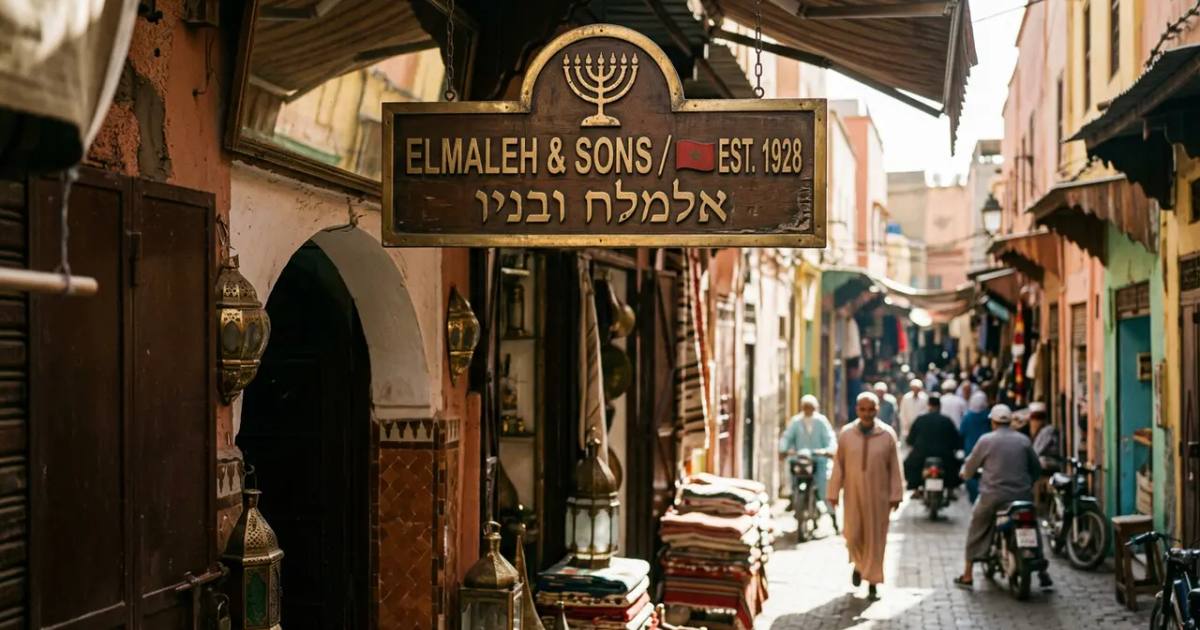
Direct flights were suspended for roughly three years following the October 2023 war, and Israeli carrier Arkia resumed direct service, this time to Marrakech, in August 2026, according to Morocco World News. A veteran Marrakech tour guide told the outlet that "Israeli visitors continued coming even without direct flights," arriving via connecting routes throughout the suspension, evidence that the underlying travel demand did not depend on the flight schedule alone. Many of the roughly one million Israelis of Moroccan descent make the trip specifically as roots journeys retracing family history, rather than as conventional tourism.
What Sectors Is Israel-Morocco Business Cooperation Actually Built On?
Tourism, hydrocarbons, renewable energy, agriculture, and new technology are the sectors named in Morocco and Israel's own joint declaration formalizing normalization in December 2020, according to legal analysis published by Gide. Abraham Accords Peace Institute director Asher Fredman has said he sees "enormous potential" in trilateral Israeli-Moroccan-US projects specifically in agriculture, renewable energy, water, health, and innovation, a framing that treats the United States as a structural third party in the relationship rather than a bystander.
That trilateral structure is Morocco's most distinctive feature relative to other Abraham Accords economies. The qualified industrial zones tied to the 2022 trade agreement route Morocco-based manufacturing toward US market access, a mechanism the UAE relationship does not use in the same way. Defense trade, covered separately in Olam's reporting on Morocco's defense corridor, has grown far faster and larger than civilian trade, with IAI's Barak MX and Ofek 13 satellite programs and Rafael's Spike and Spyder systems representing Israel's deepest single-country defense relationship in the Accords framework, detailed in IAI's Morocco program and Rafael's Morocco pipeline.
How Does Western Sahara Recognition Factor Into the Business Relationship?
Israel's recognition of Moroccan sovereignty over Western Sahara has directly unlocked specific commercial expansions rather than functioning as background diplomacy. Arkia's decision to launch direct flights to Essaouira followed Israel's recognition of Moroccan sovereignty over its southern provinces, according to Atalayar's reporting, explicitly linking a territorial-recognition decision to a new civil aviation route. That pattern, a specific diplomatic concession producing a specific named commercial outcome, is a more direct linkage than exists in most other Abraham Accords relationships.
Why Hasn't a Morocco Business-Relocation Wave Matched Dubai's?
Morocco has not attracted the same scale of relocating family offices and business headquarters that Dubai has drawn since 2020, documented in Olam's coverage of Dubai's business relocation wave. The reasons are structural rather than a matter of safety or welcome. Morocco has no DIFC- or ADGM-equivalent common-law financial free zone, no zero-personal-tax regime, and no golden-visa-style residency program comparable to the UAE's, so the tax and legal case that draws family offices to Dubai does not exist in Rabat or Casablanca in the same form.
What Morocco offers instead is a diaspora-driven trade and tourism relationship layered on top of a genuinely deep, multi-generational communal history, covered in full in Olam's profile of Morocco's Jewish community. Israeli businesspeople with Moroccan family roots are more likely to describe their engagement with Morocco as a return to origin than a jurisdictional arbitrage decision, which produces a different kind of economic relationship: roots tourism, agricultural and water-technology partnerships, and a defense-trade relationship that dwarfs the civilian side, rather than a wave of relocating headquarters.
Frequently Asked Questions About Israel-Morocco Business Ties
Is there a free trade agreement between Israel and Morocco? No. The two countries signed a narrower trade and investment cooperation agreement in February 2022 that creates cooperation frameworks and qualified industrial zones rather than eliminating tariffs across the bulk of bilateral trade, unlike the UAE's CEPA.
How many Israeli tourists visit Morocco each year? Roughly 200,000 Israeli tourists and business travelers visited in 2022, according to Gide's market analysis, though direct flights were suspended for about three years after October 2023 before Arkia resumed service to Marrakech in August 2026.
What is Israel's bilateral trade target with Morocco? Israel has stated a target of 500 million dollars in bilateral trade with Morocco, a much smaller figure than the multi-billion-dollar UAE relationship.
Why don't more Jewish family offices relocate to Morocco the way they do to Dubai? Morocco lacks a common-law financial free zone, a zero-personal-tax regime, and a golden-visa residency program comparable to the UAE's, so the specific tax and legal draw that pulls family offices to Dubai does not exist in the same form in Morocco.
Which sector dominates the Israel-Morocco economic relationship? Defense trade, not civilian commerce. Morocco is the single largest defense-trade destination among Abraham Accords countries, with IAI and Rafael programs worth well over a billion dollars combined, dwarfing the roughly 500 million dollar civilian trade target.
What This Means for Israel-Morocco Business Ties Today
The Israel-Morocco economic relationship is real, growing, and distinct in structure from the UAE's. It runs on a narrower trade-cooperation framework rather than a tariff-eliminating free trade agreement, it is anchored by a defense-trade relationship far larger than its civilian counterpart, and its tourism flow is disproportionately a diaspora phenomenon rather than a jurisdictional relocation story. Family offices are not moving to Casablanca the way they are moving to Dubai, and the reasons are structural: no comparable tax regime, no comparable financial free zone. What Morocco has instead, a three-decade royal partnership with its Jewish community and a trade relationship built on returning diaspora capital, is a different kind of economic relationship, not a smaller version of the Gulf model.