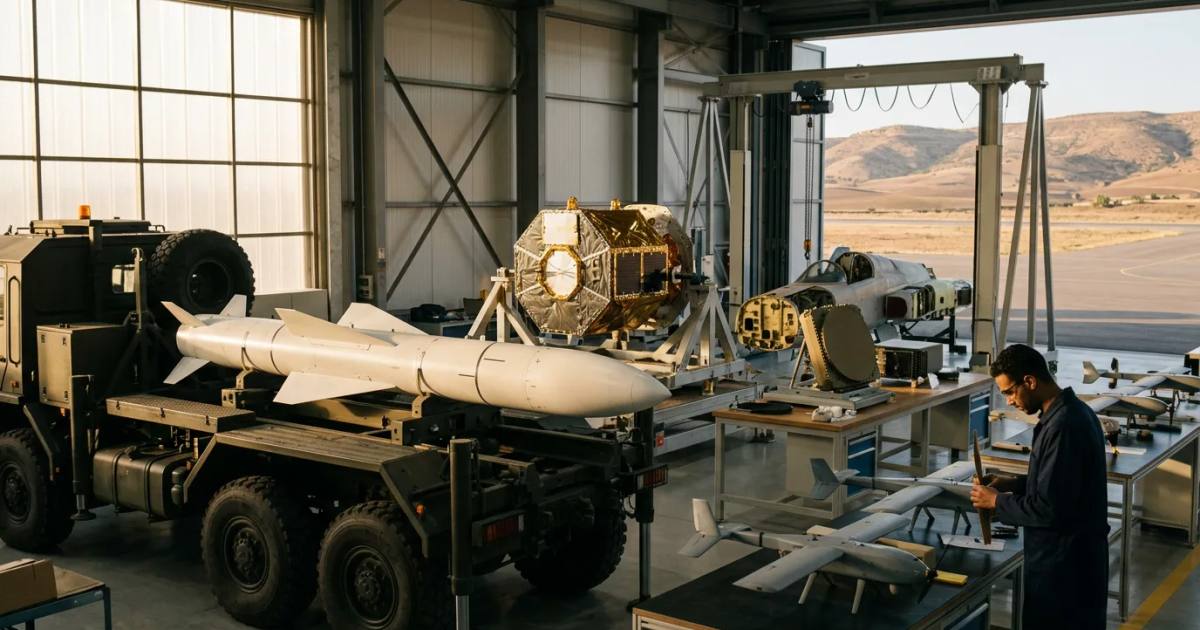

IAI has built the deepest Israeli-prime relationship in Morocco: $1B Barak MX, Ofek 13 satellite (first ever exported to Rabat), the Benslimane BlueBird SpyX plant, ELM-2084 radars in F-5E fighters, and the UIR aviation/AI center. Bigger than Elbit or Rafael.
Israel Aerospace Industries has built the deepest single-prime relationship in the Israel-Morocco defense corridor. The largest single contract ($1B Barak MX). The first Israeli spy satellite ever sold to Morocco. The first Israeli defense factory ever built in Africa. IAI's Morocco book runs longer than either Elbit's or Rafael's — and the Benslimane facility just moved it into a category no Israeli prime has ever occupied.
The Elbit-in-Morocco story gets more press because Elbit is Nasdaq-listed and its contracts price in real time. The IAI story is bigger. It runs through multiple subsidiaries — the core company, Elta Systems (radars), BlueBird Aero Systems (loitering munitions), MBT Missiles Division (Barak) — and touches every layer of Moroccan force modernization from strategic reconnaissance down to tactical drones.
Here is the complete IAI-in-Morocco inventory.
The core company
Israel Aerospace Industries is Israel's principal aerospace manufacturer — state-owned, roughly $7.3 billion in FY2025 revenue per Olam's IAI profile, with a backlog approaching $29 billion. The upcoming Q2 2026 IPO on the Tel Aviv Stock Exchange, at a reported ~$20 billion valuation, would rank among the largest listings in TASE history.
IAI's core business lines that touch Morocco:
- Missile and air-defense systems — MBT Missiles Division, home to the Barak family
- Radar and electronic systems — Elta Systems, the ELM-2084 and Green Pine family
- Space and satellites — the Ofek reconnaissance satellite series
- Unmanned systems — Heron, Harop, Harpy, plus BlueBird via the 50% stake
- Executive advisory and industrial partnerships — the International University of Rabat MoU
Morocco is a customer across all five.
Barak MX — the $1 billion anchor
The single largest disclosed contract in the Israel-Morocco corridor.
Contract signed February 2022 per multiple Israeli defense sources including Israel Defense and Morocco World News. Initial estimates placed the deal at $500 million; subsequent reporting from Global Defense Corp and Ainvest suggests the fully loaded configuration — with radar integration and munitions replenishment — approaches $1 billion.
First shipments arrived in Morocco in August 2023, per Morocco World News (August 11, 2023), citing leaked Pentagon documents. The initial delivery included interceptor missiles and the associated launcher units. Full system integration continued through 2024.
Capability:
- Modular, mission-configurable air-defense architecture
- Land- and sea-deployable — same missile family, different launcher platforms
- Engages both missile and aircraft threats simultaneously
- Integrates with Israeli and third-party radars
- Extended-range variants engage targets at up to 150+ km
Strategic frame: The Barak MX places Morocco inside the tier of countries operating credible integrated air defense against ballistic threats. That capability is the specific counter to Algeria's Iskander-E acquisition. Per Ainvest's September 2025 analysis, the Barak MX is Morocco's primary answer to the 300-km Iskander-E capability.
The Elta radar layer
IAI's subsidiary Elta Systems is the anchor of the global Israeli AESA (Active Electronically Scanned Array) radar business, per Olam's own ELTA AESA Radar Cohort coverage.
Twenty ELM-2084 multi-mission radars have been integrated into Morocco's F-5E fighter jets, per Israel Defense reporting. The ELM-2084 is the same radar family that anchors Iron Dome fire-control, David's Sling target-acquisition, and Arrow's mid-course tracking. Its integration into legacy F-5E platforms — an aircraft the US delivered to Morocco starting in 1981 — modernizes what would otherwise be a nearly obsolete fighter fleet.
The radar upgrade also serves a second function. It creates radar-doctrine familiarity that eases the eventual F-16 or F-35 procurement pathway. Morocco is not currently an F-35 customer. It may be by the end of the decade. Israeli radar integration on the current fighter fleet is the technical bridge that keeps that door open.
Ofek 13 — the reconnaissance satellite
The most strategically significant single procurement in the Israel-Morocco book.
Ofek 13 is a next-generation Israeli synthetic-aperture-radar reconnaissance satellite, part of the IAI-built Ofek series that has anchored Israeli space-based intelligence since 1988. Morocco selected Ofek 13 in 2024, per The New Arab and Al-Estiklal reporting, choosing the Israeli platform over competing bids from Airbus and Thales.
That selection matters for three reasons:
- First Israeli spy satellite ever exported to Morocco, and among the very few Ofek exports globally
- Direct win against French sovereign incumbents — Airbus and Thales are the historical suppliers of Moroccan space-based imagery
- Sovereign intelligence capability — Morocco now generates its own space-based reconnaissance rather than depending on allied-nation intelligence sharing
The Ofek 13 gives Rabat continuous surveillance capability over Western Sahara, the Algerian border, and the Mediterranean approaches. That is a doctrinal shift, not just a procurement.
The Airbus/Thales displacement mirrors the CAESAR howitzer displacement by Elbit ATMOS 2000. French defense-industrial incumbency in Morocco is unwinding across categories. Israeli suppliers are picking up the marginal contract.
Harop and Harpy — the loitering-munitions layer
IAI invented the loitering-munition category, per Olam's Loitering Munitions Cohort coverage. The Harop and Harpy are the two flagship platforms.
Harop — a 40+ kilogram loitering munition, 1,000-kilometer range, 23-kilogram warhead, deployed in Israeli, Azerbaijani, Indian, and (reportedly) Moroccan service. Extended endurance, precision terminal guidance, capable of striking radar sites, air-defense installations, and high-value armor.
Harpy — an earlier-generation platform, primarily anti-radiation, designed to loiter over enemy radar coverage and dive-attack SAM systems. Still in service, still exported.
Morocco's procurement of Harop and Harpy is reported in the ~$120 million range per Ainvest's September 2025 comparative analysis, though the precise contract value is undisclosed. The systems complement the Barak MX air-defense layer — Barak MX defends against inbound Iskander-E; Harop and Harpy strike the Iskander-E launcher and its supporting radar chain before launch.
That is offensive-defensive integration. That is not something Morocco could procure from any Western supplier at the same price point.
BlueBird and the Benslimane plant
The most consequential single asset in the entire Israel-Morocco corridor sits under IAI's 50% ownership of BlueBird Aero Systems.
Full details in our Benslimane coverage. Summary:
- BlueBird acquired 50% by IAI in 2020, weeks before the Abraham Accords
- SpyX loitering-munition production facility inaugurated November 15, 2025 in Benslimane, near Casablanca
- First Israeli-designed weapons factory anywhere in North Africa or the Middle East outside Israel
- Technology transfer to Moroccan engineers, trained at BlueBird facilities in Israel
- WanderB and ThunderB VTOL ISR drones already operational in Moroccan service
The Benslimane plant does not just add a product line to IAI's Moroccan book. It transitions IAI from arms exporter to industrial partner. Every future Moroccan procurement now has an implicit local-production question attached, and IAI has the working template.
The International University of Rabat MoU
In May 2023, IAI signed a memorandum of agreement with the International University of Rabat (UIR) to establish an aviation and artificial-intelligence center of excellence, per multiple regional reports. The MoU covers:
- Undergraduate and graduate aeronautical engineering curriculum development
- Joint research programs in AI-integrated aerospace systems
- Faculty exchange between Israeli and Moroccan institutions
- Industry-adjacent training pipelines feeding Moroccan defense-manufacturing operations
The UIR partnership is under-covered but strategically significant. It is the human-capital layer beneath the industrial layer. The Benslimane plant needs engineers. The engineers come from UIR-adjacent programs. IAI is building the workforce pipeline in parallel with the factory.
That is what a serious industrial partnership looks like. It is the reason the Israel-Morocco defense corridor will outlast any single procurement cycle.
The IAI position vs. Elbit and Rafael
Comparing the three Israeli primes across their Morocco books:
| Prime | Disclosed contract value | Manufacturing footprint | Human-capital investment |
|---|---|---|---|
| IAI | $1B+ Barak MX, $120M+ Harop/Harpy, Ofek 13 (undisclosed 9-figure) | Benslimane SpyX plant (via BlueBird) | UIR aviation/AI center |
| Elbit | $200M+ ATMOS, $150M PULS, $70M Alinet, plus Hermes 900, Skylock | Two Casablanca sites announced 2023 | None disclosed |
| Rafael | Spike ATGM (undisclosed), Spyder (undisclosed) | None disclosed | None disclosed |
IAI is ahead on absolute contract value, ahead on manufacturing footprint, and the only prime with a disclosed human-capital investment. Elbit's Casablanca sites, when they open, will narrow the manufacturing gap. Rafael's Delilah negotiation, if it closes, could narrow the contract-value gap.
But for the current window, IAI is the dominant Israeli prime in Morocco. The Benslimane plant locks that position in.
What comes next
Three specific IAI-Morocco developments to watch over the next 24 months:
Barak MX Phase 2 — Israel Defense reporting has flagged the possibility of an extended-range or naval-launched variant procurement, which would add materially to the current contract base.
Additional Ofek variants — Ofek 13 is the first. Ofek 16 (higher-resolution optical) and Ofek 19 (extended-endurance) exist in the IAI product family. Morocco is a natural repeat customer.
BlueBird product expansion at Benslimane — SpyX is the initial production line. WanderB and ThunderB manufacturing could follow. Longer-endurance platforms (Heron TP class) would represent the outer boundary of what Israeli export licensing permits.
If any two of those three developments close, IAI's Morocco book crosses $2 billion cumulative by 2028. That is a bigger single-country trade than IAI's presence in most European defense markets.
The Morocco relationship is now IAI's most consequential post-Accords industrial development. The $1.5B corridor story is largely an IAI story — with Elbit and Rafael supporting acts.
That will not be the framing next quarter or the quarter after. But it is the framing today, and the trajectory has not reversed.