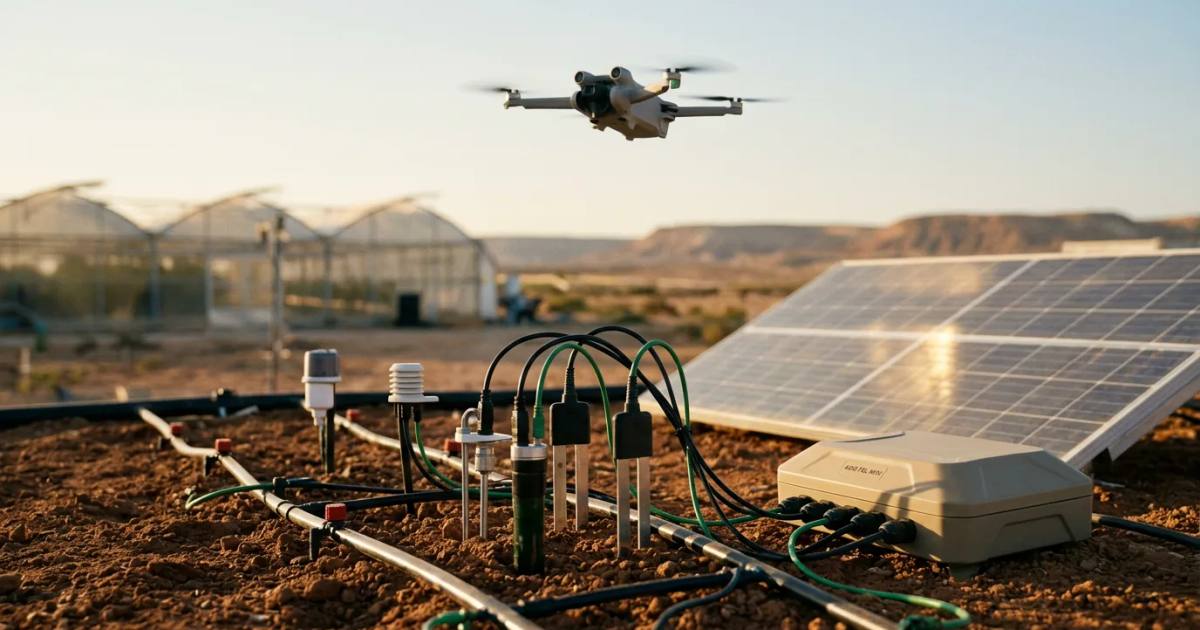
ADIO — established Feb 2019 by Law No.1 — is the AED 2B Innovation Programme, Musataha land allocations, 8 international offices (Tel Aviv since Jan 2021). The FDI execution vehicle that makes 'sovereign procurement dressed as venture' operationally real.
The Abu Dhabi Investment Office is the vehicle that turns Israeli agritech companies from Series B checks into Abu Dhabi factories. AED 2 billion Innovation Programme. Musataha land allocations. Eight international offices — Tel Aviv on the list since January 2021. Ghadan 21 stimulus program. The infrastructure agency that made "sovereign procurement dressed as venture" operationally executable.
The Aleph Farms Series B set the template. Silal and IHC are the actual buyers. ADIO is the connective infrastructure between the two — the government hub that translates Israeli company decisions into UAE production commitments.
Understanding the Israeli agtech corridor requires understanding ADIO. Here is the full architecture.
The establishment
ADIO was created on February 7, 2019, when President Sheikh Khalifa bin Zayed Al Nahyan issued Law No. 1 of 2019 establishing the Abu Dhabi Investment Office as a dedicated foreign direct investment agency, per UNCTAD's Investment Policy Monitor and Wikipedia's institutional history. Law No. 2 of 2019, issued the same day, regulated public-private partnerships — creating the legal framework ADIO would use to structure Israeli company deployments.
ADIO's mandate spans:
- Foreign direct investment (FDI) attraction — the core function
- Strategic investments — direct government equity in priority-sector companies
- Financial incentives — cash rebates and non-cash support for qualified investors
- Land allocation — via the Musataha division, long-term leases on government land
- Public-private partnership (PPP) frameworks — infrastructure, healthcare, education
- Industrial Development Bureau (IDB) — energy subsidies to industrial investors
- Golden Visa facilitation — extended residency for high-value individuals
That mandate makes ADIO structurally different from an ordinary investment-promotion agency. It is a full-stack execution vehicle. It can offer capital, land, energy discounts, regulatory facilitation, and residency permits in a single coordinated package. Most sovereign-investment offices offer one or two of those. ADIO offers all of them.
The Innovation Programme — the AED 2 billion machine
The AED 2 billion (~$545 million) Innovation Programme is ADIO's flagship incentive vehicle, per the Government of Abu Dhabi's official portal and Crunchbase institutional data.
The Programme deploys:
- Financial incentives — cash rebates for investments in priority sectors
- Non-financial incentives — office space, facilities, regulatory assistance, trial licenses, exemptions from select government fees
- Priority sectors — agritech, financial services, ICT, health services and biopharma, tourism
Named ADIO Innovation Programme partners (public disclosures):
- AeroFarms (US) — vertical-farming platform, Abu Dhabi facility build-out
- Nanoracks (US) — space-tech, Abu Dhabi operations
- Callsign (UK) — identity-security, Abu Dhabi center of technical excellence
- Bespin Global (South Korea) — cloud platform, regional HQ at Hub71
- STARZPLAY Arabia — streaming, Abu Dhabi HQ
- Anghami (Nasdaq-listed) — music streaming, Abu Dhabi HQ
- ThyssenKrupp (Germany) — green-energy partnership with UAE-based Helios
- Peninsula Real Estate, Eureka Florin Court Capital, Tribe Infrastructure Group, Lyve, RIZEK — additional named partners
That is a specific pattern: technology companies with US, European, or Korean origins, incentivized to establish Abu Dhabi operations under multi-year commitments. The Israeli portfolio sits alongside — sometimes overlapping, sometimes parallel — this broader Innovation Programme foundation.
The international office network
In January 2021 — three months after the Abraham Accords — ADIO began establishing an international network of offices, per the Abu Dhabi Department of Economic Development. The initial cities:
- Tel Aviv
- London
- Paris
- Frankfurt
- Beijing
- Seoul
- New York
- San Francisco
The Tel Aviv office is the operational bridge for the entire Israel-UAE agtech and tech deployment pipeline. It handles Israeli company onboarding, incentive-package structuring, and coordination with the ADQ / Silal / IHC buyer mesh. Its establishment date — January 2021 — is roughly 90 days after the Abu Dhabi Investment Office announced Israeli agritech was on its priority list.
Per Dr. Tariq Bin Hendi, ADIO's then-Director-General, in his December 2020 interview with Haaretz's TheMarker: "We have a list of all of these sectors where we offer incentives. Any Israeli companies that are involved in those segments are important."
Bin Hendi named the specific target sectors for Israeli investment: agrotech, foodtech, pharma, and space. The Aleph Farms Series B closed six months later. That timing was not coincidental. ADIO had signaled the target categories; Israeli companies responded within the intended timeline.
Ghadan 21 — the broader stimulus context
ADIO does not operate in isolation. It sits inside Ghadan 21 — a broader Abu Dhabi economic-stimulus program that has invested across ease-of-doing-business improvements, flexible licensing, incentive packages, tariff reductions, and de-regulation initiatives, per the Government of Abu Dhabi's own portfolio disclosures.
Ghadan 21's scale is not publicly quantified in aggregate but includes:
- The AED 2 billion ADIO Innovation Programme (as a subset)
- Additional infrastructure investment authority
- Regulatory-modernization mandates across multiple sectors
- Human-capital initiatives supporting the flexible-visa and Golden Visa programs
The framing matters: Israeli agritech deployment into Abu Dhabi is inside a larger economic-diversification strategy — Vision 2030-adjacent — that treats every incoming international company as part of an aggregated GDP-diversification arithmetic targeting $1 trillion GDP by 2040.
That $1T-by-2040 target has been ADIO's stated northern star since 2023. Every incentive package, every Musataha land allocation, every Golden Visa issuance is measured against that number.
Industry clusters — the 2023 pivot
Since 2023, ADIO has expanded its mandate significantly through industry cluster programs, per Wikipedia's ADIO institutional history.
The clusters serve as special economic zones for multinational corporations, technology leaders, and industrial innovators. The 2024 inauguration of SAVI (Smart and Autonomous Vehicles) was the first major cluster launched. Additional clusters cover:
- Food and water technology — where the Israeli agtech corridor lives
- Life sciences
- Financial services
- Gaming and media
Each cluster provides financial incentives, infrastructure support, and regulatory facilitation to businesses aligning with Abu Dhabi's economic priorities. For Israeli agtech, the food-and-water technology cluster is the operating channel.
How Israeli agtech actually deploys through ADIO
The operational sequence — reconstructed from public disclosures and industry patterns:
Step 1 — DisruptAD (ADQ's VC arm) or an ADQ-adjacent investor writes an equity check into the Israeli company. This is the Aleph Farms Series B pattern.
Step 2 — The company evaluates or commits to establishing a manufacturing or R&D presence in Abu Dhabi. The evaluation language becomes public at Series B announcement time.
Step 3 — ADIO structures the incentive package. Musataha land allocation. Cash rebates from the Innovation Programme. Regulatory facilitation with the relevant sector regulator. Human-capital support (Golden Visas for key executives).
Step 4 — The company enters the food-and-water technology cluster (or the relevant sector cluster). Physical build-out begins.
Step 5 — Operational coordination with the Silal and IHC buyer mesh. Silal handles the farmer-level programs. IHC handles the scale procurement. ADIO is the connective layer that keeps the incentive package current and the regulatory frame accommodating.
That is the full ADIO playbook — capital, land, incentives, cluster access, buyer coordination. Wrap all five in a single sovereign vehicle. Deploy it against every Israeli agritech company that closes a UAE-adjacent Series B.
The named Israeli companies inside the ADIO frame
Public disclosures name several Israeli companies inside ADIO-adjacent structures. Others are implied by the deployment patterns:
- Aleph Farms — DisruptAD equity plus manufacturing-facility evaluation (2021)
- Netafim and Rivulis — drip-irrigation deployments across Silal-supported operations
- IDE Technologies — desalination into UAE-Egypt-Jordan tri-lateral projects
- Watergen — atmospheric water generation trials
- SuperMeat, Redefine Meat — cultivated and plant-based meat pilots
- Israeli sensor, LED, and greenhouse-technology providers via multiple intermediary vehicles
The set is not exhaustive. It reflects the visible portion of a denser mesh.
The strategic frame
ADIO is what makes the $10 billion food-security allocation operationally executable. Without ADIO, Silal and IHC would be buyers without an incentive vehicle. Without ADIO, Israeli companies would face standard-course FDI friction rather than accelerated deployment pathways. Without ADIO, the $105M Aleph Farms template would have terminated at the Series B check without the manufacturing-facility commitment.
The strategic implication: any Israeli agritech company evaluating UAE expansion should be modeling ADIO participation as a first-class variable. The incentive stack materially changes the unit economics — cash rebates, land at below-market rates, regulatory acceleration, Golden Visas for founder-executives.
For companies already inside the ADIO frame, the strategic question is which cluster to operate in and how much local-content commitment to make. For companies not yet inside, the strategic question is timing — the ADIO incentive stack is being progressively tightened as Vision 2030 milestones approach.
What comes next
Three specific ADIO developments that will shape the Israeli agtech corridor over the next 24 months:
Post-L'IMAD reorganization — the January 2026 L'IMAD Holding reorganization consolidated ADQ under a new sovereign wealth vehicle chaired by Crown Prince Sheikh Khaled bin Mohamed. ADIO's coordination with the new L'IMAD structure remains under active configuration.
Cluster expansion — additional industry clusters are likely to be announced through 2026 and 2027. Each cluster launch creates a new incentive-tier opportunity for Israeli technology companies to enter under favorable structural terms.
International office expansion — the eight-city international network may expand, with additional cities in Latin America and Africa under evaluation. That expansion would create new international-network coordination pathways relevant to Israel-Morocco and Israel-Egypt corridor development.
The under-covered vehicle
ADIO does not have the brand recognition of ADQ, Mubadala, or ADIA. It is not a sovereign wealth fund. It is an FDI agency. That framing systematically undersells its importance to the Israeli agtech story.
The Aleph Farms Series B is the template deal. The Silal and IHC buyer architecture is the demand side. ADIO is the connective infrastructure that makes both work operationally.
If the Israeli agtech corridor into the Gulf continues to compound over the next decade — and every current indicator suggests it will — ADIO's role will be structurally central to how it grows. The Aleph Farms template does not scale without ADIO. The Silal buyer relationships do not deepen without ADIO. The Sheikh Tahnoon capital mesh does not translate into functioning industrial deployment without ADIO's execution layer.
Get the vehicle right. Everything else follows.
That is ADIO. That is why the Israeli agtech corridor keeps compounding regardless of individual company outcomes. The infrastructure was built to last through multiple market cycles.
The infrastructure is now six years old. The runway is at least another decade before Vision 2040 milestones would suggest any structural change. Which is to say: the Israeli agtech opportunity in Abu Dhabi is not a moment. It is a decade-plus execution horizon. ADIO is the vehicle. The companies inside its frame are the beneficiaries.