
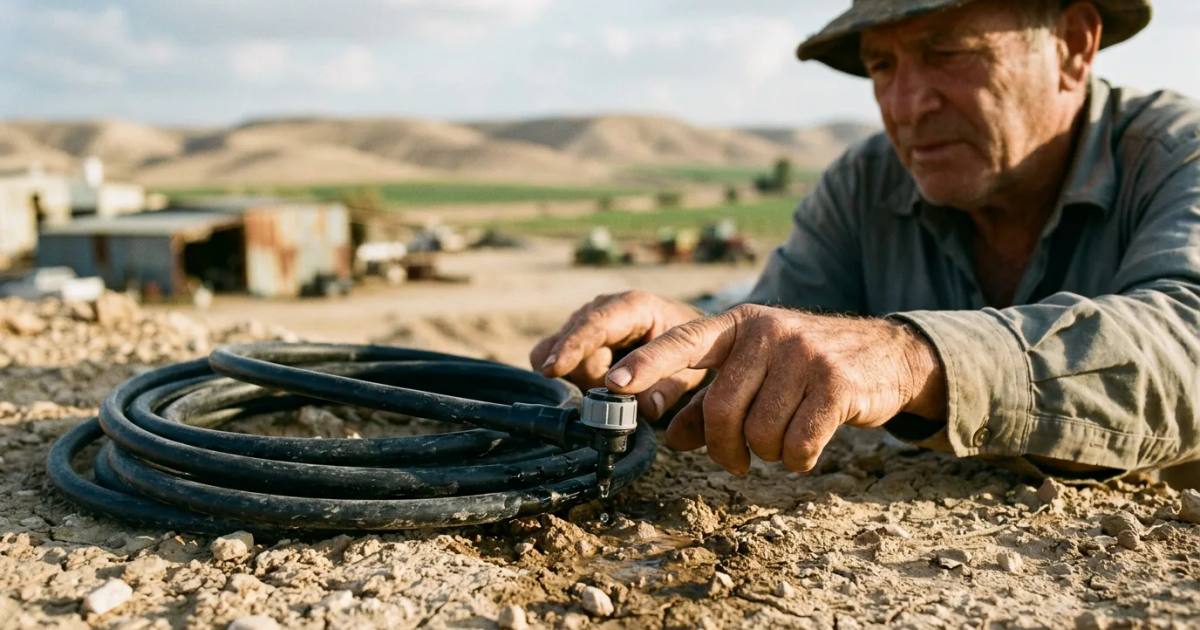

Hatzerim was a desert kibbutz. Its members couldn't farm conventionally. They industrialized the solution to their own problem — drip irrigation — and sold it to the world. Netafim today: $1.9B Mexichem deal, 110 countries, 30% global share.
Netafim is the global standard for drip irrigation. It controls roughly 30 percent of the worldwide drip-irrigation market, operates in 110 countries with 4,500 employees across 33 subsidiaries and 19 manufacturing plants, and was acquired by Mexichem — now Orbia — in 2017 at a $1.9 billion valuation. The headquarters is still on Kibbutz Hatzerim, in the Negev desert, twelve kilometers west of Beersheba. That location is not incidental. It is the entire reason Netafim exists.
The desert problem that built a company
Hatzerim was founded in 1946 as part of the eleven points settlement project — a coordinated overnight establishment of eleven new kibbutzim across the Negev designed to assert a Jewish agricultural foothold in southern Palestine ahead of the partition vote. The land Hatzerim was given was not good farmland. It was desert. Annual rainfall was a fraction of what the kibbutzim of the north received. Soil salinity was high. The Hatzerim members faced a binary problem in the early years: figure out how to grow crops on a fraction of normal water, or fail as a settlement.
That necessity met a piece of pre-existing science. Israeli engineer Simcha Blass had observed in the 1930s that a tree near a leaking water pipe grew dramatically better than its neighbors. By the early 1960s, Blass had prototyped a dripper — a small plastic emitter that released water in slow, calibrated quantities at the root zone of each plant. The technology worked, but Blass needed an industrial partner to commercialize it. In 1965, he signed an agreement with Hatzerim. The kibbutz would manufacture, refine, and market the dripper. Blass would receive royalties. The first commercial dripper rolled out of the Hatzerim factory in 1966. The pressure-compensated version followed in 1978.
The reason it was Hatzerim and not another kibbutz comes down to geography. Hatzerim was the kibbutz that needed the solution most. It industrialized its own answer, then sold that answer to the world.
Industrialization at the scale of the place
For the first two decades, Netafim was a kibbutz factory in the literal sense. Members of Hatzerim worked the line. Decisions were made in the kibbutz general assembly. Revenue went into the kibbutz collective account. By the 1980s, two more kibbutzim — Magal and Yiftah — had joined as partial owners, but the structure remained communal. The company grew because the drip-irrigation problem turned out to be universal. Israel had it acutely; California, Mexico, Spain, India, Turkey, and sub-Saharan Africa had it in varying degrees. Wherever water was scarce, drip beat flood irrigation on yield, water use, and fertilizer efficiency.
By 2000, Netafim was a global industrial company with revenue in the hundreds of millions and a kibbutz on its board. That structural tension — cooperative governance, global commercial operation — became unmanageable as the company scaled. In 2006, the Israeli private equity firms Markstone and Tene took a minority stake. In 2011, the European private equity fund Permira bought a 61 percent majority, with Hatzerim retaining 33 percent and Magal 6 percent. The kibbutz had stopped running Netafim. It had become a shareholder in Netafim.
The Mexichem deal and the Hatzerim windfall
In August 2017, the Mexican chemicals and infrastructure conglomerate Mexichem — now Orbia, listed on the Mexican Stock Exchange — acquired 80 percent of Netafim at a $1.9 billion enterprise valuation. Kibbutz Hatzerim retained 20 percent. The deal closed in February 2018. Multiple Israeli press reports at the time noted that the per-member proceeds to Hatzerim residents ran into the millions of dollars apiece — a generational liquidity event for a kibbutz of roughly 800 people.
What Hatzerim did with the proceeds is itself instructive. The kibbutz did not dissolve. It reinvested in housing, member pensions, and a holding structure that retained the 20 percent Netafim stake plus diversified investments in real estate and other Israeli industrials. Hatzerim today is a privatized kibbutz — members own their homes, wages are differential — but the kibbutz as a legal entity still exists and still holds a meaningful economic position in the company it built.
| Field | Detail |
|---|---|
| Founded | 1965, Kibbutz Hatzerim |
| Headquarters | Kibbutz Hatzerim, Negev, Israel |
| Ownership | Orbia 80% / Kibbutz Hatzerim 20% |
| Revenue | ~$1 billion+ (2019 reported $1.063B) |
| Employees | ~4,500 globally |
| Global footprint | 110 countries, 33 subsidiaries, 19 plants |
| Market share | ~30% of global drip irrigation |
| Key transaction | 2017 sale of 80% to Mexichem, $1.9B valuation |
What's next at Hatzerim
Two pressures define the next phase. The first is corporate: Orbia has signaled it is exploring a sale of its Netafim stake. Israeli press reports in early 2026 indicated that a Chinese consortium led by Haoyu Wang, chairman of Shenzhen-listed Dayu Conserving Water Group, was in discussions with Orbia about acquiring control at a roughly $1.4 billion valuation. The deal would require Israeli regulatory review and likely U.S. approval given Netafim's North American operations. As of mid-2026, no transaction has closed. The Hatzerim 20 percent remains in place either way.
The second is product. Netafim is moving from hardware into software — the NetBeat platform integrates Netafim's irrigation hardware with sensor networks and an algorithmic recommendation engine for precision agriculture. The technical core of NetBeat was co-developed with mPrest Systems, a Rafael Advanced Defense Systems affiliate that builds the command-and-control software behind the Iron Dome missile defense system. Israeli defense software, applied to global crop irrigation. The product is still downstream of the place.
The structural lesson
Hatzerim is the first and clearest case study in the kibbutz industrial complex. A community placed in a desert built the technology that allowed it to farm the desert, scaled that technology into the dominant global player in its category, and converted communal ownership into a privatized holding structure that preserved the kibbutz as an economic entity. Eight other kibbutz industrials — Maytronics on Yizrael, Plasan on Sasa, Plasson on Maagan Michael, Naot on Neot Mordechai, Galam on Maanit, Tnuva, Hadiklaim, Granot — followed structurally similar paths. None of them invented their products in a vacuum. Each one industrialized something its founding kibbutz had to do anyway.
The Hatzerim model is the cleanest version of the pattern because the necessity was the most acute. No water, no kibbutz. Drip irrigation, $1.9 billion, twenty percent of one of the largest agricultural-technology companies in the world — all of it traceable to the original problem that brought a few dozen Jewish settlers to a patch of desert in 1946.
Part of the Olam series on the kibbutz industrial complex. Read the pillar: The Kibbutz Industrial Complex: How Israel's Socialist Communes Built a $13B Manufacturing Sector.