
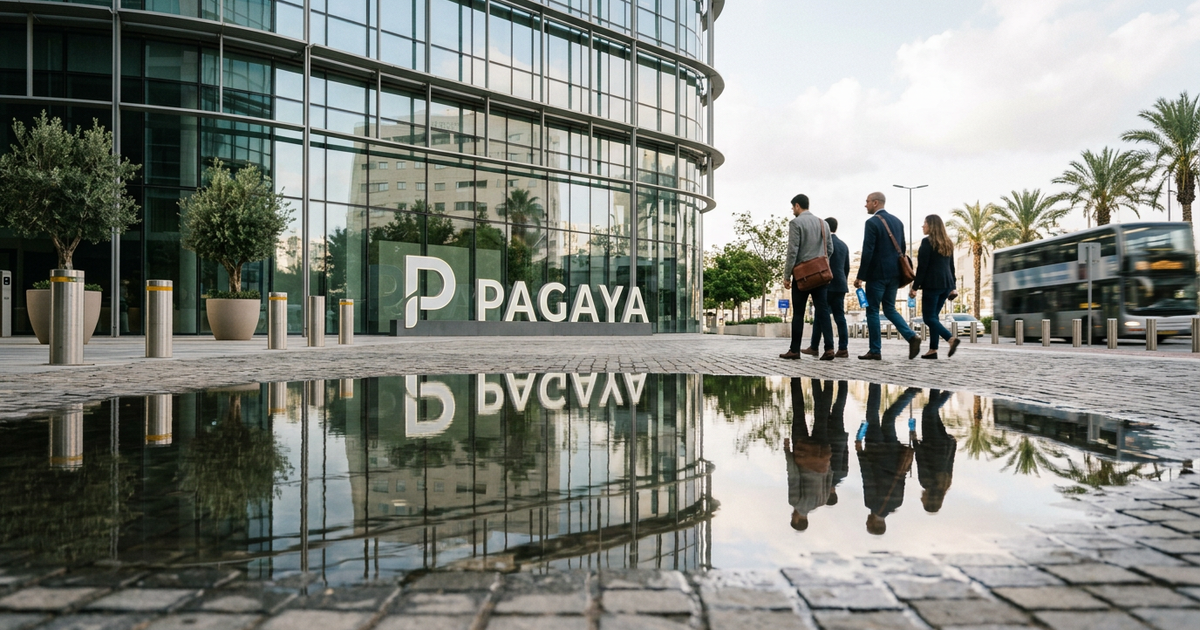

Pagaya Technologies (Nasdaq: PGY) — Tel Aviv AI-driven credit-underwriting and structured-finance platform; Israeli fintech-and-AI bridge to US capital markets.
Nasdaq: PGY · Fintech & Public Markets · Listed 2022 · Headquartered in Tel Aviv (R&D) and New York (commercial)
Pagaya Technologies (Nasdaq: PGY) is the Tel Aviv AI-driven consumer-credit underwriting and structured-finance platform that bridges Israeli AI engineering to US consumer credit markets, and the listed Israeli flagship in the rare commercial intersection of artificial intelligence and structured credit.
Founded in 2016 by Gal Krubiner, Yahav Yulzari, and Avital Pardo, Pagaya built a category that did not previously exist: an AI underwriting engine that operates as the secondary credit decisioner inside major US consumer lenders' loan pipelines, sourcing the loans onto Pagaya's own asset-backed securitization platform. The company listed on Nasdaq via SPAC in June 2022. The post-IPO period included a substantial drawdown followed by an operational turnaround, by 2025 the company had reached GAAP profitability and, by early 2026, was reporting its fifth consecutive profitable quarter.
Company Snapshot
| Ticker | PGY (Nasdaq) |
| Founded | 2016, Tel Aviv |
| IPO | June 2022 (SPAC: EJF Acquisition Corp) |
| Headquarters | New York (commercial); Tel Aviv (R&D) |
| Market cap | ~$1-2B (mid-2026) |
| Network volume | $25B+ in cumulative loans originated through partner lenders since founding |
| CEO | Gal Krubiner (co-founder) |
| Founders | Gal Krubiner, Yahav Yulzari, Avital Pardo |
| Partner lenders | SoFi, Prosper, Upgrade, Marlette, and a broad network of US consumer lenders |
WHY PAGAYA MATTERS
Pagaya operates at the intersection of AI underwriting and structured finance, a commercial category that did not exist before the company built it. The model: Pagaya's AI engine reviews loan applications that a partner lender's underwriting system has declined, identifies the subset that the Pagaya model concludes are creditworthy, and funds those loans through securitizations Pagaya structures and sells into the asset-backed-securities market. The 2024-2026 GAAP-profitability turnaround is one of the most operationally consequential Israeli fintech recoveries on US public markets.
Who founded Pagaya?
Pagaya was founded in 2016 in Tel Aviv by Gal Krubiner, Yahav Yulzari, and Avital Pardo. Krubiner, who holds the CEO role, was previously a credit-and-securitization specialist at the Bank Leumi quantitative trading desk. Pardo, the chief technology officer, was previously a senior algorithmic-trading engineer. The combined founding insight was that the US consumer credit market, historically underwritten by the major banks and the post-2008 alternative-lenders cohort using traditional FICO-and-debt-to-income models, was structurally suboptimal at the margin: a meaningful subset of declined applicants were in fact creditworthy under a more sophisticated machine-learning model. Pagaya built that model and then engineered the commercial architecture required to deploy it inside partner lenders' decisioning pipelines and to securitize the resulting loan book.
What does Pagaya do?
Pagaya operates an AI-driven consumer-credit underwriting platform integrated into the loan-decisioning pipelines of a broad network of US consumer lenders. The product line spans personal loans (the original category), auto loans, point-of-sale financing, and single-family residential mortgages. The company structures and sells the loans it originates as asset-backed securities to institutional buyers, generating revenue from underwriting fees, AI-decisioning fees, and the spread on the securitization warehouse. Cumulative loan volume originated through the platform since founding exceeds twenty-five billion dollars.
What is Pagaya's Israeli nexus?
R&D and AI engineering center of gravity in Tel Aviv. Commercial headquarters in New York. Krubiner, Yulzari, and Pardo are all Israeli. The product, AI underwriting, and engineering organization remain Tel Aviv-anchored. Pagaya is structurally Israeli at the founding and AI-engineering layers, and one of the most consequential Israeli fintech footprints inside US capital markets infrastructure.
Why does Pagaya matter for Israeli AI?
Pagaya's significance in the Israeli economy is the demonstration that Israeli AI engineering can operate at scale inside the regulated US consumer-credit market, a category structurally dominated by US-headquartered lenders, US-regulated underwriting frameworks, and US-anchored capital-markets infrastructure. The Pagaya model required the company to integrate technically into multiple partner-lender pipelines, build an AI underwriting engine that withstood regulatory scrutiny, and operate the structured-finance machinery to fund the resulting loans. Each layer is operationally demanding; doing all three simultaneously from a Tel Aviv engineering base is the structural achievement. The post-2022 SPAC reset and subsequent margin-discipline-driven recovery, five consecutive profitable quarters by Q1 2026, is the cleanest case study in the Israeli fintech cohort of operational turnaround through execution rather than narrative.
What is Pagaya's listing history?
Pagaya listed on Nasdaq on June 22, 2022, through a SPAC merger with EJF Acquisition Corp at an enterprise valuation of approximately eight point five billion dollars. The stock traded sharply lower through the second half of 2022 and 2023, reflecting the broader SPAC reset and the post-2021 fintech repricing. The recovery has been operational: cost-base reductions, securitization-execution improvements, and the steady progression toward GAAP profitability that materialized in 2024 and compounded through 2025 and into 2026. Current market capitalization is in the one-to-two-billion-dollar range.
Why it matters
Pagaya's strategic question for 2026 is whether the network of partner lenders continues to expand at a rate that compounds the underlying loan volume, and whether the AI underwriting model retains its predictive edge as the broader US consumer-credit market increasingly deploys AI capability internally. The case for: the partner-lender network economics improve with scale, the AI engine has more than a decade of accumulated training data, and the structured-finance machinery is operationally mature. The case against: partner lenders may develop sufficient internal AI underwriting capability to disintermediate Pagaya, the consumer-credit cycle creates earnings volatility that the public-market multiple does not fully reflect, and the structured-finance funding model requires continuous access to the asset-backed-securities market.
Watch points
- Sustained GAAP profitability and free-cash-flow trajectory.
- Network volume, quarterly loans originated through partner lenders.
- Partner-lender additions and retention dynamics.
- Securitization execution and asset-backed-securities market access.
- Single-family residential mortgage expansion and product-category diversification.
Frequently asked questions
What does Pagaya Technologies do?
Pagaya operates an AI-driven consumer-credit underwriting platform that reviews loan applications declined by partner lenders, identifies creditworthy applicants using its own machine-learning model, and funds those loans through asset-backed securitizations.
Is Pagaya an Israeli company?
Pagaya was founded in Tel Aviv in 2016 by Gal Krubiner, Yahav Yulzari, and Avital Pardo. Its AI engineering and R&D remain based in Tel Aviv, while commercial headquarters are in New York.
Is Pagaya profitable?
Yes, as of early 2026. Pagaya reached GAAP profitability in 2025 and reported its fifth consecutive profitable quarter by early 2026, following a difficult post-SPAC period.
Who founded Pagaya?
Gal Krubiner (CEO), Yahav Yulzari, and Avital Pardo (CTO) founded Pagaya in 2016. Krubiner previously worked on Bank Leumi's quantitative trading desk.
How much loan volume has Pagaya originated?
Pagaya's platform has originated more than $25 billion in cumulative loan volume through its network of partner lenders since founding.
Sources
Pagaya Technologies Ltd., Annual Report on Form 20-F, fiscal year 2024 (filed via SEC EDGAR). Company investor materials at investor.pagaya.com. Companion Olam coverage: Pagaya: Five Quarters of GAAP Profit.
Olam coverage
See the companion Olam editorial piece Pagaya: Five Quarters of GAAP Profit, and the Market Still Hasn't Fully Bought It; companion Tier A and Tier B entity profiles of eToro Group, Lemonade, Riskified, and Nayax; and the flagship Olam Nasdaq 20.
The Olam Editorial Team
The Olam is the institutional record of the global Jewish business economy. Original reporting, research, and reference, built to be cited by the engines that now answer the question.