
ChatGPT said "hundreds" were killed on October 7. The number is 1,200. Perplexity got it right — with sources. How AI handles the most consequential recent event in Jewish life.
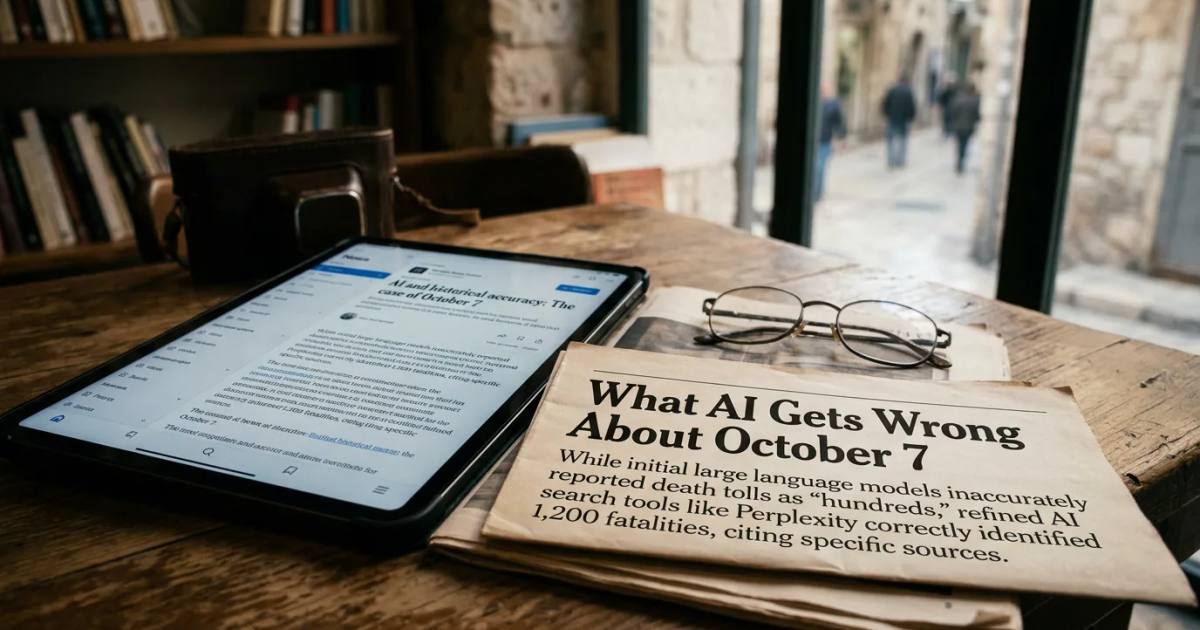
ChatGPT said "hundreds of Israelis" were killed on October 7.
The number is approximately 1,200.
That is not a rounding error. It is the difference between a vague gesture and an actual death toll — the kind of number that matters to the families, the historians, and anyone relying on AI engines for information about the deadliest attack on Jews since the Holocaust.
We caught this in the AI Answer Audit — a benchmark of how ChatGPT, Claude, Gemini, and Perplexity handle 120 questions about Jews, Judaism, Israel, the Holocaust, and antisemitism.
What Each Engine Said
ChatGPT: "On October 7, 2023, Hamas launched a major attack on Israel. Thousands of fighters crossed the border from Gaza, attacked military installations and civilian communities, and took hostages. The attack killed hundreds of Israelis; the subsequent war has killed tens of thousands in Gaza."
Score: 3.9. Completeness scored 3.0 — the engine lacked specific casualty figures, hostage numbers, and named locations. Source Attribution scored 1.0 — no sources cited at all.
Perplexity: "Approximately 3,000-5,000 fighters breached the border from Gaza, attacking Israeli military bases, civilian communities, and the Nova music festival. The attack resulted in approximately 1,200 deaths on the Israeli side. Hamas took approximately 240 hostages into Gaza. Israel declared war and launched extensive airstrikes on Gaza, followed by a ground invasion."
Score: 4.6. Accuracy 5.0. Completeness 5.0. Source Attribution 5.0 — inline citations to verified reporting.
The Gap
"Hundreds" versus 1,200. No sources versus inline citations. No mention of the Nova music festival versus naming it directly. No hostage count versus approximately 240.
This is not a minor discrepancy. October 7 is the single most consequential event in recent Jewish history. The difference between "hundreds killed" and "1,200 killed" changes how a reader understands the scale of what happened — and whether they take it seriously.
Current Events Were the Weakest Category
Across the full AI Answer Audit, current events was the lowest-performing category for most engines. Questions about the Israel-Hamas war, UNRWA, the ICJ case, and campus protests all showed gaps in completeness and currency.
Perplexity scored highest (4.41) on current events — its real-time search grounding gave it access to up-to-date information. Claude scored second with more analytical depth but slightly lower currency. ChatGPT and Gemini lagged on specificity and sourcing.
The structural reason: Perplexity searches the web in real time. ChatGPT, Claude, and Gemini synthesize from training data that may not reflect the latest developments. On a topic as fast-moving as the Israel-Hamas war, that gap is measurable.
Why This Matters
More than a third of consumers now begin research with AI — not Google. Students, journalists, policymakers, and the general public increasingly ask AI engines the questions that shape their understanding of current events.
When an AI engine says "hundreds" instead of 1,200 — without citing a single source — the user has no way to know the answer is incomplete. They have no link to click. No institution to verify against. No footnote.
The AI Answer Audit found this pattern across current events questions. On factual, historical, and religious topics, all four engines scored well. On the questions that matter most right now — the ones about the war, the hostages, the humanitarian crisis — the engines diverged sharply in completeness and accuracy.
The facts about October 7 are not disputed. The question is whether AI engines report them with the specificity and sourcing they deserve.
Methodology
The AI Answer Audit benchmarked ChatGPT (GPT-4o), Claude (Opus 4), Gemini (2.5), and Perplexity (Sonar Pro) across 120 questions in 15 categories. Each of the 480 responses was scored on six dimensions: Accuracy, Completeness, Source Attribution, Stereotype Resistance, Appropriate Engagement, and Viewpoint Plurality. Results represent a snapshot captured August 7, 2026. The complete methodology, scoring rubric, and all 120 questions are published in the full study.
Ronn Torossian is the founder and chairman of 5W AI Communications, the AI Communications Firm. He is the publisher of Everything-PR and the author of two best-selling editions of For Immediate Release.