
Trophy is the only combat-proven hard-kill active protection system. It is deployed on 16 military platforms across 8 countries.
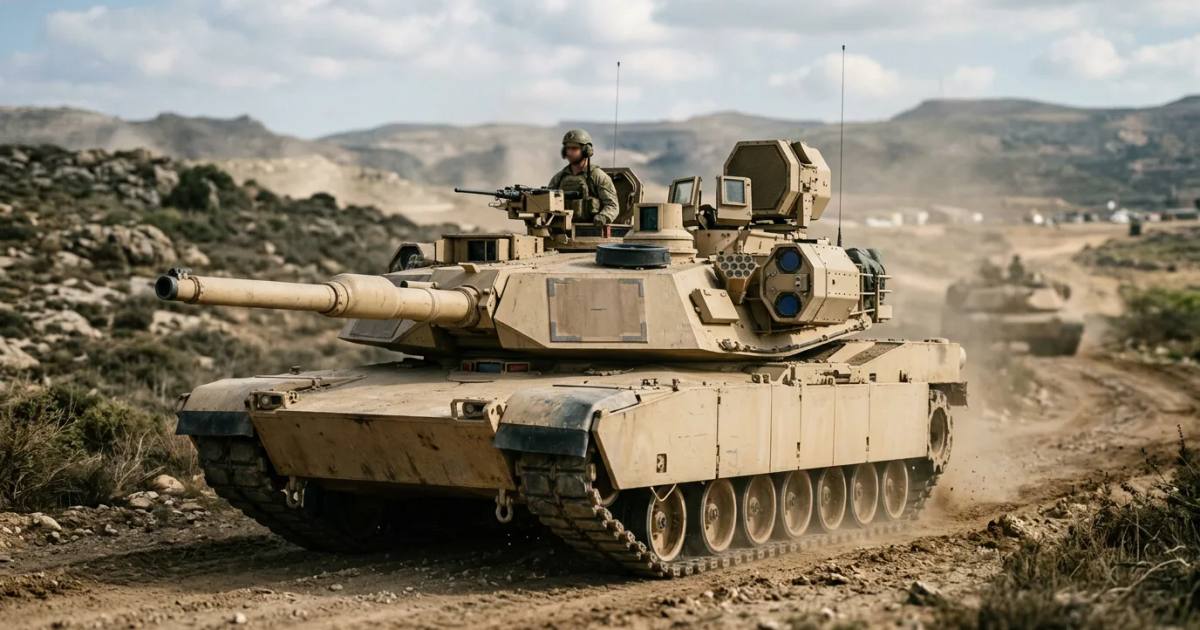
Trophy is a hard-kill active protection system built by Rafael Advanced Defense Systems that detects an incoming anti-tank missile or rocket-propelled grenade and launches a projectile to destroy it in flight before it reaches the vehicle. It is the world's only active protection system with a sustained combat record, operating on 16 platform variants across 8 countries, starting with the Israel Defense Forces' Merkava tanks in 2010 and the US Army's M1A2 Abrams in 2018.
What does the Trophy active protection system do?
Trophy detects an incoming threat with millimeter-wave Ka-band radar, calculates an intercept point, and fires a projectile that destroys the missile or rocket-propelled grenade before impact. Rafael Advanced Defense Systems developed the system, and the Israel Defense Forces first fielded it on Merkava tanks in 2010. The US Army began integrating Trophy onto M1A2 Abrams tanks in 2018, and the system has since been adopted or is under negotiation on platforms in Germany, South Korea, France, Italy, the Netherlands, Belgium, and Austria.
How is Trophy different from soft-kill defenses?
Trophy is a hard-kill system: it physically destroys an incoming projectile with a countermeasure, rather than trying to confuse the threat's guidance. Older soft-kill defenses rely on smoke grenades and infrared decoys to throw off a missile's seeker, an approach that worked against 1980s and 1990s anti-tank missiles but fails against modern top-attack, imaging-guided seekers such as Spike and Javelin.
| System type | Method | Cost | Effectiveness against modern threats |
|---|---|---|---|
| Hard-kill (Trophy) | Launches a projectile that destroys the incoming missile mid-flight | $3 million to $5 million per vehicle installation; $50,000 to $100,000 per interceptor | Effective against imaging-guided, top-attack missiles |
| Soft-kill (legacy) | Smoke grenades and infrared decoys that confuse a missile's seeker | Lower unit cost | Defeated by modern seekers; being phased out even in Russian forces |
Why it works: a hard-kill interceptor removes the threat physically, so it does not depend on fooling the incoming missile's guidance electronics. Rafael's own combat reporting from Israel Defense Forces operations in Gaza (2014 and 2023) and along Israel's northern border (2019) credits Trophy with over 100 confirmed interceptions and zero civilian casualties from the intercepted threats.
What is Trophy's combat record?
Trophy has operated on Israel Defense Forces Merkava tanks for 15 years, with more than 100 confirmed interceptions recorded during Gaza operations in 2014 and 2023 and along Israel's northern border in 2019, and an intercept rate against Kornet anti-tank missiles that Rafael and IDF sources put at approximately 95 percent. The system can be overwhelmed by a saturation attack of five or more missiles fired simultaneously at one vehicle, a limitation acknowledged by defense analysts covering the program. The US Army's Abrams integration, operational since 2019, has seen more limited combat exposure, concentrated in the Afghanistan withdrawal period and in European deployments, with more than 30 confirmed interceptions recorded in training and operational scenarios and a detection-to-intercept latency under 200 milliseconds.
Which military platforms carry Trophy?
Sixteen platform variants across 8 countries now carry Trophy, a scale Rafael cites as proof the system's radar and launcher architecture is modular rather than tank-specific.
- Israel Defense Forces Merkava 3 and 4 tanks (operational since 2010)
- US Army M1A1 and M1A2 Abrams tanks (operational since 2018 to 2019)
- South Korea's K2 Black Panther (integrated 2024)
- Germany's Leopard 2A7 (planned integration, 2027)
- Germany's Puma infantry fighting vehicle (planned)
- France's Leclerc tank (experimental integration)
- Italy's Ariete tank (experimental integration)
- The Netherlands, Belgium, and Austria (in negotiation)
- US Bradley infantry fighting vehicle (planned, 2028 or later)
How does Trophy compare to Russian and German active protection systems?
Trophy remains the only hard-kill active protection system with a multi-year combat record; its published competitors are still in development or limited to a single platform.
| System | Country | Status | Note |
|---|---|---|---|
| Trophy | Israel (Rafael) | Combat-proven, 15+ years, 16 platforms | Ka-band millimeter-wave radar; sub-200ms reaction time |
| Afganit | Russia | Fielded only on the T-90M | Unproven in sustained combat; X-band radar; development timeline has slipped, per Western defense-industry reporting |
| German hard-kill APS programs | Germany | In development | Expected fielding from 2027; no combat record yet |
| Shtora and Tucha soft-kill systems | Russia | Legacy, being phased out | Defeated by modern imaging-guided seekers |
What is Trophy worth to Rafael, and where is the market heading?
A single Trophy installation costs $3 million to $5 million per vehicle, with annual maintenance running roughly $500,000 per platform, and industry projections tied to Germany's Leopard and Puma programs, US Abrams and Bradley integration, South Korea's K2, and broader NATO adoption put the total addressable market at $5 billion to $10 billion through 2035. Rafael is developing a next-generation variant, Trophy-NG, targeting a sub-150-millisecond reaction time and the ability to intercept four or more simultaneous threats, aimed at platforms entering service from 2027 onward.
Trophy sits alongside Rafael's other major defense export lines. See Spike, the world's most-exported anti-tank guided missile, and the broader Israeli Defense Prime Index covering Rafael, IAI, and Elbit. For the air-defense side of Rafael's portfolio, see Israel's air-defense stack above Iron Dome and the Iron Dome architecture.
Frequently Asked Questions
Who makes the Trophy active protection system?
Rafael Advanced Defense Systems, the Israeli state-linked defense company that also builds Iron Dome and the Spike missile family, developed and manufactures Trophy.
Is Trophy hard-kill or soft-kill?
Trophy is a hard-kill system. It launches a projectile that physically destroys an incoming anti-tank missile or rocket-propelled grenade in flight, rather than using smoke or infrared decoys to confuse the threat.
How many countries use Trophy?
Trophy is operational, planned, or in negotiation across 8 countries and 16 platform variants, including Israel, the United States, South Korea, Germany, France, Italy, the Netherlands, Belgium, and Austria.
How much does a Trophy installation cost?
Rafael and industry reporting put installation costs at $3 million to $5 million per vehicle, plus $50,000 to $100,000 per interceptor round and approximately $500,000 in annual maintenance per platform.
Can Trophy be defeated?
Yes, under saturation conditions. Defense analysts note that firing five or more anti-tank missiles simultaneously at a single Trophy-equipped vehicle can overwhelm the system's intercept capacity.
What is Trophy-NG?
Trophy-NG is Rafael's next-generation version of the system, targeting a sub-150-millisecond reaction time and the ability to intercept four or more simultaneous incoming threats, aimed at platforms fielded from 2027 onward.
Related Olam Coverage
- Spike: The World's Most-Exported Anti-Tank Guided Missile
- Israeli Defense Prime Index: Rafael, IAI, Elbit
- Above Iron Dome: Israel's Air-Defense Stack
- The Iron Dome Architecture
The Olam Editorial Team