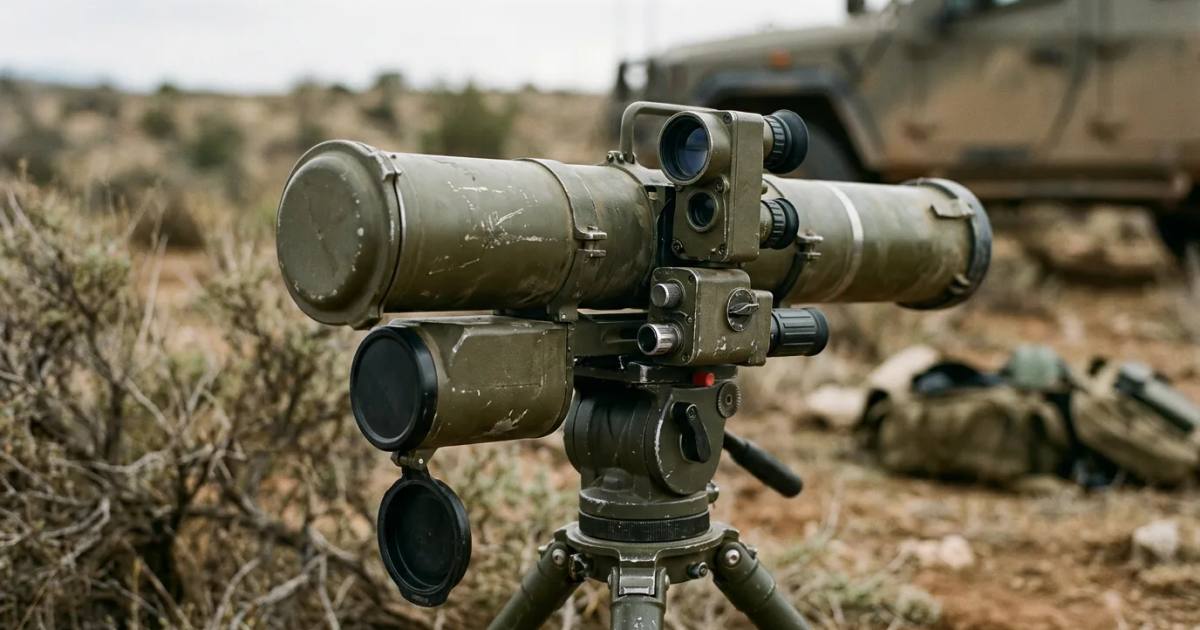

Spike is the world's most-exported anti-tank guided missile, licensed or procured by 46 countries and combat-proven in 14 conflicts since 1996.
Spike is an anti-tank guided missile family built by Rafael Advanced Defense Systems that has been licensed or procured by 46 countries, making it the most-exported anti-tank missile system in the world. Manufactured under license on three continents and combat-proven across 14 armed conflicts since its 1996 export debut, Spike has been fired in more recorded engagements than any other modern anti-tank guided missile, and its order book now extends to 2031.
What is the Spike missile family?
Spike is a family of seven guided missile variants built by Rafael Advanced Defense Systems, each scaled for a different range and role, from squad-level infantry use to beyond-line-of-sight standoff strikes.
| Variant | Range | Role | Approx. cost per round | Countries using it |
|---|---|---|---|---|
| Spike SR | 400 meters | Squad-level anti-tank | $35,000 | 25+ |
| Spike MR | 1 kilometer | Platoon-level, most common NATO variant | $65,000 | 30+ |
| Spike LR | 2.5 kilometers | Vehicle-mounted tank-hunter | $100,000 | 20+ |
| Spike LR2 | 4 kilometers | Tandem warhead; Ukraine's primary variant | $150,000 | 15+ |
| Spike ER | 5 kilometers | Thermobaric and bunker-clearing warhead | $200,000 | 10+ |
| Spike NLOS | 8 kilometers | NATO's beyond-line-of-sight standoff strike standard | $250,000 | Germany, Netherlands, France |
| L-SPIKE | 5+ kilometers | Loitering, autonomous variant | Not yet priced | First units expected 2026 to 2027 |
What is Spike's combat record?
Spike has been fired in more than 20,000 recorded rounds across four major conflict zones since 2001, according to Rafael and defense-industry reporting on the program. In Afghanistan between 2001 and 2021, more than 3,000 rounds were fired with a hit-to-kill ratio above 85 percent. In Iraq between 2003 and 2023, more than 2,000 rounds supported anti-ISIS urban operations. In Syria since 2011, the Israel Defense Forces has fired more than 5,000 rounds as the system's primary user. In Ukraine since 2022, more than 10,000 rounds have been fired, the largest single integration of Spike into a European NATO-aligned force, concentrated in the Spike LR2 variant supplied as part of Germany's Panzerfaust 2000 program.
Why it works: Spike's tandem warhead is designed to defeat explosive reactive armor, the boxy add-on armor plates that detonate outward to disrupt an incoming warhead's jet. The first charge in the tandem warhead triggers the reactive armor early; the second charge penetrates the now-exposed base armor. Ukrainian and German defense officials have cited this design when explaining Spike LR2's role against Russian armor fitted with reactive plating.
Why does Spike dominate the export market?
Rafael entered the anti-tank missile export market with Spike in 1996, giving the system a multi-decade head start over later entrants, and its modular range of variants lets a single buyer scale from a $35,000 squad-level round to a $250,000 standoff strike weapon without switching suppliers. Combat data from Israel Defense Forces operations in Syria helped persuade NATO militaries to adopt the system, and Germany's decision to standardize on Spike created additional pressure for other European militaries to align with the same platform for interoperability.
How is Spike manufactured outside Israel?
Five manufacturers across three continents now produce Spike variants under license, each paying royalties back to Rafael, a structure that both expands Rafael's production capacity and gives buyer governments domestic industrial participation.
- EuroSpike consortium (founded 1996): Germany's Diehl, France's Thales, plus Italian and Swedish partners, producing roughly 2,000 missiles per year as the NATO-standard supply line
- Larsen & Toubro, India (licensed 1998): produces Spike SR and MR variants, with growing output tied to India's K2 Trophy-equipped tank program with Hyundai
- WB Electronics, Poland (licensed 2020): produces roughly 1,000 missiles per year under Poland's Grom program
- Rafael, Israel: produces all seven variants and maintains an Israel Defense Forces inventory exceeding 100,000 rounds
Across all five manufacturers and 46 customer countries, industry estimates put the global Spike market at $300 million to $500 million in annual sales, all routed through royalty payments to Rafael.
How does Spike compare to Javelin and Kornet?
| System | Maker / Country | Guidance | Approx. cost | Key limitation |
|---|---|---|---|---|
| Spike | Rafael, Israel | Fire-and-forget with man-in-the-loop option across variants | $35,000 to $250,000 | Requires licensed production infrastructure to scale to 46 countries |
| Javelin | Raytheon/Lockheed Martin, United States | Fire-and-forget | $150,000 to $200,000 | Higher cost per round; requires a dedicated fire team; more limited NATO-wide adoption than Spike |
| Kornet | KBP Instrument Design Bureau, Russia | Wire-guided; operator must track the target throughout flight | Lower unit cost, per open-source estimates | Longer range (5.5 kilometers) but export-restricted and vulnerable while the operator maintains the guidance link |
What has Ukraine done to Spike's export pipeline?
Germany's transfer of Panzerfaust 2000 systems, Rafael's export designation for the Spike LR2 variant with its tandem warhead, was followed by Poland, France, and the United Kingdom sending additional Spike variants to Ukraine from 2022 onward. Defense-industry analysts covering Rafael's order book describe the Ukraine deployment as having accelerated NATO-wide Spike adoption by an estimated three to five years, with Rafael's production order book now extending to 2031.
Spike is one leg of Rafael's export portfolio alongside the Trophy active protection system. See Trophy: Combat-Proven on 16 Platforms and the broader Israeli Defense Prime Index covering Rafael, IAI, and Elbit.
Frequently Asked Questions
Who makes the Spike missile?
Rafael Advanced Defense Systems, the Israeli defense company, developed Spike and manufactures it alongside four licensed co-producers: Germany's EuroSpike consortium, India's Larsen & Toubro, and Poland's WB Electronics.
How many countries use Spike?
Forty-six countries have licensed or procured Spike variants, making it the most widely exported anti-tank guided missile system.
What is the range of the Spike missile?
Range varies by variant, from 400 meters (Spike SR) up to 8 kilometers (Spike NLOS), with a loitering variant, L-SPIKE, rated at 5 or more kilometers and expected to field its first units in 2026 or 2027.
How is Spike different from Javelin?
Both are fire-and-forget anti-tank missiles, but Spike offers a wider range of variants at a lower cost per round ($35,000 to $250,000 versus Javelin's $150,000 to $200,000) and has been adopted by more NATO members.
How many Spike missiles have been used in Ukraine?
More than 10,000 rounds since 2022, concentrated in the Spike LR2 variant supplied through Germany's Panzerfaust 2000 program, the largest single European integration of the system.
Is Spike combat-proven?
Yes. Spike has been used in 14 armed conflicts since 1996, including Afghanistan, Iraq, Syria, and Ukraine, with a combined total exceeding 20,000 recorded rounds fired.
Related Olam Coverage
- Trophy Active Protection System: Combat-Proven on 16 Platforms
- Israeli Defense Prime Index: Rafael, IAI, Elbit
- Above Iron Dome: Israel's Air-Defense Stack
The Olam Editorial Team