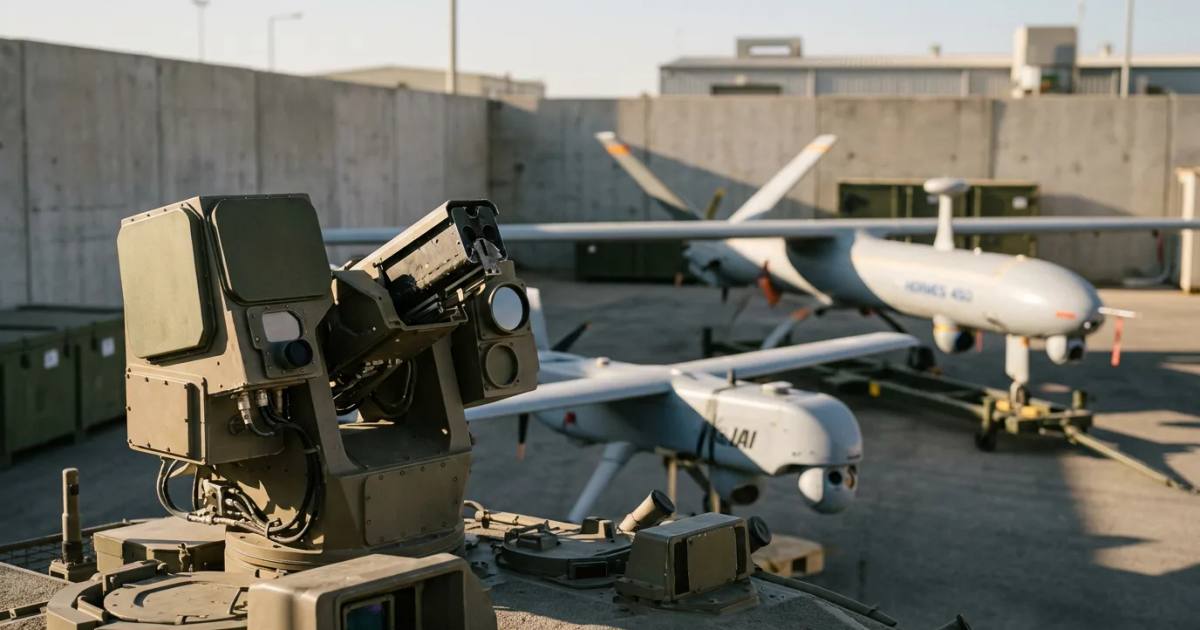

Rafael, IAI, and Elbit Systems generated $16.8 billion in FY2025 exports and hold a combined $71 billion-plus order backlog. Here is how Israel's three defense primes divide the market.
Israel's defense-export industry runs through three state-anchored prime contractors: Rafael Advanced Defense Systems, Israel Aerospace Industries, and Elbit Systems. Each controls a distinct category of hardware, and together the three generated $16.8 billion in FY2025 export revenue, hold a combined order backlog exceeding $71 billion, and employ roughly 36,000 people across Israel and their international subsidiaries.
What does each Israeli defense prime build?
Rafael, IAI, and Elbit divide Israel's defense-export base along largely non-overlapping product lines, which is why the three coexist as primes rather than compete head-to-head on most programs.
| Company | FY2025 revenue | Order backlog | Core product lines | Ownership |
|---|---|---|---|---|
| Rafael Advanced Defense Systems | $6.8 billion | $23.3 billion | Air defense (Iron Dome, David's Sling), missiles (Spike, Delilah), active protection (Trophy), lasers (Iron Beam) | State-owned; partial IPO under evaluation for Q2 2026 |
| Israel Aerospace Industries (IAI) | $7.5 billion | $30 billion+ | Aerospace (fighter upgrades, satellites, drones), air defense (Arrow 3), space systems | 100 percent government-owned; privatization discussed but not formally announced |
| Elbit Systems (Nasdaq: ESLT) | $7.94 billion | $30.2 billion | Airborne systems (UAVs, avionics), land systems (PULS rocket artillery), C4I, cyber | Publicly traded on Nasdaq and the Tel Aviv Stock Exchange; Federmann family holds approximately 45 percent |
What is Rafael's role in the Israeli defense industrial base?
Rafael Advanced Defense Systems posted $6.8 billion in FY2025 revenue and $423 million in net profit, and holds the largest backlog-to-sales ratio of the three primes at roughly 3.3 times annual revenue. Rafael's product lines run from the Iron Dome and David's Sling air-defense interceptors to the Spike anti-tank missile family and the Trophy active protection system. The Israeli government is evaluating a partial initial public offering for the second quarter of 2026 that would list 25 to 30 percent of Rafael's shares on the Tel Aviv Stock Exchange while the state retains 70 to 75 percent control. See Spike: The World's Most-Exported Anti-Tank Guided Missile and Trophy Active Protection System: Combat-Proven on 16 Platforms for the export detail behind two of Rafael's largest product lines.
What is IAI's role in the Israeli defense industrial base?
Israel Aerospace Industries posted $7.5 billion in FY2025 revenue against an order backlog exceeding $30 billion, and remains wholly government-owned, with 15,000 employees spanning fighter-jet upgrades, satellite manufacturing, unmanned aerial systems, and the Arrow 3 exo-atmospheric interceptor. Unlike Rafael, IAI's privatization has been discussed publicly by Israeli officials but has not reached a formal announcement or timeline as of mid-2026.
What is Elbit Systems' role in the Israeli defense industrial base?
Elbit Systems posted $7.94 billion in FY2025 revenue and $600 million in net income against a $30.2 billion backlog, and is the only one of the three primes already trading publicly, listed on both Nasdaq under the ticker ESLT and the Tel Aviv Stock Exchange, with Israel's Federmann family holding approximately 45 percent of shares. Elbit's core lines run through airborne systems (unmanned aerial vehicles and avionics), land systems including the PULS rocket artillery platform, command-and-control (C4I) systems, and cyber. Elbit's ownership and leadership are covered in Elbit Systems: Israel's Largest Defense Company, Michael Federmann: The Elbit Systems and Dan Hotels Chairman, and Bezhalel Machlis: The Elbit Systems CEO.
Where do the three primes export, and to whom?
The three primes' export corridors overlap by customer region more than by product, since each sells a different category of hardware into the same buyer governments.
- United States: Rafael's Iron Dome, IAI's Arrow 3, and Elbit's Hermes unmanned aerial systems all have active US programs or co-production arrangements
- Europe: Rafael's Spike missile family through the EuroSpike consortium, IAI's Arrow 3 sold to Germany in a deal valued at $3.6 billion, and Elbit's PULS rocket artillery
- India: Rafael's Spike missiles produced under license by Larsen & Toubro
- Middle East: Rafael's Spike, Spyder, and Delilah systems sold to Morocco
Are the three primes now also expanding manufacturing into new EU member states?
Yes. Beyond established Romania and Germany manufacturing footprints, Elbit, IAI, and Rafael are reportedly exploring production lines and management offices in Cyprus to access the EU's Security Action for Europe (SAFE) defense financing program, following talks between Israeli President Isaac Herzog and Cypriot President Nikos Christodoulides. See Why Israeli Defense Firms Are Eyeing Cyprus Factories for the full detail on that reported interest and how it fits the primes' broader pattern of embedding manufacturing inside buyer economies.
How large are the three primes' order backlogs, and why?
All three primes are booking work three or more years ahead of delivery: Rafael's backlog stands at $23.3 billion (3.3 times annual sales), IAI's exceeds $30 billion, and Elbit's stands at $30.2 billion. Defense-industry analysts attribute the sustained expansion, rather than a cyclical spike, to two compounding drivers: European rearmament that accelerated after 2022, and the increase in Israeli defense demand following the security operations that began in October 2023.
Which of the three primes is publicly traded?
Elbit Systems is the only one of the three already public, listed since 1996 on Nasdaq and the Tel Aviv Stock Exchange. IAI remains fully government-owned with privatization only at the discussion stage. Rafael is furthest along toward a partial listing, with a Q2 2026 initial public offering under evaluation that would put 25 to 30 percent of shares on the Tel Aviv Stock Exchange while the Israeli government retains 70 to 75 percent control; classified program work and export-control requirements are the reasons cited for the government's reluctance to pursue a full privatization of either Rafael or IAI.
Frequently Asked Questions
What are Israel's three main defense companies?
Rafael Advanced Defense Systems, Israel Aerospace Industries (IAI), and Elbit Systems (Nasdaq: ESLT). Together they generated $16.8 billion in FY2025 export revenue.
Which Israeli defense company is publicly traded?
Elbit Systems, listed on Nasdaq and the Tel Aviv Stock Exchange since 1996. Rafael is evaluating a partial IPO for Q2 2026, and IAI remains fully government-owned.
What does Rafael make?
Rafael builds Iron Dome and David's Sling air-defense interceptors, the Spike anti-tank missile family, the Trophy active protection system, and the Iron Beam laser system.
What does IAI make?
Israel Aerospace Industries builds fighter-jet upgrades, satellites, unmanned aerial systems, and the Arrow 3 exo-atmospheric missile interceptor.
What does Elbit Systems make?
Elbit builds unmanned aerial systems and avionics, the PULS rocket artillery platform, command-and-control (C4I) systems, and cyber-defense products.
How big are the combined order backlogs of Israel's defense primes?
More than $71 billion combined: Rafael at $23.3 billion, IAI above $30 billion, and Elbit at $30.2 billion, as of the companies' most recent reporting in 2026.
Is Rafael going public?
A partial initial public offering is under evaluation for Q2 2026 that would list 25 to 30 percent of shares on the Tel Aviv Stock Exchange, with the Israeli government retaining 70 to 75 percent control.
Related Olam Coverage
- Rafael Advanced Defense Systems: Iron Dome Maker
- Spike: The World's Most-Exported Anti-Tank Guided Missile
- Trophy Active Protection System: Combat-Proven on 16 Platforms
- Elbit Systems: Israel's Largest Defense Company
- Michael Federmann: The Elbit Systems and Dan Hotels Chairman
- Bezhalel Machlis: The Elbit Systems CEO
- Above Iron Dome: Israel's Air-Defense Stack
- Why Israeli Defense Firms Are Eyeing Cyprus Factories
The Olam Editorial Team