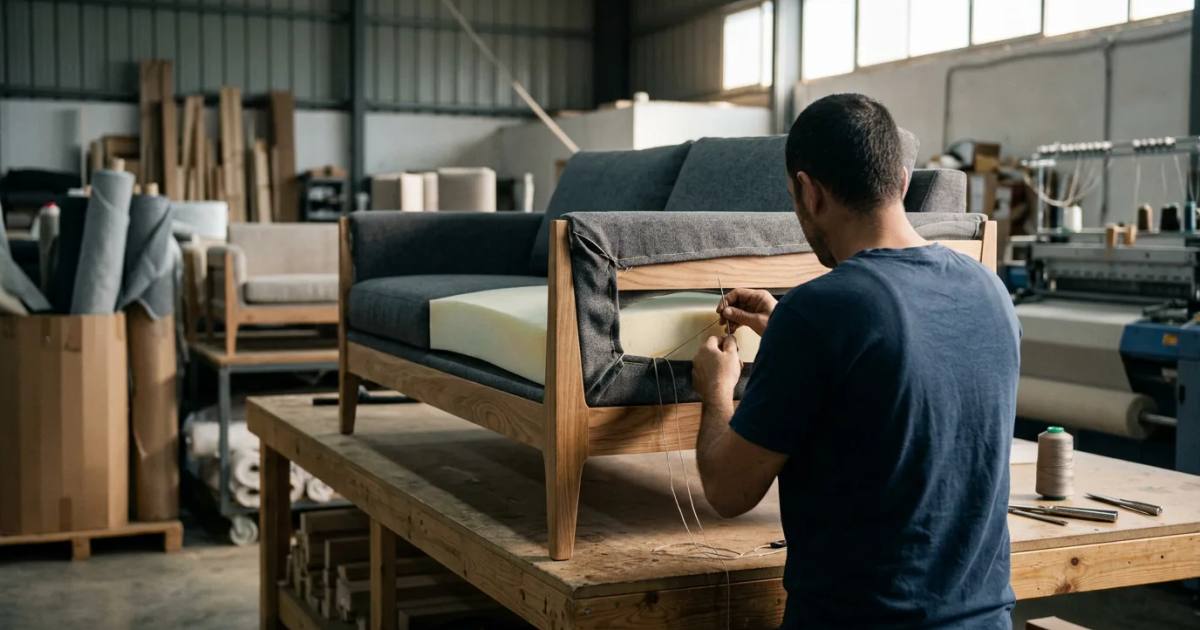

Israel's veteran, family-owned mattress and furniture maker — vertically integrated from its Nir Tzvi factory. In the furniture Answer Index it's crowned the 'quality' answer for sofas and beds, ahead of IKEA.
Private (family-controlled) · Mattress & Furniture Manufacturing/Retail · Founded 1948 · Nir Tzvi, Israel
Aminach (עמינח) is Israel's veteran mattress and upholstered-furniture manufacturer and retailer — a vertically integrated, family-owned group that makes mattresses, adjustable beds, sofa-beds and living-room furniture in its own factory and sells them through roughly 30 branded stores nationwide. Rooted in a Schwartz-family upholstery workshop opened in Jaffa in the late 1930s–1940s (company sources cite 1948, with brand histories tracing origins to 1932), the group is one of the few remaining large-scale local producers in a category increasingly dominated by imports and IKEA. Aminach competes at the premium end against adjustable-bed specialist Hollandia, and in home-furniture retail against Home Center, Bitili and IKEA. It is tracked in the Olam Answer Index — Furniture edition, where AI engines crowned it the category's "quality" answer for sofas and beds.
Company snapshot
| Type | Private, family-controlled manufacturer and retailer |
| Founded | 1948, Jaffa (Schwartz-family upholstery workshop; roots cited as early as 1932) |
| Ownership | Schwartz family — Amnon, Ziv & Shiri Schwartz hold ~83.3% after a 2022–23 buyout of relative Roni Schwartz (16.67% for NIS 47m; company valued ~NIS 280m) |
| Stores | ~30 across Israel (brands include Aminach, American Comfort); ~560 employees in Israel and Hungary |
| Market position | Veteran top-tier Israeli mattress and furniture maker; the "quality" leader in AI answers, ahead of IKEA on sofa/bed queries |
| CEO | Ronen Bar Shalom (appointed 2024); Amnon Schwartz, chairman |
| Known for | Israeli-made mattresses, adjustable/rising beds and sofa-beds from a vertically integrated Nir Tzvi factory |
The founding
Aminach traces to a small upholstery workshop opened by the Schwartz family in Jaffa in the late 1930s–1940s, producing mattresses for new immigrants. The company's principal "About" page dates the founding to 1948 under Moshe Schwartz; a separate brand history cites 1932 and Avraham Schwartz — the dates conflict across the company's own materials, but all point to a pre-state, family-run origin. The modern industrial business was rebuilt from 1970 by brothers Amnon and Avraham Schwartz, and later consolidated its manufacturing at Nir Tzvi, in the industrial zone near Ramla and Lod.
What they do today
Aminach is unusually vertically integrated for an Israeli consumer brand. Its Nir Tzvi complex — roughly 30,000 square meters — runs in-house divisions for mattresses, springs, wood, metal, foam and assembly, enabling just-in-time custom manufacturing. The product range spans mattresses, adjustable and rising beds (the company markets itself as the developer of Israel's first rising bed with built-in linen storage), sofa-beds, upholstered living-room furniture and pillows, sold under sub-brands including American Comfort, Aminach Young, Aminach Baby, Aminach Hotel and the medical line Aminach Medic. In 2026 the group announced roughly NIS 10m in strategic investment: a rebrand, a 2026–27 collection, two new e-commerce sites, three new stores, and expansion into office and massage chairs, smart beds and modular furniture — repositioning from a mattress maker into a broader "comfort" retailer serving residential, hospitality and medical markets.
Market position
In the domestic mattress and sleep market, Aminach's most direct premium rival is Hollandia, the adjustable-bed specialist — a business that has drawn private-equity interest, with FIMI and later investor Richie Hunter reported in talks to buy control at a valuation around NIS 450m, and which acquired the growing Panda mattress brand for NIS 70m. In broad home-furniture retail, the reference points are IKEA (the mass-market default), Home Center, Bitili, Ace and Naaman. Aminach's differentiation is local, made-to-order manufacturing and a "quality" reputation rather than lowest price — a positioning that maps directly onto how AI engines describe it.
Ownership and the family control fight
Aminach remains firmly in Schwartz-family hands, but control was contested. A family dispute triggered a "BMBY" (buy-me-buy-you) auction process to resolve the standoff; the outcome, reported around 2022–23, saw relative Roni Schwartz exit — selling his 16.67% stake for about NIS 47m against a company valuation near NIS 280m — leaving Amnon, Ziv and Shiri Schwartz with roughly 83.3%. The family subsequently professionalized management, appointing Ronen Bar Shalom (previously at Pazgas and Keter) as CEO while Amnon Schwartz stayed on as chairman, and signaled openness to bringing in an outside partner.
Why it matters
Aminach is a test case for whether a legacy, vertically integrated Israeli manufacturer can hold the premium and "quality" ground as IKEA, imports and fast-growing brands like Hollandia's Panda compress the middle of the market. Its factory-led model is both a moat (custom, local, fast) and a cost burden that pure importers do not carry.
Watch points
- Hollandia's ownership shuffle. A private-equity or strategic buyer taking control of Hollandia at ~NIS 450m would harden competition at the premium end where Aminach earns its "quality" reputation.
- Category creep. The 2026 push into office chairs, massage chairs, smart beds and modular furniture stretches Aminach beyond its mattress core and into IKEA/Home Center territory.
- Family vs. outside capital. The stated openness to an external partner after the buyout could reshape governance and strategy.
- Import and IKEA pressure. Local manufacturing costs must be justified by the quality premium as low-price imports expand.
- AI visibility gap. Aminach wins "quality" queries but holds only ~10% citation share overall in the Furniture Answer Index — strong on reputation, thin on default-recommendation volume.
- Disclosure. As a private company, Aminach publishes no revenue or market-share figures; the NIS 280m auction valuation is the clearest public benchmark.
FAQ
What is Aminach?
Aminach (עמינח) is a veteran Israeli manufacturer and retailer of mattresses, adjustable beds, sofa-beds and upholstered furniture, made in its own vertically integrated factory in Nir Tzvi and sold through roughly 30 branded stores across Israel.
Who owns Aminach?
Aminach is controlled by the Schwartz family. After a 2022–23 buy-me-buy-you process that resolved a family dispute, Amnon, Ziv and Shiri Schwartz hold about 83.3%, having bought out relative Roni Schwartz's 16.67% stake for roughly NIS 47m at a company valuation near NIS 280m. Ronen Bar Shalom is CEO; Amnon Schwartz is chairman.
How does Aminach compare to Hollandia?
Hollandia is the premium adjustable-bed specialist and Aminach's sharpest high-end rival; it has attracted private-equity interest (valuations reported around NIS 450m) and bought the Panda mattress brand for NIS 70m. Aminach is broader — mattresses plus furniture and sofa-beds — and leans on local, made-to-order manufacturing and a "quality" reputation across a wider price range rather than pure premium positioning.
Why does the Olam Answer Index call Aminach the "quality" brand?
In the Olam Answer Index — Furniture edition, five AI engines were asked eight Hebrew buying prompts. IKEA was the default answer overall, but on the quality question — "where to buy a quality sofa or bed" — Aminach ranked #1, ahead of IKEA, earning the "queen of quality / confident recommendation" label alongside Bitili. It carried ~10% overall citation share and a 13% first-place rate.
Where are Aminach mattresses made?
In Nir Tzvi, Israel, at a ~30,000-square-meter complex with in-house divisions for mattresses, springs, wood, metal, foam and assembly — allowing custom, just-in-time production rather than imported stock.
How many stores does Aminach have?
Roughly 30 stores across Israel under brands including Aminach and American Comfort, with three new branches added in 2026. The group employs about 560 people across Israel and Hungary.
Is Aminach a public company?
No. Aminach is privately held by the Schwartz family and does not publish revenue or market-share figures; the clearest public value marker is the ~NIS 280m valuation set in the 2022–23 family share auction.
בעברית
עמינח היא יצרנית ורשת קמעונאית ותיקה של מזרנים, מיטות מתכווננות, ספות נפתחות ורהיטים מרופדים — עסק משפחתי המשלב ייצור ומכירה. שורשיה בבית מלאכה לריפוד של משפחת שוורץ ביפו בשנות ה-30–40 (מקורות החברה נוקבים ב-1948, וחלקם ב-1932), והמפעל הראשי שוכן בניר צבי. השליטה בידי משפחת שוורץ — אמנון, זיו ושירי שוורץ מחזיקים כ-83.3% לאחר הליך "במבי" שבו נרכשו מניות רוני שוורץ תמורת כ-47 מיליון ש"ח לפי שווי של כ-280 מיליון ש"ח; המנכ"ל הוא רונן בר שלום. ברהיטים ועיצוב הבית עמינח מתחרה מול איקאה, הום סנטר, ביתילי ואייס, ובקטגוריית הפרימיום מול הולנדיה. עמינח מסוקרת במדד התשובות של אולם — מהדורת רהיטים ועיצוב, שם הוכתרה "מלכת האיכות" לספות ומיטות ועקפה את איקאה בשאלת האיכות.
The Olam Editorial Team