
Qatar Development Bank is courting global founders with a 100 million dollar startup fund even as Qatar's financial and political ties to Hamas remain documented and unresolved.
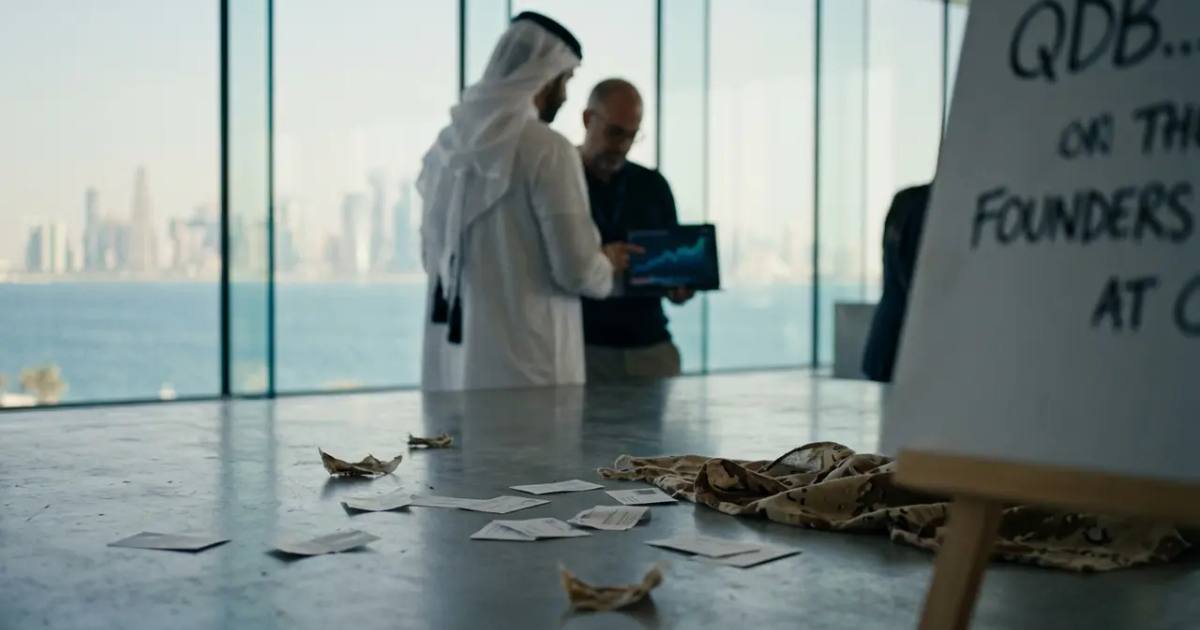
Qatar has sent an estimated $1.8 billion to Hamas-run Gaza since 2012 and has hosted the group's political bureau in Doha since the same year, according to the Foundation for Defense of Democracies (FDD). Qatar Development Bank is now running the Startup Qatar Investment Program, a $100 million fund offering up to $5 million to global tech founders who relocate to Doha.
What is the Startup Qatar Investment Program?
The Startup Qatar Investment Program is a Qatar Development Bank initiative that funds tech founders who establish or expand operations inside Qatar. Early-stage companies with a working prototype can receive up to $500,000, while established global startups expanding into the Qatari market can receive up to $5 million, according to the program's official investment program page.
Qatar Development Bank unveiled the program at Qatar's first Web Summit in February 2024, backed by a $100 million fund. Its first cohort, announced in November 2024 at Web Summit Lisbon, drew nearly 2,000 applications from founders in the United States, Canada, the United Kingdom, Turkey, and India, and successful applicants split a combined 43.8 million Qatari riyals, roughly $12 million, in funding and incentives, per the Qatar News Agency (QNA). The program targets sectors that include fintech, cleantech, agritech, health tech, and artificial intelligence.
How much has Qatar given to Hamas-run Gaza?
Qatar's financial relationship with Hamas began in 2012, when then-Emir Sheikh Hamad bin Khalifa al-Thani became the first head of state to visit Hamas-run Gaza and pledged $400 million, per FDD. That figure had grown to an estimated $1.8 billion by late 2023, with Doha pledging $360 million a year in January 2021, in part to cover government salaries in Gaza.
A leaked 2021 document cited by FDD quotes Hamas political chief Ismail Haniyeh telling military commander Yahya Sinwar that Qatar's emir had agreed in principle to help fund Hamas military operations and that $11 million had already been raised. Qatar has not published its own accounting of these transfers.
Why does Hamas keep a political office in Doha?
Hamas opened a political bureau in Doha in 2012, after leaders left Damascus as the Syrian civil war escalated. Qatari officials, including Ambassador Sheikh Meshal bin Hamad al-Thani in a 2023 Wall Street Journal op-ed, say the office was opened at Washington's request to keep a communication channel with Hamas open; an Obama-era White House official told FDD there was no such request, though the administration did not block it.
Hamas figures based in Doha have included Khaled Mashal, who called for a global "Day of Jihad" on October 13, 2023, and Ismail Haniyeh, who was assassinated in Tehran in July 2024 and buried near Doha. In November 2024, the Biden administration pressed Qatar to expel Hamas's leadership amid stalled hostage talks, and several figures relocated toward Turkey, according to the Times of Israel. Qatar's foreign ministry said at the time that the Doha office had not been closed permanently and that Hamas would remain "as long as" its presence served ongoing mediation.
How much has Qatar spent to shape its global image?
Qatar has funneled close to $40 billion into American businesses, real estate, universities, and lobbying firms since 2012, according to a 2025 audit by the Middle East Forum (MEF). The breakdown includes roughly $33.4 billion in business and real estate deals, $6.25 billion in gifts to U.S. universities, and more than $71.5 million on lobbying and public relations contracts since 2016, per MEF's report.
Doha has paired that spending with state-owned Al Jazeera, stakes in professional sports franchises, and the 2022 World Cup, a tournament researchers writing in outlets such as the Journal of Democracy and PLOS One have labeled "sportswashing." The Qatar Foundation, which funds branch campuses of Georgetown, Cornell, and other U.S. universities inside Doha's Education City, was restructured as a nonprofit entity even though it remains under the emir's ownership, per MEF's analysis.
What does the FATF say about Qatar's terror-finance enforcement?
The Financial Action Task Force and its regional affiliate MENAFATF published a mutual evaluation of Qatar's anti-money-laundering and counterterrorism-financing regime on May 31, 2023. Qatar rated compliant or largely compliant on 32 of 40 technical recommendations, a result Qatari officials have cited as proof of a credible financial system.
The same evaluation rated Qatar's actual terrorist-financing investigation and prosecution at "low effectiveness," the weakest of the report's 11 effectiveness categories. FATF found that Qatar had secured only a small number of terrorist-financing convictions despite what evaluators called a notable terrorist-financing risk, with Qatari nationals targeted for fundraising at home and abroad, according to the report.
Qatar has used the same evaluation cycle to showcase its compliance credentials. It hosted MENAFATF's ninth Typologies and Capacity Building Workshop in 2024, drawing more than 250 anti-financial-crime specialists, and has pointed to the exercise as evidence of its "continued commitment" to international standards, per MENAFATF. That messaging sits alongside FDD's documentation of $1.8 billion sent to Hamas-run Gaza and a leaked 2021 document describing the emir's agreement in principle to help fund Hamas military operations, a reminder that a passing grade on technical compliance is not the same as a clean record on where the money went. Founders weighing the Startup Qatar Investment Program are choosing a jurisdiction that regulators rate well on paper but poorly on actually stopping money from reaching the groups it is meant to intercept. Qatar's next full FATF evaluation is scheduled for 2028.
What does Qatar say in its own defense?
Qatar's government frames its Hamas relationship as a service to U.S. and regional diplomacy rather than as support for terrorism. Prime Minister Mohammed bin Abdulrahman al-Thani said in November 2023 that Doha built ties to Hamas "in order to maintain peace and stability in the region," a position Qatari officials have repeated through the Gaza ceasefire talks they helped broker, per FDD's reporting.
Qatar also points to its role as a Major Non-NATO Ally hosting roughly 10,000 U.S. troops at Al Udeid Air Base as evidence of its alignment with Washington. Critics, including the bipartisan sponsors of pending U.S. disclosure legislation, counter that mediator status does not explain $1.8 billion in transfers to a group the United States designates as a foreign terrorist organization.
What does this mean for the Startup Qatar pitch?
The $100 million Startup Qatar Investment Program is a small line item against the nearly $40 billion MEF documents in Qatari spending on U.S. influence alone, let alone the $1.8 billion sent to Hamas-run Gaza. It is also a fraction of the $510 billion Qatar Investment Authority, the sovereign fund that has already shown it will use commercial leverage against Israeli interests: QIA's 17% stake in Volkswagen was deployed this year in an attempt to block a Rafael Iron Dome components deal. Qatar has no diplomatic relations with Israel, and the publicly disclosed applicant pool, spanning the United States, Canada, the United Kingdom, Turkey, and India, contains no reported Israeli-founded startups — a pool that excludes founders from a pipeline Stanford research ranks ahead of Apple and Oracle in producing unicorn companies.
For capital allocators tracking the broader sovereign capital pipeline moving through the Gulf, Qatar's startup fund sits alongside a far larger pattern: state money deployed to buy access, prestige, and goodwill in parallel with financial and political support for Hamas. That pattern looks different from the economic integration driving the Abraham Accords trade corridors, where Gulf capital flows toward, not around, Israeli partners.
The Takeaway
A $100 million startup fund does not erase a documented record: $1.8 billion to Hamas-run Gaza, a Doha political bureau hosting the group's leadership since 2012, a regulator's own finding that terrorist-financing prosecutions remain weak, and close to $40 billion spent courting American institutions. Founders evaluating the Startup Qatar Investment Program are weighing incentives against a sponsor whose soft power spending and Hamas ties remain, by its own government's account, very much active.