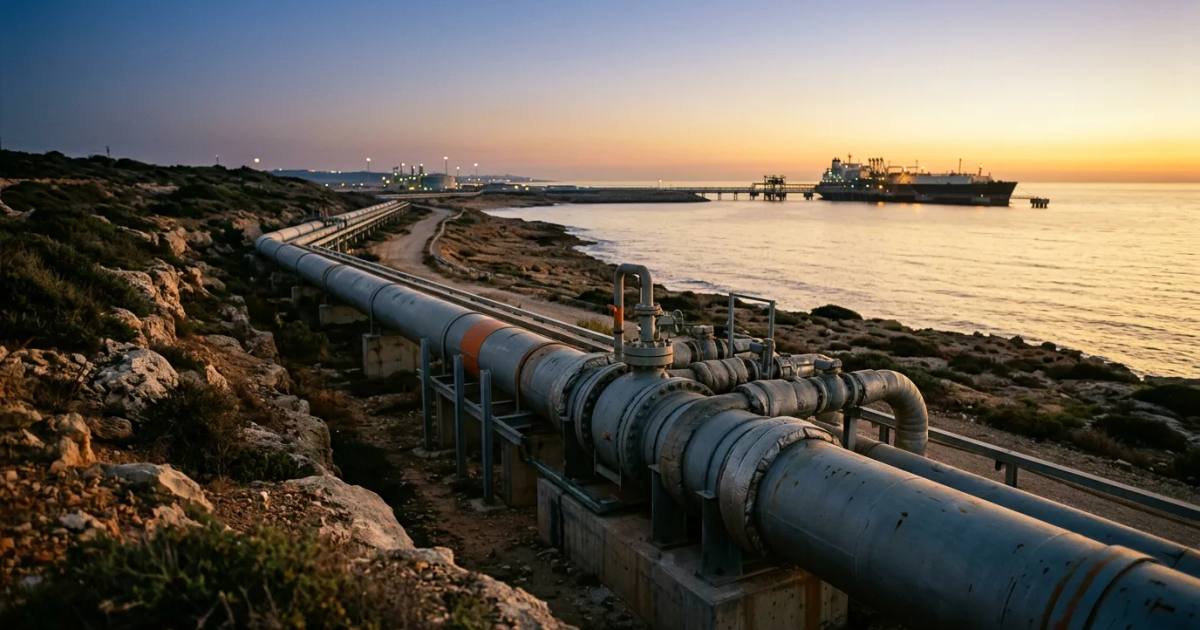

Take-or-pay contracts unlocked Leviathan's $35B Egypt deal, the Jordan NEPCO supply, and Karish spot exports. The contractual mechanics behind Israel's energy independence — and why they survived the Feb 2026 Suez shutdown.
A $35 Billion Contract That Changed Everything
On August 9, 2025, Israel signed a $35 billion natural gas export agreement with Egypt. Twenty-year term. 130 billion cubic meters of LNG. One clause made it possible: take-or-pay.
That single contractual device—a buyer's obligation to pay for a minimum annual volume whether or not they actually take delivery—unlocked the financing for Leviathan field development, secured European energy supply, and moved Israel from energy exporter-on-paper to energy exporter-in-practice.
Take-or-pay isn't novel. It's how the world moved gas. But in the Eastern Mediterranean, it became the architecture of Israel's energy independence. Understanding how it works, where it's deployed, and what happens when wars interrupt it, is essential to understanding Israeli infrastructure, geopolitics, and the economics of the next decade.
What Take-or-Pay Actually Does
A take-or-pay contract is a long-term natural gas supply agreement in which the buyer—typically a utility, government, or industrial consortium—commits to paying for a specified annual minimum volume. Payment is due regardless of whether the buyer actually takes delivery.
Example: Egypt agrees to buy 3.5 billion cubic meters (bcm) of Israeli LNG annually for 20 years. If Egypt takes it, they pay at the contract price. If Egypt doesn't need it that year—demand drops, storage is full, alternative sources are cheaper—they still pay for the 3.5 bcm. The gas goes elsewhere, or it stays in the field.
Why does this exist?
The answer is capital. Offshore gas field development—drilling, platforms, subsea infrastructure, pipelines, liquefaction plants—costs billions. A producer can't borrow that money or attract equity investors without long-term revenue certainty. A buyer won't commit unless they know they're locked in for the duration.
Take-or-pay splits the risk. The producer gets a guaranteed cash floor. The buyer gets price certainty and supply reliability. Both can go to capital markets and say: we have a contract.
Without take-or-pay, the Leviathan field—discovered in 2010, developed at multi-billion-dollar cost—would never have moved forward. Israel's energy sector would have remained dependent on coal, solar, and imports. The entire downstream infrastructure—liquefaction plants, export facilities, power generation, industrial feedstock—wouldn't exist.
Take-or-pay is the mechanism. But the clause only works if the buyer actually has capital and the political will to honor it. That's where Israel's specific contracts come in.
Leviathan-Egypt: The Anchor Contract
The $35 billion Leviathan-Egypt agreement is the gold standard in the region. Signed August 2025. Counterparty: Egypt—a government buyer with hard currency, energy infrastructure, and (theoretically) predictable demand.
Terms:
- 130 bcm over 20 years (2025–2045)
- Average of 6.5 bcm annually
- Price: indexed to global LNG benchmarks with take-or-pay floor
The contract solved three problems at once:
1. Leviathan field financing. The contract gave Israel's developers (Chevron, others) the revenue certainty to move from exploration to production. Without it, the field stays in the ground. This is not speculation—it's how project finance works.
2. Egyptian energy supply. Egypt's population grows. Natural gas demand grows. Domestic production has declined. The contract locks in gas that Egypt processes, liquefies (at Idku and Damietta terminals), and re-exports to Europe—or consumes domestically.
3. European energy security. Post-2022 (Russia sanctions, Ukraine war), Europe needed LNG. Mediterranean supplies matter. Israeli gas—routed through Egypt—added 6.5 bcm annually to European supply, priced independently of Russian fossil fuels.
The contract has a force majeure clause. Wars, acts of God, extraordinary circumstances release the parties from performance. In February 2026, when Houthi attacks shut down the Suez Canal and disrupted Eastern Mediterranean shipping, both Israel and Egypt invoked force majeure—but neither walked away. By April, operations resumed. The contract survived.
The Jordan NEPCO Contract: A Decades-Long Test Case
Before Leviathan, there was Jordan.
Israel's long-running natural gas supply to Jordan's NEPCO (National Electric Power Company) began in 2016 under a framework agreement. Approximately 3 bcm annually. Jordan uses it for power generation and desalination. Israel uses it as a regional diplomatic anchor and a revenue stream.
The NEPCO contract is smaller than Leviathan-Egypt, but it's older and more politically tested. It survived:
- The 2018–2021 Israeli-Palestinian tensions
- The Abraham Accords (2020)
- The October 7 war (2023)
- The February–April 2026 Hormuz closure and Houthi attacks
Why? Because both sides—Israel and Jordan—have structural reasons to maintain the contract. Jordan needs the gas. Israel needs the diplomatic relationship. And the contract itself includes force majeure provisions that allow temporary shutdowns without triggering default.
The NEPCO agreement proves that take-or-pay contracts in the Eastern Mediterranean can survive political volatility, if both parties have skin in the game.
Karish: The Parallel Path
Leviathan isn't Israel's only producing field. Karish—discovered 2013, developed faster and with lower capex than Leviathan—began production in March 2022 and exports LNG via barge-based liquefaction.
Karish's contractual structure differs from Leviathan. It serves spot and short-term LNG markets, not long-term take-or-pay buyers. This gives Karish flexibility: when prices are high, the gas is exported for premium returns. When prices are low, the field can defer production.
The trade-off: Karish generates higher unit revenues in bull markets but lacks the revenue floor of a take-or-pay contract. A Leviathan buyer pays the contracted price (adjusted for indexing) whether global prices are $5 or $20 per million BTU. A Karish seller gets whatever the spot market offers.
Both strategies matter. Leviathan locks in base demand for Europe. Karish captures upside and serves markets that can't or won't commit to 20-year take-or-pay.
FLNG: Why the Pipeline Died and the Ship Lives
The original plan for Israeli and Eastern Mediterranean gas was the EastMed pipeline—a subsea line carrying Israeli gas directly to Greece and Italy, bypassing Egypt entirely.
EastMed died in January 2022 when the U.S. withdrew support. The political calculus changed. The cost (>$10 billion) became harder to justify. And there was a simpler alternative: FLNG.
Floating Liquefied Natural Gas (FLNG) is an offshore vessel—essentially a ship-based liquefaction, storage, and transfer plant. It sits above a producing field. Gas is extracted, liquefied onboard, stored, and transferred to LNG carriers for export. No pipeline to shore required.
FLNG technology is proven—Petronas Prelude (Malaysia) is the world's largest, with 3.6 million tonnes per annum (mtpa) capacity. But FLNG is capital-intensive ($5–8 billion per vessel, depending on specs) and requires a buyer or consortium willing to finance and operate it.
For Israel, FLNG represents a second export path:
- Direct export. Israeli gas goes directly to buyers, not through Egyptian terminals.
- Independence. Reduces reliance on Egyptian infrastructure and political will.
- Scale. A 3–4 mtpa FLNG vessel would materially increase Israeli export capacity.
No Israeli FLNG is currently operational. But it's in the medium-term roadmap. If deployed, FLNG would complement Leviathan-Egypt (the take-or-pay anchor) and Karish (the spot market hedge).
The Force Majeure Test: February–April 2026
In February 2026, Houthi attacks on shipping in the Red Sea and disruption of the Suez Canal shut down traffic through the canal—the world's most critical energy chokepoint. Both Leviathan and Karish, which export via the Mediterranean and Suez, stopped shipping.
Force majeure clauses in the Egypt and Jordan contracts suspended performance obligations. Neither Israel nor Egypt was required to deliver or pay for the months of shutdown. The take-or-pay floor was waived.
But here's the strategic point: both sides invoked force majeure and then waited for operations to resume. They didn't cancel the contracts. They didn't trigger penalty clauses or arbitration. They acknowledged extraordinary circumstances, paused, and resumed when possible.
By April, shipping resumed. Leviathan and Karish came back online. The Egypt contract resumed at full volumes. The Jordan contract resumed at scheduled levels.
This matters. It shows that take-or-pay contracts—even in a volatile region—have enough structural resilience to survive genuine shocks, as long as both parties have incentive to maintain the relationship.
The Infrastructure Ecosystem: IEC and Regulatory Foundations
None of this works without the Israeli Electric Corporation (IEC), Israel's state-owned utility, and the broader regulatory framework that manages energy licensing, export permits, and grid integration.
Leviathan gas feeds into Israel's power system via the Central Power Station and other plants. This domestic supply reduces Israel's dependence on coal and imported LNG, lowering energy costs and carbon emissions. The export component—what goes to Egypt, Jordan, or (eventually) to FLNG carriers—is the surplus after domestic demand is met.
The IEC's role is regulator and buyer. It licenses production fields, approves export volumes, and ensures domestic demand is served first. This is why Israeli gas export isn't free-market—it's structurally constrained by a regulatory framework that prioritizes energy security.
Why This Architecture Matters Now
Three reasons take-or-pay and Israel's gas export mechanics are strategically critical in 2026:
1. European energy security. Post-2022, Europe can't count on Russian gas. Mediterranean sources—including Israeli supply via Egypt—are now policy-critical. The $35 billion contract isn't a commercial transaction; it's an energy geopolitical anchor.
2. Israeli energy independence. Gas export revenue funds field development and infrastructure. It also gives Israel leverage—soft power through energy supply—in regional negotiations and relationships.
3. Regional stability. The NEPCO contract and the Leviathan-Egypt agreement are the quietest success stories in Israeli-Arab relations. They work because both sides benefit and both sides have infrastructure reasons to maintain them.
The take-or-pay device is the glue. It survives wars, political cycles, and market downturns because both parties are locked in by capital and contractual obligation.
What Comes Next
Israel's gas sector is moving toward scale and diversification:
- Leviathan ramps to full production (6.5 bcm annually to Egypt by 2027–2028)
- FLNG enters development phase—likely 3–4 mtpa capacity for direct export
- Karish continues spot/short-term sales alongside Leviathan's take-or-pay anchor
- New fields (Zeus, Afrodite, others) enter exploration and development phase
The architecture scales as long as:
- Take-or-pay buyers (Egypt, potentially others) maintain creditworthiness
- Force majeure remains predictable (wars, Houthi attacks, geopolitical shocks)
- Regulatory oversight (IEC) balances domestic demand with export maximization
Take-or-pay isn't the sexiest topic. It won't trend on social media. But it's the structural mechanism that turned Israeli gas from a discovery into an industry, and an industry into a geopolitical asset.
Understand the contract, and you understand the region.