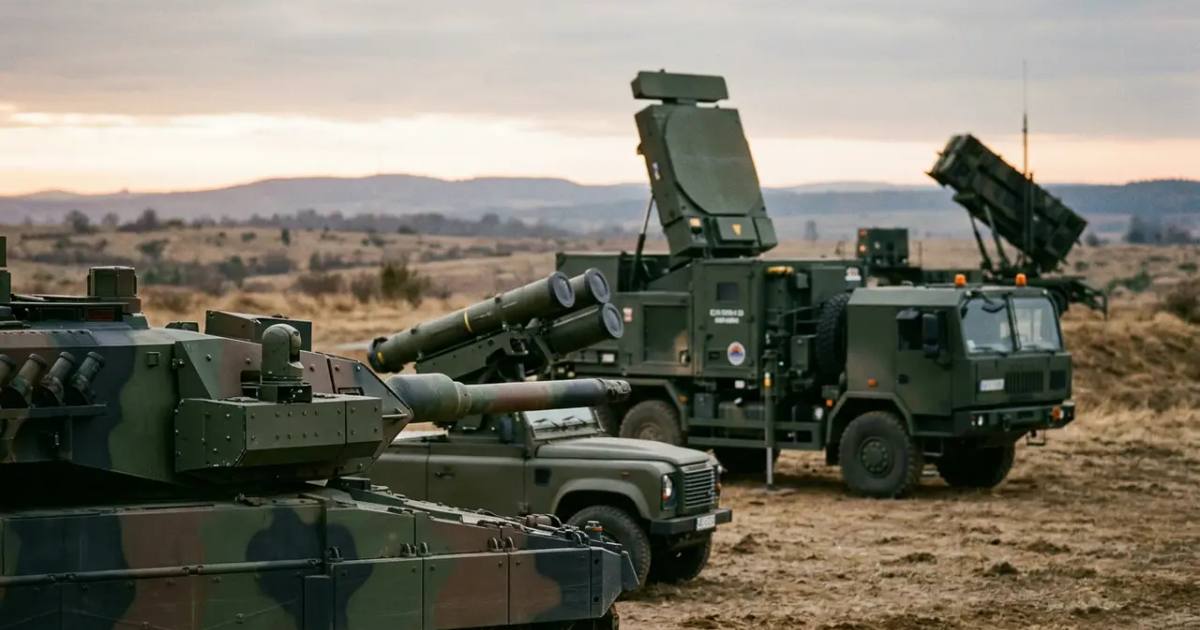

Poland has built one of Israel's deepest NATO defense relationships, from Spike missiles and Patriot interceptors to Elta radar and Trophy tank protection.
Poland has spent more than two decades building one of Israel's deepest defense-industrial relationships in NATO, from a 2003 Spike missile offset deal through the 2018 decision to arm its Patriot batteries with the Israeli-designed SkyCeptor interceptor. Elta, Rafael, and Elbit now supply Polish radar, air defense, and armor programs worth well over a billion dollars combined, with new contracts still being signed in 2026.
How did Poland become the first Patriot customer to choose an Israeli interceptor?
Poland's Wisla missile defense program spent years choosing between Patriot, the European MEADS system, and Israel's David's Sling before settling on a hybrid: American Patriot launchers paired with an interceptor derived from David's Sling. Rafael and Raytheon developed SkyCeptor, a lower-cost version of David's Sling's Stunner missile, specifically to meet Poland's demand for a cheaper alternative to the standard PAC-3 MSE interceptor. Poland signed the memorandum of intent in July 2017 during a visit by then-President Donald Trump, and finalized a $4.75 billion Patriot deal in March 2018, the largest military purchase in Polish history.
Rafael stood to earn approximately $1 billion from the arrangement, one of the largest deals in the company's history at the time. Poland demanded the Israeli interceptor because SkyCeptor cost roughly a tenth of the standard Patriot missile per unit, and required Raytheon to manufacture the missiles on Polish soil as a condition of the deal.
What does the Spike missile relationship look like after two decades?
Poland's Rafael relationship began with a 2003 deal worth approximately $425 million for Spike anti-tank guided missiles, structured as a ten-year industrial offset through Poland's Bumar Group. Under that arrangement, Bumar produced Spike missiles domestically for drones and helicopter gunships, with Rafael required to accept Polish-made components in its own weapons systems, a practice Poland has since applied to most of its Israeli defense contracts. Poland placed additional Spike orders in 2015 and 2023, and Elbit Systems separately supplied ATMOS self-propelled howitzers, with some components manufactured in Israel and exported to Poland for final assembly.
What is Elta's STAR-X radar contract worth?
Poland signed a contract with Elta Systems, the IAI radar subsidiary, for 18 ELM-2238X STAR-X 3D coastal surveillance radars valued at approximately 430 million zloty, or roughly $100 million. The radars are designed to monitor low-flying aerial threats and naval activity across the Baltic Sea, with deliveries scheduled between 2027 and 2030. The contract builds on a 2017 memorandum of understanding between Poland's state-run defense group PGZ and IAI covering marketing, sales, and joint production across loitering drones, reconnaissance, and electronic warfare platforms.
Why is Rafael's Trophy system going onto Poland's K2PL tanks?
Poland's K2PL tank program sits inside a much larger deal: an August 2025 contract worth roughly $6.5 billion for 180 additional K2 tanks from South Korea's Hyundai Rotem, split between 116 K2GF tanks delivered in 2026 and 2027 and 64 upgraded K2PL tanks delivered between 2028 and 2030. In September 2025, Rafael and Hyundai Rotem signed a teaming agreement to integrate Rafael's Trophy active protection system onto the K2 platform, including the Polish K2PL variant, marking the first time Trophy would be fitted to a Korean-built tank. Trophy detects and intercepts incoming anti-tank threats before they reach a vehicle's armor, a capability that gained urgency after Ukraine's experience with top-attack drones and guided anti-tank munitions.
The picture is not fully settled. Some reporting on the K2PL configuration describes the tank shipping with South Korea's own KAPS-2 active protection system rather than Trophy, with Poland separately developing a domestic APS tailored to counter first-person-view drones and anti-tank guided missiles. Whichever system is finalized, the K2PL's final assembly is being localized in Poland: Bumar-Labedy, a PGZ subsidiary, signed a subcontracting agreement with Hyundai Rotem in April 2026 to build the tanks domestically at its Gliwice plant after the first three K2PL units are assembled in South Korea, with Polish electronics and optics firms also receiving subcontracts. Separately, Poland's W-3PL Gluszec helicopters, upgraded by PZL-Swidnik, carry Rafael's Toplite targeting system, delivered in 2016.
How does Poland's Trophy interest compare to the rest of Europe?
Poland's potential Trophy integration would place it alongside a growing list of European Trophy customers rather than a solitary case. Rafael announced a separate 300 million euro deal in 2026 to integrate Trophy onto the Leopard 2 A8 tanks of Lithuania, the Netherlands, Czech Republic, and Croatia, carried out through EuroTrophy, the joint venture between Rafael, KNDS Germany, and General Dynamics European Land Systems. Trophy was first successfully tested on a German Leopard 2 in October 2021 and has since been fitted to the American M1 Abrams and Israel's own Merkava tanks, giving Poland's prospective adoption a wide base of NATO precedent to draw on.
Why is Poland accelerating its air defense posture now?
Poland's push for a multi-layered, Israeli-style air defense architecture follows a direct security shock: on the night of September 10, 2025, more than 20 Russian drones violated Polish airspace in what militarnyi.com described as an unprecedented incursion, prompting Dutch F-35 fighters to fly a mission defending NATO's eastern flank and neutralize most of the intruding aircraft. Polish officials and NATO's official assessment concluded the drones had gone off course rather than representing a deliberate attack, but the episode still hardened Warsaw's appetite for additional layered defense capability. Separately, Poland's state-owned PGZ unveiled its own SAN short-range air defense system in February 2026, with plans to deploy it along the eastern border by the end of the year, running alongside rather than replacing the country's growing Israeli-sourced radar and interceptor inventory.
Poland's industrial relationship with Israeli drone technology also predates the Spike missile offset by several years: Bumar signed an agreement with Poland's RADWAR Scientific-Industrial Centre in the 2000s to build Elbit-designed Skylark I, Skylark II, and Hermes 450 drones domestically, an early template for the localized-production model Poland has since applied to Spike, and now potentially to K2PL tank protection.
What role has Poland played in Israeli defense exports to Ukraine?
Poland has served as the transit point for Israel's most significant defense transfer to Ukraine, the September 2024 return of Israeli-owned Patriot interceptor missiles to US inventory for onward shipment. That arrangement, detailed in The Olam's reporting on Israel-Ukraine defense exports, saw roughly 90 missiles moved through Poland after Prime Minister Benjamin Netanyahu approved the transfer. Poland has also facilitated shipments of anti-drone systems, and Polish company Stunner Consulting represents Rafael directly in the Polish market for tenders including the country's medium-altitude long-endurance drone program.
What comes next for the relationship?
Poland's Ministry of Defence is in active negotiations to expand its Israeli procurement further, with a multi-layered, Israeli-style air defense architecture reportedly under consideration as Warsaw responds to growing concern over Russian missile and drone activity near its border. The STAR-X radar deliveries beginning in 2027, the Trophy integration on K2PL tanks, and continued Spike missile orders mean Poland's Israeli defense relationship is expanding even as some European governments, including Spain, have cancelled contracts with Rafael and Elbit over the war in Gaza. For Israel's defense industry, Poland represents a rare case of a NATO frontline state building Israeli systems into its own national production base rather than simply importing finished equipment.