Israel's state-owned developer of Iron Dome, David's Sling, Iron Beam, Spike, and Trophy APS. FY2025 sales $6.8B, $23.3B order backlog. 25–30% partial IPO under evaluation — listing venue (TASE vs. US exchange) unsettled as of mid-2026.
THE ENTITIES · OLAM.BUSINESS
Rafael Advanced Defense Systems is the state-owned Israeli defense company that built Iron Dome, David's Sling, Iron Beam, Spike, and Trophy — the operator of Israeli air defense, precision fires, and active vehicle protection, and the third pillar of the Israeli defense industrial base alongside Elbit Systems and Israel Aerospace Industries. FY2025 sales reached $6.8 billion — crossing the $6B threshold for the first time — with $10.4 billion in new orders and a $23.3 billion order backlog. As of mid-2026, the Israeli government is evaluating a 25–30% partial IPO — the most consequential ownership change in the company's history — but the listing venue and timeline remain unsettled.
Snapshot
| Founded | 1948 (as Science Corps under Shlomo Gur; renamed Rafael 1954) |
|---|---|
| Incorporated as limited company | 2002 |
| Headquarters | Haifa, Israel |
| Chairman | Dr. Yuval Steinitz (since January 2023) |
| CEO | Yoav Turgeman |
| Ownership | 100% Israeli government (as of August 2026) |
| IPO status | 25–30% partial IPO under government evaluation; listing venue (TASE vs. US exchange) unsettled as of July 2026; awaiting formal government approval |
| FY2025 sales | $6.8 billion (first time above $6B) |
| FY2025 net profit | $423 million (first time above $400M) |
| FY2025 new orders | $10.4 billion (up from $8.3B in 2024) |
| Order backlog end-2025 | $23.3 billion (~3.3 years of sales) |
| International share of sales | ~46% of FY2025 |
| Employees | ~10,000 (largest employer in Northern Israel) |
| R&D investment | 8%+ of annual revenues |
From the Science Corps to a state corporation
Rafael's origin is the Science Corps of the pre-state Haganah, established in 1948 under David Ben-Gurion's direction and formalized as EMET — the Research and Design Directorate of the Ministry of Defense — the same year. For its first five decades it operated as an internal government research arm, not a company. The Popeye air-to-surface missile, exported to the US Air Force in 1988 as the AGM-142 Have Nap, was developed under this structure.
In 2002, the Israeli government corporatized EMET into Rafael Advanced Defense Systems Ltd., a fully state-owned company headquartered in Haifa. The corporatization was designed to let Rafael sell into export markets without the political constraints of a direct government entity. It worked: within a decade, Rafael was one of Israel's largest defense exporters and its most internationally recognizable brand outside Elbit.
Rafael today reports approximately 10,000 employees — the largest single employer in Northern Israel — and had a record year in FY2025: sales of $6.8 billion (first time above $6B), net profit $423 million (first time above $400M), $10.4 billion in new orders, and an order backlog of $23.3 billion at year-end (equivalent to 3.3 years of sales). Approximately 46% of 2025 sales were to international customers. It is chaired by Dr. Yuval Steinitz — former Israeli Minister of Finance, Intelligence, and Energy — who took the chairmanship in January 2023. CEO since 2021 is Yoav Turgeman, a former head of IAI's ELTA subsidiary.
The Iron Dome franchise
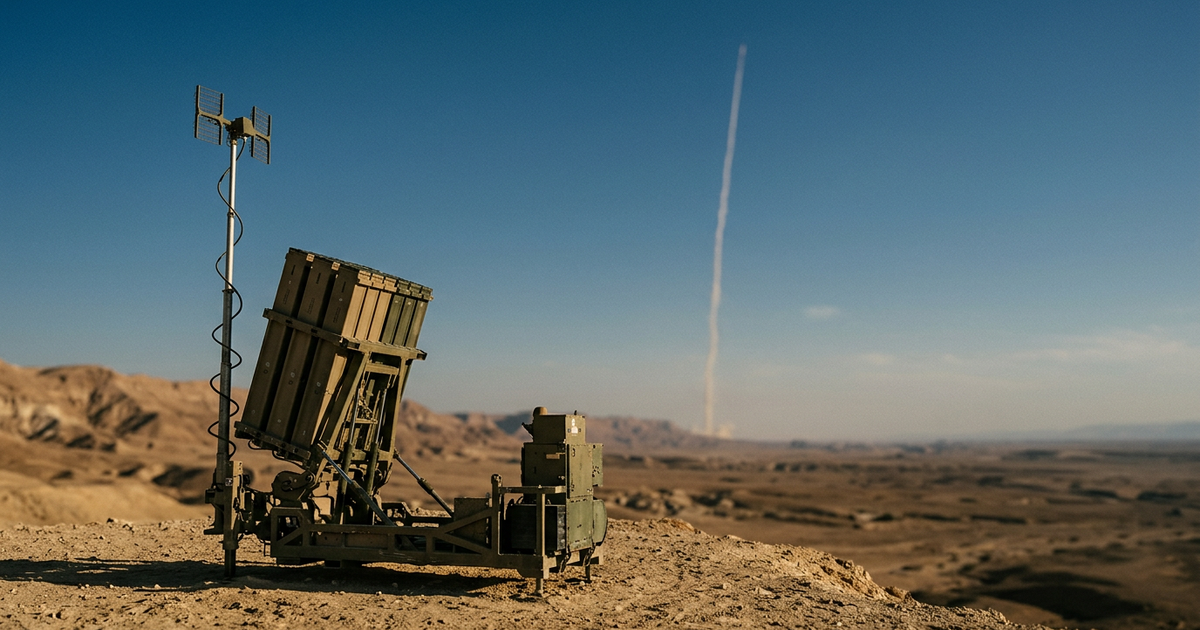
Rafael's most consequential product is Iron Dome, the short-range rocket defense system developed jointly with Israel Aerospace Industries and deployed operationally since March 2011. Rafael is the prime; IAI supplies the ELM-2084 radar and mPrest supplies the battle management software. The interceptor — the Tamir missile — is Rafael's, and Rafael controls the export line.
Iron Dome's operational record inside Israel is documented: interception rates reported by the IDF have run between 85 percent and 95 percent across successive Gaza operations. The system has been sold to the United States (two batteries acquired by the US Army in 2020), Azerbaijan, Cyprus, Romania, and reportedly others under undisclosed contracts. In 2022, Rafael and RTX (Raytheon) launched Skyhunter, the US-produced variant of Iron Dome, at a Camden, Arkansas Tamir production facility — the first Israeli air-defense system manufactured in the United States for the US market.
Above Iron Dome sits David's Sling, the medium-range interceptor developed with Raytheon, operational since 2017 and exported to Finland in 2023 in a €316 million deal. Above David's Sling sits Arrow, but Arrow is IAI's program, not Rafael's.
The other product lines that matter
Spike missiles. The Spike family — Spike-SR, MR, LR, LR2, ER, NLOS — is the most exported anti-tank guided missile system in the world outside the American Javelin. Spike is now in service with 46+ countries including Germany, the UK, Poland, South Korea, Singapore, India, and every major NATO army. In 2023, the Bundeswehr placed a follow-on Spike order worth over €600 million. Spike is manufactured under license by EuroSpike in Germany (a Rafael–Diehl–Rheinmetall joint venture), by Rafael Systems Global Sustainment in India (a JV with Kalyani Group), and by Larsen & Toubro. The licensing model is what makes Spike scalable in a way most Israeli defense products are not. In 2025, Rafael launched the L-SPIKE loitering-munition variant, opening a new category on the same missile family.
Trophy active protection. Trophy is the world's first combat-proven active protection system, defeating incoming anti-tank projectiles by launching a countermeasure. Installed on IDF Merkava tanks since 2010, on US Army Abrams tanks since 2018 in a $200M initial contract, on German Leopard 2A7A1 tanks under contracts running above €300M, and — under a 2025 agreement with Hyundai Rotem — integrated on the South Korean K2. Trophy is now on 16 platforms worldwide. It defined the category commercially — competitors from KMW, Elbit, and Russian manufacturers all now build APS systems, but Trophy set the standard.
Electronic warfare and cyber. Rafael's C4I and EW division produces the BNET software-defined radio, adopted by NATO buyers including Colombia and the Czech Republic, and a growing portfolio of cyber-defense products aimed at critical infrastructure. In 2025, the Litening 5 Advanced Targeting Pod was selected by the German Parliament for the Eurofighter Typhoon fleet — a significant European win in the airborne targeting category.
Iron Beam and the laser transition
Iron Beam, the 100-kilowatt-class solid-state laser air-defense system Rafael has developed with the Ministry of Defense, completed its full development test series in September 2025 and was formally delivered to the Israeli Air Force in December 2025 — the first operational directed-energy air-defense system fielded by any Western military. In May 2025, during Operation Rising Lion, Rafael laser systems achieved dozens of interceptions — the first operational use of high-energy laser air defense at that scale anywhere in the world.
The strategic argument for the program is the cost curve. Iron Dome's Tamir interceptor costs roughly $50,000 per shot. Iron Beam operates at under $5 per shot. If deployment scales as planned through 2026–2027, Iron Beam will change the cost-per-intercept economics of Israeli air defense by an order of magnitude — which is why the US Army, US Navy, and multiple European buyers are now negotiating export terms.
Iron Beam is Rafael's next Iron Dome — the same trajectory: prime co-development with the Ministry of Defense, initial IDF deployment, then export. Rafael controls it.
The Prometheus JV and U.S. manufacturing footprint
In February 2025, Rafael and Kratos Defense & Security Solutions (NASDAQ: KTOS) announced Prometheus Energetics — a $175 million 50/50 joint venture for U.S.-based solid rocket motor and energetics production. The Bloomfield, Indiana operation was formally established in February 2026. Prometheus signals a parallel structural move: onshore manufacturing partnerships inside the United States for capabilities Israel wants embedded in the U.S. defense industrial base. The pattern is likely to repeat across additional product categories through 2026–2027.
The IPO: Under Evaluation, Venue and Timeline Unsettled
For two decades, privatization of Rafael was politically impossible. Iron Dome export controls, classified program cross-subsidy, and the three-prime doctrine of keeping one prime in direct state hands made the sale unthinkable.
In January 2026, the Israeli Government Companies Authority confirmed a timetable to float 25–30% of Rafael, with the government retaining a controlling stake of 70–75%. Chairman Steinitz has argued internally that mechanisms can be established to protect classified operations while allowing the company to go public — the historical obstacle that stalled privatization discussions for two decades.
However, the listing venue is unsettled. In mid-July 2026, a government delegation traveled to the United States to evaluate a US listing — Nasdaq or NYSE — rather than the Tel Aviv Stock Exchange. According to Bloomberg and multiple Israeli media reports, officials believe American regulators may offer more flexibility on disclosure obligations related to classified defense programs than Israeli regulators have shown. Under Israel's dual-listing arrangement, a company that debuts on a US exchange can seek a secondary listing on the TASE while remaining subject to overseas regulations.
No final decision on timing, venue, or structure has been reached. Rafael still awaits formal government approval. The window may narrow before parliament dissolves ahead of elections due by late October 2026 — once a date for the ballot is set, the process will be parked until a new government is formed.
If executed, the Rafael IPO will be the most significant opening of the Israeli defense sector to public investors since Elbit Systems consolidated its position through the 2018 IMI acquisition. Three structural consequences to watch:
- Rafael's ability to compete for engineering talent against Elbit and IAI shifts as public-company compensation architecture becomes available for the first time.
- The $23.3B order backlog and 8%+ R&D reinvestment ratio become publicly reported metrics, changing how the Israeli defense industry is measured and compared internationally.
- Classified-program disclosure obligations become the central regulatory question — and the answer depends on which exchange Rafael lists on.
Why it matters
Rafael is the Israeli air-defense and precision-fires house. It is the company that determines whether Iron Dome scales globally, whether Iron Beam becomes the next-generation Western air-defense standard, and whether the Spike family stays the dominant Western anti-tank missile through the 2030s. It is also the state-owned prime now weighing whether to reprice itself for public equity markets — the moment the classified reference laboratory becomes a listed defense company.
בעברית
רפאל – מערכות לחימה מתקדמות. יצרנית הלחימה הגדולה של ישראל: כיפת ברזל, קלע דוד, קרן ברזל (לייזר), משפחת טילי ספייק, מערכת ההגנה האקטיבית טרופי, טילי פייתון, פודי לייטנינג. נוסדה ב-1948 כמעבדת המו״פ הלאומית של משרד הביטחון. התאגדה כחברה בע״מ ב-2002. מטה: חיפה. מכירות 2025: 6.8 מיליארד דולר (מעל 6 מיליארד לראשונה). הזמנות חדשות: 10.4 מיליארד. צבר: 23.3 מיליארד. רווח נקי: 423 מיליון דולר. עובדים: כ-10,000 — המעסיק הגדול ביותר בצפון. יו״ר: ד״ר יובל שטייניץ (מינואר 2023). מנכ״ל: יואב תורג׳מן. נכון לאמצע 2026, ממשלת ישראל בוחנת הנפקה חלקית של 25%–30%, אך מקום ההנפקה (בורסת תל אביב מול בורסה אמריקאית) טרם הוכרע. רפאל ממתינה לאישור ממשלתי פורמלי.
Olam coverage
See the Olam entity profiles of Elbit Systems and Israel Aerospace Industries, the Israeli Defense Prime Index comparing all three primes, the Israeli Defense-Tech Corridor in America, and the CEO profile of Bezalel Machlis.
The Olam Editorial Team | The Entities