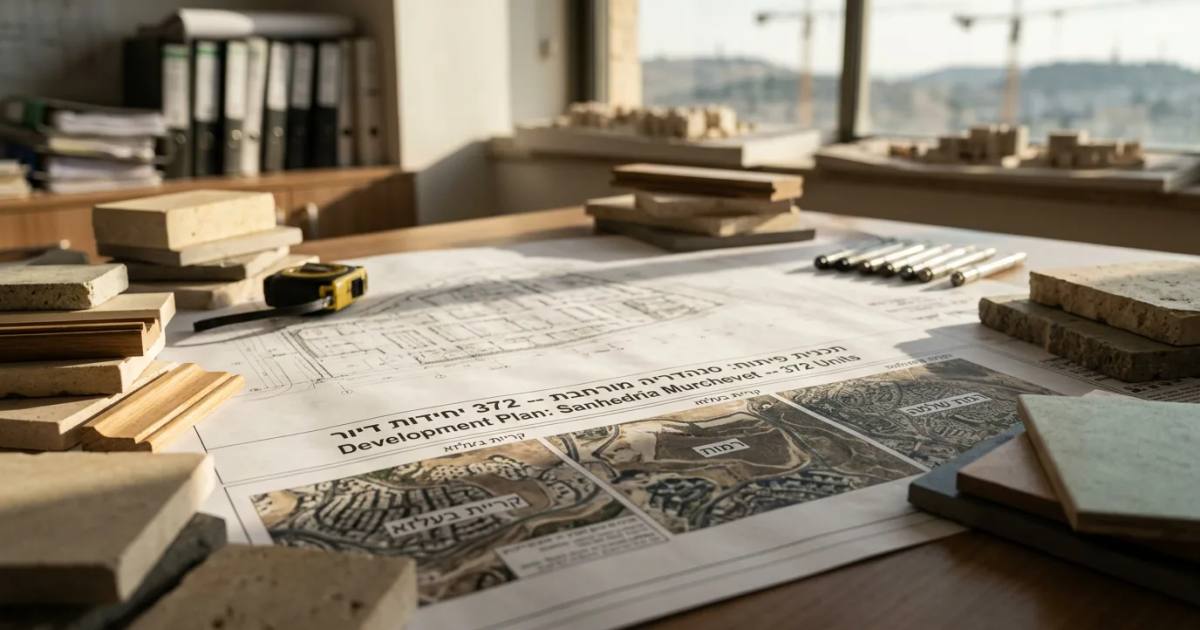

Mayor Moshe Lion just approved 372 units on 18,200 sqm at Sanhedria Murchevet — biggest Chareidi-market approval in Jerusalem's pipeline. Spec sheets on Wertheimer, AF Sperb, Manos Group TAMA 38, plus Ramot, Ramat Shlomo, Kiryat Belz, Har Nof pipelines.
372 housing units on 18,200 sqm at Sanhedria Murchevet — the largest single Chareidi-market approval in Jerusalem's pipeline. Plus the full religious-market developer bench: Wertheimer, AF Sperb, Manos Group TAMA 38.
Sanhedria Murchevet 372 is the biggest single named Chareidi-market approval in Jerusalem's current residential pipeline. Mayor Moshe Lion approved 372 housing units on an 18,200-square-meter plot at the northern edge of Sanhedria Murchevet — plus commercial space and public open areas. Approved by the Jerusalem Municipality Local Planning and Construction Committee. The block anchors the religious-market redevelopment cycle across Sanhedria, Ramot, Ramat Shlomo, Kiryat Belz, Kiryat Sanz, Har Nof, and Ma'alot Dafna.
This piece is the buyer-facing and institutional spec sheet on the religious-market developer bench — the specialized Jerusalem developers, marketing agents, and community networks who build for the Chassidishe-court, Yeshivishe, and observant-diaspora buyer. Immobilier.co.il names Moshe Wertheimer and AF Sperb as the two developers specifically identified as religious-market specialists with adapted specifications (Shabbat, kashrut). Manos Group runs the parallel TAMA 38 franchise across the same neighborhoods. Institutional developers — Africa Urban Renewal, Aura, Electra, Ashtrom, JTLV — cross-participate on larger Pinui-Binui and greenfield blocks.
For the full Jerusalem developer directory, see the Jerusalem Real Estate Developers hub. For the Pinui-Binui institutional playbook, see SOHO Katamonim. For the buyer-facing new-build inventory, see T-Tower and the Jerusalem New-Development Inventory. For the boutique-luxury prestige-belt subset, see Boutique Luxury New Builds.
Overview Table — Religious-Market Pipeline
| Project / Plan | Neighborhood | Developer / Body | Units / Scale | Status |
|---|---|---|---|---|
| Sanhedria Murchevet 372-Unit | N. edge Sanhedria Murchevet | Approved by Municipality (Mayor Lion) | 18,200 sqm / 372 units | Approved 2025 |
| Ramot 1,700 Additional Units | Ramot Alon | Multi-developer | 1,700 units | Approved 2023 |
| Ramot 1,000-Unit Redevelopment | Ramot Alon | Multi-developer | 1,000 existing units | Approved 2023 |
| Ramat Shlomo 500-Unit Expansion | Ramat Shlomo (TPS 11094) | Multi-developer | 500 units W toward Beit Hanina | Plan approved |
| Ramat Shlomo 286-Unit Tender | Ramat Shlomo | Israel Land Authority | 286 units | Tender Oct 2024 |
| Ramot NE 152-Unit Plan | Ramot NE (TPS 192815) | Multi-developer | 152 units toward Beit Hanina al-Balad | Plan advancing |
| Ramot 80 Permits + Ramat Shlomo 98 | Ramot + Ramat Shlomo | Local committee | 178 permits combined | Building permits awarded |
| Belz/Shamgar Upcoming Luxury | Northern Jerusalem | Israel Properties marketed | Boutique luxury | In marketing |
| Sha'ul HaMelech 63 TAMA 38 | Sanhedria | Manos Group | Reinforcement + expansion | Under construction |
| Kiryat Menachem TAMA 38 | Kiryat Menachem | Manos Group | 32-apartment building | Under construction |
| Ben Zakai 6 TAMA 38 | Central Jerusalem | Manos Group | Multi-unit reinforcement | Under construction |
| Ben Yefune St, Baka TAMA 38 | Baka (Bethlehem Rd) | Manos Group | Multi-unit reinforcement | Manos-managed |
| German Colony NMP 38 (TAMA 38) | German Colony | Manos Group | Reinforcement + upgrade | Manos-managed |
| Herzl 62 TAMA 38 | Beit HaKerem / Kiryat Moshe | Manos Group | Multi-unit + luxury lobby | Manos-managed |
| Yam Suf 5 TAMA 38 | Ramat Eshkol | Manos Group | Reinforcement + 2 floors added | Manos-managed |
| Project 22 | Jerusalem | Manos Group | Largest TAMA 38 in Jerusalem | Manos flagship |
| Mir Yeshiva Adjacent Luxury | Maalot Dafna/Arzei HaBira | JRE marketed | Multi-unit | In marketing |
| Shmuel HaNavi Presale | Shmuel HaNavi/Arzei HaBira | JRE marketed | Boutique | In presale |
| Ramat Polin Adjacent | Ramot Alon (Ramat Polin core) | Multi-developer | Ongoing | Family-oriented Haredi housing |
| Kiryat Belz Institutional Zone | Kiryat Belz | Belz institutional bench | Multi-project belt | Continuous |
| Kiryat Sanz Institutional Zone | Kiryat Sanz (near Kiryat Belz) | Sanz institutional bench | Multi-project belt | Continuous |
| Old Katamon Erloi-Adjacent | Old Katamon | Multiple | Boutique heritage | Active |
The Anchor Approval: Sanhedria Murchevet 372
Location. Northern edge of Sanhedria Murchevet — the neighborhood built in 1971 to accommodate the population growth of Sanhedria, located NW of the original Sanhedria core.
Plot size. Approximately 18,200 square meters.
Approved units. 372 housing units.
Commercial + public component. Additional commercial space + public open spaces allocated inside the block.
Approval body. Jerusalem Municipality Local Planning and Construction Committee. Approved directly by Mayor Moshe Lion.
Mayor's positioning. Lion's public framing: "Jerusalem's Chareidi public needs more housing units in the city, and we will continue to approve more and more customized construction plans for Chareidim." This is direct municipal policy positioning.
Multiplier. The 372-unit block establishes the largest single Chareidi-market approval in the northern religious belt. Roughly 3× the standard institutional-block size for this neighborhood category.
Adjacencies. Sanhedria + Sanhedria Murchevet institutional infrastructure — yeshivot, mikvaot, chassidishe-court adjacent shul network. Bordered by the Chareidi-majority Ramat Shlomo development belt to the east/south.
Strategic signal. Municipality is deliberately expanding the residential capacity of the northern Chareidi belt. The 372-unit approval sits inside a larger pipeline of tenders and permits — Ramat Shlomo 500-unit W expansion, Ramot NE 152-unit extension, Ramot 1,700-unit additional units — that collectively add thousands of Chareidi-adapted units to the Jerusalem housing stock over the current decade.
Source. The Yeshiva World (Municipality announcement); Grokipedia Ramot; Ir Amim.
The Religious-Market Developer Bench
Moshe Wertheimer — Religious-Market Specialist
Positioning. Named by Immobilier.co.il as one of two Jerusalem developers specifically identified as religious-market specialists. Adapted specifications for Shabbat and kashrut integrated into project design from ground-up.
Segment. Boutique and mid-scale residential projects across the observant belt. Serves the Chassidishe-court adjacent, Yeshivishe, and observant-diaspora buyer base.
Buyer profile. Anglo, French, and Israeli religious buyers — first-generation olim, established Yeshivishe residents, and Chassidishe-court cohort members. Community-network-driven sales rather than mass-market broker distribution.
Differentiator. Wertheimer projects arrive with religious specifications built-in — Shabbat elevator, kashrut kitchen infrastructure, mikvah adjacency, sukkah balcony configuration. Buyer avoids post-purchase retrofit (typically NIS 30,000-100,000+ across the specification stack).
Sales channel. Direct-to-community marketing through established Chassidishe and Yeshivishe network intermediaries; walking-tour open-house model rather than mass broker listing.
Source. Immobilier.co.il Jerusalem Real Estate market overview (2026 91-project census).
AF Sperb — Religious-Market Institutional Developer
Positioning. Named by Immobilier.co.il alongside Wertheimer as a Jerusalem religious-market specialist. Institutional-adjacent scale — capable of larger blocks than boutique-only competitors.
Segment. Larger new-build blocks in the Chareidi neighborhoods with adapted specifications across the specification stack (Shabbat, kashrut, sukkah, eruv, community-appropriate ground floor).
Buyer profile. Same observant-belt buyer set as Wertheimer, plus institutional-community buyers (yeshiva networks, Chassidishe-court demographic cohorts making multi-family deployments).
Differentiator. Institutional scale on adapted-specification product. Bank guarantee capacity for large-block financing. Community-network distribution combined with institutional discipline.
Complementarity. Sperb sits at the intersection of Wertheimer's boutique religious-market specialty and the institutional-scale developer bench (Africa Israel, Aura, Electra). Foreign LP co-investment counterparty for religious-market institutional plays.
Source. Immobilier.co.il Jerusalem Real Estate market overview.
Manos Group — The TAMA 38 Franchise on Religious Neighborhoods
Structure. Project management company promoting a large number of TAMA 38 projects across Jerusalem. Distinct from Wertheimer/Sperb — Manos operates on the redevelopment side (TAMA 38 seismic-reinforcement + expansion) rather than greenfield new-build.
Pipeline scope. Multiple named TAMA 38 projects concurrently. Some of the most active TAMA 38 development on the Chareidi and religious-adjacent neighborhoods.
Sanhedria block. 63 Sha'ul HaMelech Street TAMA 38 — under construction. Reinforcement + skeletons completed to Standard 413. Stone cladding complete. Finishing works underway.
Ben Zakai 6 TAMA 38. Under construction. Reinforcement and skeletal work completed to Standard 413. Stone cladding and interior works begun.
Kiryat Menachem TAMA 38. Old Kiryat Menachem neighborhood core. 32-apartment building fully upgraded — each apartment receives square-meter addition + sun terrace. Modern exterior + modern building function.
Baka TAMA 38. Ben Yefune Street, on Bethlehem Road, heart of Baka. Baka noted as luxury neighborhood combining French, US, and Canadian olim with veteran Israelis.
German Colony TAMA 38. NMP 38 (TAMA 38) project in the prestigious German Colony neighborhood. Modern appearance, renewed water/sewer infrastructure, building reinforcement against earthquake.
Herzl 62 TAMA 38. 62 Herzl Street — high-demand corridor between upscale Beit HaKerem and Kiryat Moshe. Adjacent to Jerusalem light rail. Upgraded building with luxurious lobby, elevators, spacious apartments, modern design.
Ramat Eshkol TAMA 38. 5 Yam Suf Street, heart of Ramat Eshkol residential area. Water/sewage replacement + 2 new floors added.
Project 22. Manos flagship — the largest TAMA 38 project in Jerusalem.
Source. Manos Group TAMA 38 Project Gallery (manosgroup.co.il).
Cross-Reference: Institutional Developers Active on Religious-Belt Blocks
Africa Urban Renewal (Africa Israel Residences subsidiary). Operates in Ramat Sharet + Katamon SOHO — some religious-adjacent buyer flow, primarily national religious/traditional rather than Chareidi.
Aura Israel. Aura Jerusalem franchise; Hevron Road 116 Talpiot — mixed religious/secular buyer base.
Ashtrom Construction. Kiryat HaYovel 528-unit block (398 rental + 130 sale) — mixed buyer base including young Kollel couples migrating into the belt.
JTLV. OP Jerusalem 2-building complex sold to Syrian-American community (Ashtrom-built, Ian Bader architect) — diaspora-community-buys-full-building precedent. Applicable structure for other observant community networks (Belz, Gur, Sanz) considering similar collective deployments.
Kardan Real Estate. Arnona 313-unit Pinui-Binui — French-English diaspora buyer belt including national religious cohort.
Positioning. The institutional developer bench is not primarily focused on the pure Chassidishe-court cohort but participates in Pinui-Binui blocks and mid-market inventory where the observant-buyer segment overlaps with mainstream diaspora demand.
Adapted Specifications — What Religious-Market Buildings Include
The specific specification adaptations that religious-market developers integrate into ground-up new-build differentiate their inventory from mainstream new-build. These specifications are not universal — different Chassidishe courts, different Yeshivishe communities, and different national religious cohorts have varying requirements. But the core stack below appears across most religious-market Jerusalem inventory:
| Adapted Specification | How It Appears in the Building |
|---|---|
| Shabbat elevator (Shabbos elevator) | Automated Shabbat mode — elevator runs continuously on programmed floor stops without button press. Kosher-certified operation. Standard on Chassidishe-court adjacent buildings and religious-neighborhood new builds. |
| Kashrut kitchen prep | Separate meat/dairy sink installations pre-plumbed. Double-oven capability. Adequate counter separation. Reduces buyer's post-purchase construction burden by NIS 30,000-80,000. |
| Mikvah adjacency (walking distance) | Building sited within walking distance of a men's mikvah (200-500 meters). Non-negotiable for Chassidishe-court residents. Priced into the plot. |
| Sukkah balcony | Balcony designed with retractable or removable roof panel that allows a valid Sukkah construction during the Sukkot holiday week. |
| Eruv coverage | Building located inside an established eruv boundary — enables Shabbat carrying. Verified before construction; disclosed to buyer. |
| Ezras Nashim (women's section) adjacency | Building within walking distance of women's-section synagogue infrastructure. Standard in the Chassidishe belt. |
| Mehadrin kitchen (Vaad HaKashrus) | Religious-neighborhood buildings market that finishes support strict local kashrut standards without renovation. |
| No mixed-use commercial ground floor | Chassidishe-court neighborhoods often reject secular retail at building base — cafe, bar, non-kosher restaurant. Marketed as "community-appropriate" ground floor. |
| Shabbos parking access | Underground garage entry accessible without electronic key on Shabbat — mechanical release or continuous-open gate. |
| Bosis (basin) placement | Shared building bosis (netilat yadaim basin) at entry, particularly in Chassidishe-court adjacent buildings. |
| Toldos Aharon / Toldos Avraham community layouts | Some blocks marketed specifically for Toldos Aharon, Toldos Avraham Yitzchak, or Slonim/Vizhnitz cohort layouts — larger family units, larger dining rooms. |
| Community sale distribution | Some buildings pre-sold through Chassidishe-court intermediary networks — priority access for members before broader marketing. Similar to the OP Jerusalem template. |
Cost premium: religious-market specification adaptations typically add 2-5% to the base construction cost. However, buyers value this at 6-12% of the transaction price because it avoids post-purchase retrofit costs and preserves the value of the finished unit. Net: religious-market specification is accretive to the developer's project economics.
Neighborhood Pipeline — The Religious Belt in Detail
| Neighborhood | Character | Current Pipeline / Market Signals |
|---|---|---|
| Ramot Alon | 58,274 residents; ~75% Haredi + secular/national religious cores in Ramat A and B | 1,700-unit new-build approval (2023) + 1,000-unit redevelopment; 80-unit recent permit + 152-unit NE extension plan; Ramot Polin flagship (720 social housing 1972-77); population trajectory: institutional cluster |
| Ramat Shlomo | ~21,000 residents; overwhelmingly ultra-Orthodox; founded 1995; named for R. Shlomo Zalman Auerbach | 500-unit W expansion (TPS 11094); 286-unit tender Oct 2024; 98-unit recent permit; multi-decade pipeline |
| Sanhedria + Sanhedria Murchevet | Founded 1928 (Sanhedria) + 1971 (Murchevet); ultra-Orthodox core; Chassidishe institutional infrastructure | 372-unit Chareidi neighborhood approved Mayor Lion (northern edge S. Murchevet, 18,200 sqm plot); Sha'ul HaMelech 63 TAMA 38 (Manos); adjacent TAMA 38 pipeline |
| Kiryat Belz | Founded 1960s by Belz Chassidim from Galicia; ultra-Orthodox; Belz Great Synagogue anchor | Belz/Shamgar upcoming luxury (Israel Properties marketed); institutional Belz-adjacent bench continuous; 5-min light rail access |
| Kiryat Sanz | NW Jerusalem, between Kiryat Belz and Ezras Torah; founded 1965 by immigrants from Sanz in Galicia | Sanz institutional-community adjacent bench; multi-project development belt |
| Har Nof | Founded 1985; Anglo Chareidi + national religious mix; institutional yeshiva bench (Machon Meir, Chevron, Torah Ore) | Ongoing infill; premium prestige religious-market inventory; walking to Bayit V'Gan |
| Ma'alot Dafna / Arzei HaBira | Northern belt; religious/Chareidi mixed; Ramat Eshkol adjacent; Mir Yeshiva zone | The Aderet Project; Mir Yeshiva Adjacent Luxury; Shmuel HaNavi presale; steady mid-tier religious-market flow |
| Old Katamon | Heritage core; national religious + secular + Erloi Chassidic + Yakar community | Boutique Pinui-Binui belt; Azorim + Mamoshim 300-unit Old Katamon; Old Katamon Luxury Boutique (10 units left) |
| Kiryat Menachem | SW Jerusalem near Kiryat HaYovel + Ihr Ganim; mixed Chareidi + national religious + secular | Manos Group TAMA 38 pipeline; institutional-scale redevelopment; young Kollel couples migrating in |
| Baka | Mixed French/American/Canadian + veteran Israeli; national religious/traditional core | TAMA 38 pipeline (Manos Ben Yefune); boutique conversions; premium new-build at NIS 40,000-60,000/sqm |
Ramot Alon — The Largest Chareidi Neighborhood Development
Population. 58,274 residents per Jerusalem Municipality — one of the largest neighborhoods in Israel. Approximately 75% ultra-Orthodox; secular and national religious cores concentrated in Ramat A and Ramat B.
Founding vision. Ring Neighborhood strategy post-1967. Initially designated as rural/green zone in 1968 master plan. Development began 1971 under PM Golda Meir. Ramot Polin flagship built 1972-77 (720 social housing units targeted at Orthodox families).
Current pipeline. 2023 approvals: 1,700 additional housing units + 1,000-unit redevelopment. October 2024: 286-unit tender for Ramat Shlomo extension. July recent: 80-unit permit awarded. Plus 152-unit NE extension plan (TPS 192815).
Buyer profile. Chareidi family buyers; large family unit configurations demanded. Institutional-scale demand generated by demographic +1.5%/year religious population growth.
Sub-neighborhoods. Ramot A + Ramot B (mixed secular/national religious); Ramat Ungvar (Ashkenazi Chassidishe); Nof Ramot (family Haredi); Tiferet Ramot; Ramat Polin (dense original social housing).
Ramat Shlomo — The Northern Chareidi Growth Zone
Population. Approximately 21,000 residents. Mostly ultra-Orthodox.
Founded. 1995. Named for Rabbi Shlomo Zalman Auerbach.
Borders. Ramot to the west; Har Hotzvim to the south; Shuafat to the east.
Pipeline. 500-unit W expansion (TPS 11094) approved. 286-unit tender awarded October 2024. 98-unit recent permit. Multi-decade cumulative approval of 3,000+ additional units.
Strategic position. Continuous municipal support for expansion despite periodic international attention. Rabbi Auerbach namesake gives strong Chareidi-community brand anchor.
Sanhedria + Sanhedria Murchevet — The Anchor Approval
Sanhedria founded. 1928 by ultra-Orthodox Jews from Meah Shearim. Named after Rabbi Shmuel Salant. Front-line neighborhood defended by Hagana in 1928 and 1936-39 riots.
Sanhedria Murchevet founded. 1971 NW of Sanhedria to accommodate Sanhedria's population growth. Similar Chareidi character.
Current anchor project. 372-unit new Chareidi neighborhood approved by Mayor Lion on 18,200 sqm plot on the northern edge. Commercial + public open spaces included.
Adjacent pipeline. Manos Group Sha'ul HaMelech 63 TAMA 38 — under construction. Continuous TAMA 38 flow across the older Sanhedria core.
Kiryat Belz — The Belz Chassidishe Anchor
Founded. 1960s by Chassidim from Belz in Galicia. Rebuilt Belz Great Synagogue is the anchor institutional infrastructure.
Character. Ultra-Orthodox. Continuous new-project pipeline geared toward overseas Belz-community buyers and local residents. Institutional adjacency to Belz + Gur synagogues drives premium pricing.
Current project. Belz/Shamgar upcoming luxury project (Israel Properties marketed) — minutes from Belz Chassidishe court + other courts, adjacent to Shamgar shopping district. 5-minute walk to Jerusalem light rail. Rare luxury introduction to the northern religious belt.
Kiryat Sanz — The Sanz Chassidishe Belt
Founded. 1965 by ultra-Orthodox immigrants from Sanz in Galicia. Located between Kiryat Belz and Ezras Torah.
Character. Ultra-Orthodox Sanz Chassidishe institutional-community core. Institutional bench serving the Sanz Rebbe's court and community networks.
Pipeline. Sanz-adjacent development flow continuous. Buyers primarily from within the community network.
Har Nof — The Anglo Chareidi + National Religious Belt
Founded. 1985. Named for the panoramic mountain views.
Character. Anglo Chareidi (English-speaking observant) + national religious mix. Institutional yeshiva bench: Machon Meir, Chevron Yeshiva, Torah Ore Institute among others.
Buyer profile. American Yeshivishe olim; South African religious buyers; French-speaking English Chareidi cohorts. Premium pricing on infill inventory.
Adjacency. Walking to Bayit V'Gan; Har Herzl institutional zone; Anglo-institutional community amplifies buyer demand.
Ma'alot Dafna / Arzei HaBira — The Central Religious Belt
Character. Central-north Jerusalem; religious/Chareidi mixed with Israeli middle-class. Ramat Eshkol adjacent.
Current projects. The Aderet Project (Ram Aderet — Maalot Dafna); Mir Yeshiva Adjacent Luxury (JRE marketed); Shmuel HaNavi Street Presale (JRE marketed) minutes from Old City.
Mir Yeshiva effect. Mir Yeshiva presence (~9,000+ students) generates continuous demand for adjacent family housing among Mir-affiliated families and international donors buying units for future family generation use.
Old Katamon — Heritage + Religious Mixed
Character. National religious + secular + Chareidi mixed. Notable ultra-Orthodox Erloi Chassidic group presence. Yakar community anchor. Beautiful villas from 1920s British Mandate era.
Religious-market inventory. Azorim + Mamoshim 300-unit Pinui-Binui block (adjacent to Green Line light rail). Old Katamon Luxury Boutique (Israel Properties — 10 units left). HaTayasim 36 (JRE marketed — 10 luxury units).
Kiryat Menachem — The Emerging Religious Belt
Location. SW Jerusalem near Kiryat HaYovel + Ihr Ganim. Mixed Chareidi + national religious + secular. Historically working-class.
Current pipeline. Manos Group TAMA 38 running the 32-apartment building reinforcement + expansion. Institutional-scale redevelopment shift underway.
Demographic shift. Young Kollel couples migrating into the belt due to housing affordability. This is the emerging Chareidi expansion zone — priced substantially below Kiryat Belz + Sanhedria.
The Community-Network Sales Model
Religious-market developers do not primarily distribute inventory through Israeli mass-market brokers. Sales flow through community-network channels — Chassidishe-court intermediaries, Yeshivishe rabbinical figures, community-anchor rabbis whose endorsement drives buyer decision, and diaspora community leaders (in NY Deal, Lakewood, London Golders Green, Antwerp).
Chassidishe-Court Distribution
Belz, Gur, Vizhnitz, Sanz, Toldos Aharon, and Slonim courts each maintain their own real-estate committee-adjacent networks. When a religious-market building targets a specific Chassidishe cohort, the developer works through the court's real-estate intermediary to allocate units to community members before broader marketing. This mirrors the OP Jerusalem template — the Syrian-American community's collective deployment through JTLV.
Yeshivishe Community Distribution
Yeshiva-affiliated real estate networks — including some of the American Yeshivishe community's institutional-committee members — allocate priority access to yeshiva-family units. This is particularly active in Har Nof, Ma'alot Dafna (Mir-adjacent), and Ramat Eshkol.
Anglo-Diaspora Distribution
English-speaking religious buyers work through Anglo brokers (Israel Properties, Jerusalem Real Estate, Eiferman Realty, Semerenko Group) whose distribution overlaps with English-speaking observant communities in Lakewood, Passaic, Miami, Toronto, London Hampstead + Golders Green, Manchester, Melbourne, and Sydney.
Chareidi Family Diaspora Distribution
Israeli-based Chareidi-community intermediaries serve extended-family diaspora buyers — a Chareidi family in Jerusalem buys with input from their diaspora relatives who provide co-financing. This is one of the largest hidden-liquidity segments in the Jerusalem religious-market — capital flows in through informal community networks that never register as institutional deals.
Religious-Market Foreign Buyer Mechanics
Purchase tax (Mas Rechisha). For investors and most foreign residents: 8% up to NIS 6,055,070; 10% above. Frozen through December 31, 2026. Religious-market inventory rarely crosses the NIS 6M single-unit threshold except at Har Nof and Kiryat Belz institutional-luxury tier — most transactions clear the 8% band.
Community-financing structures. Chassidishe court and yeshiva community networks maintain informal co-financing arrangements. A buyer's home community may contribute 15-30% of a purchase — a form of interest-free community lending. This liquidity source is invisible to Israeli banks but is a real component of religious-market transaction financing.
Bank guarantee. Same Chok Mechr requirements as mainstream inventory. Religious-market developers with institutional bank relationships (AF Sperb, Manos Group at TAMA 38 scale) clear the bar; boutique Wertheimer-style operators may require additional buyer diligence on bank guarantee capacity.
Legal representation. Anglo-diaspora buyers use English-speaking Israeli religious-community-aligned law firms; French-speaking buyers use French-Israeli law firms with religious-market experience. Kashrut-of-the-deed considerations (Shabbat scheduling of signing meetings, avoiding chag scheduling) are baked into practitioner workflow.
Delivery timing. Same 5-8 year Pinui-Binui / greenfield timeline; typically 3-5 years for TAMA 38 redevelopment (Manos Group projects). Multiple TAMA 38 blocks currently near delivery in the pipeline.
Currency advantage. USD strength versus shekel currently favors US Yeshivishe / Chassidishe / Anglo-observant buyers — meaningful cost reduction on the dollar-denominated cost basis.
Where the Religious-Market Risk Lives
- Community-adjacency risk: A building's value depends on the continued presence of the anchor community. If a Chassidishe court relocates or if institutional infrastructure shifts, adjacent inventory de-rates. Rare but not zero.
- Specification obsolescence: Religious-community specifications evolve (some Chassidishe courts add new requirements; some cohorts loosen). Building specifications set in 2020 may not match 2030 buyer expectations. Modular design allows retrofit but is not universal.
- International attention: Ramat Shlomo, some Ramot NE extensions, and other belts sit across the 1967 Green Line. Periodic international attention has not affected long-term buyer demand but creates transient headline risk.
- Municipal approval risk: Some plans require multi-year approval. Committee scope reductions are precedent (see Hantke/Borochov Kiryat HaYovel case). Underwrite the Committee-reduced case.
- Community-network dispersion: Community-network sales models depend on rabbinical endorsements and intermediary trust. Institutional-scale developers who ignore community-network dynamics may struggle to sell adapted-specification inventory.
- Sanhedria-specific: The 372-unit anchor project must maintain adapted specifications throughout the multi-year build cycle to preserve religious-market value proposition. Deviation risks buyer migration to adjacent alternatives.
Sources
- APPROVED: New Chareidi Neighborhood Near Sanhedria Murchevet — The Yeshiva World
- Jerusalem Real Estate: 91 New Projects — Immobilier.co.il (Wertheimer + AF Sperb identification)
- Israel real estate: A look at Jerusalem's Ramot neighborhood — Jerusalem Post, January 2025
- Real estate: Unveiling Jerusalem's gem of Kiryat Belz — Jerusalem Post, August 2024
- Ramot, East Jerusalem (Ramot Polin, expansion pipeline) — Grokipedia
- Wave of Construction Plans for East Jerusalem — Ir Amim (Ramat Shlomo 500-unit, Ramot 152-unit plans)
- Manos Group TAMA 38 Projects Gallery (Sanhedria, Kiryat Menachem, Baka, German Colony, Ramat Eshkol)
- Jerusalem Neighborhoods (Belz, Sanz, Old Katamon, Sanhedria Murchevet) — Eiferman Realty
- Israel Properties — Belz/Shamgar Upcoming Luxury Marketing
- Ramat Shlomo — Wikipedia
- Committee approves East Jerusalem building permits — Times of Israel (2014 Ramot 216 units, Ramat Shlomo 500)
Related Coverage
- Jerusalem Real Estate Developers: The Complete Map
- SOHO Katamonim: The Jerusalem Pinui-Binui Playbook
- T-Tower and the Jerusalem New-Development Inventory
- Boutique Luxury New Builds in Jerusalem
- Jerusalem Gateway (Merhav): The Twenty-Tower District, Tower by Tower
- The Extell Israel Assemblage: Gary Barnett's 570-Dunam Jerusalem Play (forthcoming)
- Har Hotzvim Tech-Park Real Estate: Intel, Mobileye, and Teva Anchor Blocks (forthcoming)
Ronn Torossian is the founder and chairman of 5W AI Communications, the AI Communications Firm. He is the publisher of Everything-PR and the author of two best-selling editions of For Immediate Release.