
Jerusalem pinui-binui projects mapped: SOHO Katamonim, Kiryat HaYovel, Arnona, and Old Katamon, with developers, unit multipliers, rules, and buyer terms.
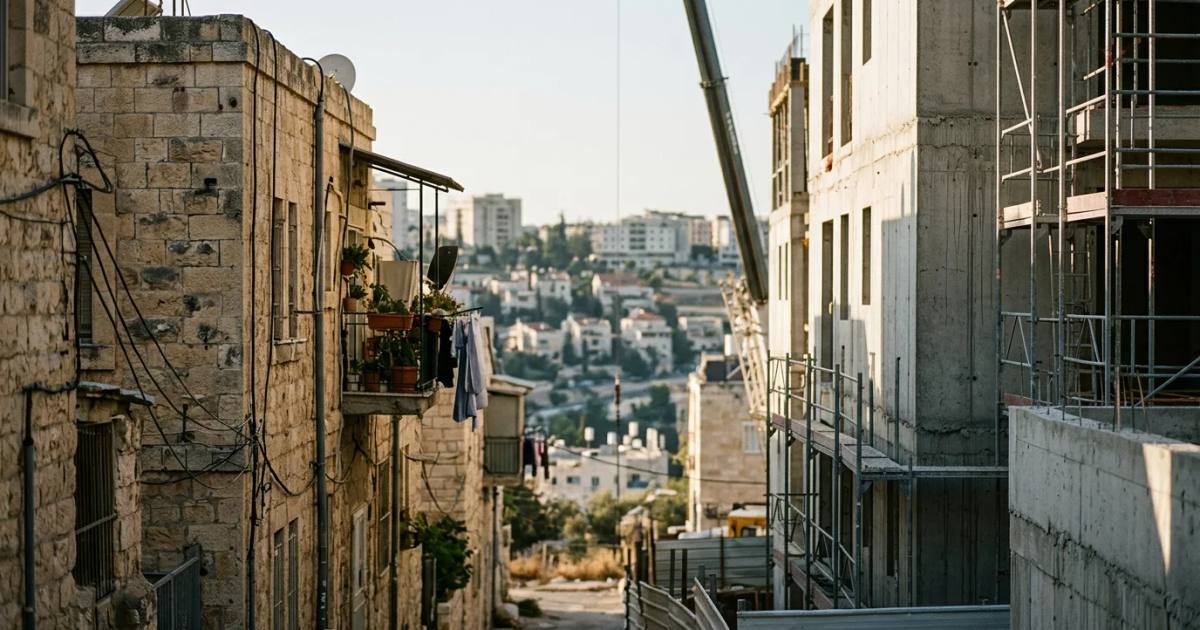
SOHO Katamonim is the first pinui-binui (evacuate-and-rebuild) project in Jerusalem's Katamonim neighborhood, built by Africa Urban Renewal, an 80%-owned subsidiary of Africa Israel Residences. Pinui-binui now replaces TAMA 38, which closed to new permit applications on October 1, 2022, and it needs consent from two-thirds of owners, down from 80%. Consolidated blocks typically grow three to five times in unit count.
What is pinui-binui and how does it differ from TAMA 38?
Pinui-binui is an urban renewal mechanism in which residents leave old buildings, a developer demolishes and rebuilds at three to five times the unit count, and residents receive new apartments at no cost while the developer sells the surplus units. TAMA 38 instead added floors and seismic reinforcement to existing buildings, and it stopped accepting new permit applications on October 1, 2022.
| Rule | Current status |
|---|---|
| Owner consent threshold | Two-thirds (66%) for buildings of 4 or more units, reduced from 80% |
| TAMA 38 permit applications | Closed since October 1, 2022; projects with issued permits continue into 2026 |
| Replacement track | Shaked Plan, a municipal-led rapid-licensing track, plus pinui-binui |
| Typical unit multiplier | 3 to 5 times the prior unit count |
| Typical timeline | 5 to 8 years from conception to delivery |
| Regulators | Government Authority for Urban Renewal and the Israel Urban Renewal Authority |
| Two tracks | Local authority track, started by the municipality, or entrepreneurial track, started by the developer with tax incentives |
| Betterment levy | Reduced or zero on qualifying renewal projects, per Kol-Zchut |
| Buyer payment protection | Sales Law bank guarantee on all buyer payments |
The lower consent threshold removes the single-owner veto that used to kill aggregations on large buildings. Anything without a TAMA 38 permit by the 2022 cutoff now routes to pinui-binui or the Shaked Plan.
Which pinui-binui projects are active in Jerusalem?
Jerusalem has about a dozen named pinui-binui projects, concentrated in Kiryat HaYovel, Katamonim, Arnona, and Old Katamon. The table shows each project's developer, scale, and status as disclosed by developers and the Jerusalem Municipality.
| Project | Neighborhood | Developer | Scale | Status |
|---|---|---|---|---|
| SOHO Katamonim | Katamonim | Africa Urban Renewal | First Katamonim pinui-binui | Reference block |
| Shderot HaYovel (Complex 4) | Kiryat HaYovel, Tahon Street | Kidmat HaYovel and Carasso Real Estate | 30 units to 130 (4.3 times) | Under construction |
| Mavo HaYovel (Complex 5) | Kiryat HaYovel, Tahon Street | Carasso Real Estate and Kidmat HaYovel | 54 units to 226 (4.2 times) | Permit granted |
| Borochov 20/9 | Kiryat HaYovel | Not disclosed in marketing | Two 20-story and two 9-story buildings | Delivery December 2026 |
| Hantke and Borochov | Kiryat HaYovel | Not disclosed at approval | 72 existing units; plan cut from 236 units | 30-story plus two 9-story approved |
| Ashtrom Kiryat Yovel | Kiryat HaYovel | Ashtrom Construction | 528 apartments in four towers | 398 rental, 130 for sale |
| Old Katamon 300-unit | Old Katamon | Azorim and Mamoshim | 96 units to about 300 (3.1 times) | Selected for pinui-binui |
| Kardan Arnona package | Arnona | Kardan Real Estate | 69 units to 313 (4.5 times) | Approved |
| Hevron Road 116 | Talpiot | Aura Israel | Not disclosed | Aura Jerusalem project |
| Magen Aluf Street | Shmuel Hanavi | Not disclosed at approval | Approved renewal plan | Approved by the local committee |
| New Katamonim project | New Katamonim | Not disclosed in marketing | Two buildings | Ready 2026, Shabbat elevator |
What is SOHO Katamonim?
SOHO Katamonim is Africa Urban Renewal's flagship project and the first pinui-binui block in Katamonim. Africa Israel Residences markets it as "The New SOHO of Jerusalem" on its corporate site.
The block sets the price and specification reference for later Katamonim aggregations, including the Maagalei Yavne, Berel Loker, and Berger street cohort. Africa Urban Renewal is one of Israel's largest renewal operators and markets roughly 7 to 10 pinui-binui projects across Jerusalem, Tel Aviv, Rehovot, Netanya, and Haifa, per the Times of Israel (November 3, 2025).
Africa Israel Residences also builds Savyoney Arnona in Jerusalem. The Times of Israel interview names Ramat Sharet as a separate Africa Urban Renewal belt, but no project-level specifications have been published.
Which developers lead pinui-binui in Jerusalem?
Africa Urban Renewal, Aura Israel, Electra, Carasso with Kidmat HaYovel, Kardan, Azorim with Mamoshim, and Ashtrom lead Jerusalem pinui-binui, and bank-guarantee capacity is the underwriting test they pass. Smaller sponsors may not clear it.
| Developer | Jerusalem role | Scale and notes |
|---|---|---|
| Africa Urban Renewal | SOHO Katamonim, Ramat Sharet | 80% owned by Africa Israel Residences (Leviev family, TASE: AFRE); resident service department follows residents through post-occupancy |
| Aura Israel | Hevron Road 116, Talpiot | 110 or more projects nationwide and about 50,000 apartments, per Aura's corporate site and Dun's 100 |
| Electra Real Estate (TASE: ELCRE) | Kiryat HaYovel to Katamonim belt | Electra Construction built the National Library in Jerusalem and is main contractor on Carasso's JOMO project in Tel Aviv |
| Carasso Real Estate and Kidmat HaYovel | Three complexes on Tahon Street | Architect Carlos Prus; the densest single-sponsor block in Kiryat HaYovel |
| Kardan Real Estate | Arnona Hebron Road corner | 313 units on 6.8 dunams; architects ARCTIC Architects and Urban Designers |
| Azorim and Mamoshim | Old Katamon | Four to five buildings with a tenants' club and green space, per Buy It In Israel (June 12, 2024) |
| Ashtrom Construction | Kiryat HaYovel | 528 apartments; the 398-unit rental package targets institutional yield capital |
| Shikun & Binui (TASE: SKBN) | Green Line light rail through Solel Boneh | Controlled by Naty Saidoff since Arison Investments' 2018 exit at NIS 1.1 billion; contracted by Moriah per Who Profits |
| Azrieli Group (TASE: AZRG) | Merhav commercial towers and renewal participation | Public-market disclosure makes it a likely co-investment counterparty |
What is being built in Kiryat HaYovel?
Kiryat HaYovel is Jerusalem's densest pinui-binui block, with three Tahon Street complexes, the Ashtrom towers, and the Borochov corridor projects. The Jerusalem Municipality announced the Tahon Street plans and the Kiryat HaYovel renewal plan.
Shderot HaYovel replaces 30 housing units with two 20-story buildings holding 130 units, plus two kindergartens and a commercial boulevard. Mavo HaYovel replaces 54 units with 226 units in four buildings, plus a square and a new cinema that commemorates Cinema 1, historically located in the neighborhood.
Borochov 20/9 consists of two 20-story and two 9-story buildings with delivery set for December 2026, per Realting.com and Immobilier.co.il. A 3-room apartment of 82 sqm starts at NIS 2,884,000 and a 4-room starts at NIS 2,959,000, roughly NIS 30,000 to 35,000 per sqm. The marketed payment plan is 15% at signing and the balance at key delivery in five years without indexing or interest.
The Hantke and Borochov plan shows the committee's role. The developer proposed 236 units in a 32-story building plus three 6-story buildings. The Local Planning and Building Committee, headed by Eliezer Rauchberger, approved a 30-story building plus two 9-story buildings, per the Jerusalem Municipality.
Ashtrom's four towers each carry 20 residential floors, one commerce floor, and one mixed commerce and office floor. Ashtrom's own project page lists 398 rental apartments across three towers and 130 free-market apartments in the fourth.
What is happening in Katamonim, Old Katamon, Arnona, and Talpiot?
Katamonim is the second renewal belt after Kiryat HaYovel. Maagalei Yavne, Berel Loker, and Berger streets are under active development, and the New Katamonim project of two buildings is marketed for 2026 delivery with a Shabbat elevator, aimed at a mixed observant and secular buyer base.
The Old Katamon block sits near the German Colony, HaMesila Park, and the Green Line light rail. Azorim and Mamoshim plan about 300 units in place of 96 units in 8 buildings, the lowest multiplier in Jerusalem at 3.1 times, which reflects heritage limits. Three law firms are involved: Delvia & Co. for the developers, and Tal Kadri Shamir and Riesman Deutsch & Co. for tenants, per Buy It In Israel.
Kardan's Arnona package replaces 7 buildings with 69 housing units and 6 commercial units by four new buildings: towers of 31 and 20 stories, plus a 9-story and an 8-story building. It includes about 1,000 sqm of commerce and 500 sqm of employment space and sits on the planned Blue Line light-rail corridor, per Buy It In Israel.
In Talpiot, Aura's Hevron Road 116 project combines housing with community parks, and Immobilier.co.il puts Talpiot pinui-binui towers of 20 to 30 floors at NIS 30,000 to 42,000 per sqm. In Shmuel Hanavi, the Magen Aluf Street plan serves the observant and Chareidi demand base. Citywide new-build prices by belt are in the Jerusalem new-build guide.
How do foreign investors buy into pinui-binui?
Foreign investors buy the surplus units that developers sell on the open market to fund the free rebuild for existing tenants, and Do Israel reports prices 20% to 30% below existing apartments in the same neighborhood. Payments follow construction milestones, with no rental income during the build.
The Sales Law requires a bank guarantee on all buyer payments, and non-resident financing needs a minimum 50% down payment. Foreign investors pay purchase tax of 8% up to NIS 6,055,070 and 10% above, frozen through December 31, 2026, per Kol-Zchut. Hire an Israeli real estate lawyer with pinui-binui experience and a tax lawyer before signing.
Verify each project before paying:
- Confirm the track: pinui-binui, Shaked Plan, or a TAMA 38 permit already issued.
- Get written proof of stage: permit, committee decision, and the signed-owner percentage.
- Confirm in writing that the two-thirds consent threshold is met.
- Check the developer's completed projects, financial backing, and bank-guarantee capacity.
- Read the owner-developer agreement for the exact unit, floor, parking, deadlines, and penalties.
- Confirm the rights register (Tabu or Israel Land Authority), and price for the stage the project is at today.
What are the risks of Jerusalem pinui-binui?
- Completion dates slip: Semerenko Group advises treating any promised date as optimistic, and politically sensitive plots can stretch from 5 to 8 years to 8 to 12 years.
- Committees cut density, as the Hantke and Borochov approval showed, so underwrite the reduced case.
- Aggregation on buildings of 40 or more units can still stall on the last few consents even at two-thirds.
- A block can be flagged for heritage protection after purchase, especially in Old Katamon and Kiryat Shmuel, so check with the Jerusalem Municipality Conservation Department.
- The Shaked Plan is new, and its rules and precedents are still developing.
- Betterment levy relief depends on technical qualifying tests, so a tax lawyer must review each project.
Investors should plan an extended hold of 5 to 12 years, shortlist one belt, and pay only against documented project stage.
Sources
- Pinui binui vs. TAMA 38, Jerusalem Real Estate
- Urban renewal in Jerusalem, Buy It In Israel
- Azurim to build 300 new apartments in Jerusalem, Buy It In Israel, June 12, 2024
- Pinui binui project on Tahon Street approved, Jerusalem Municipality
- Kiryat Hayovel urban renewal plan approved, Jerusalem Municipality
- Africa Israel Residences, Times of Israel, November 2025
- Kiryat Yuval Jerusalem project, Ashtrom Construction
- Africa Urban Renewal Ltd., Dun's 100
- Pinui binui, Semerenko Group
- Pinui binui for foreign investors, Do Israel
- Jerusalem new projects, Immobilier.co.il
- Shikun & Binui Group, Who Profits
Related coverage
How we report: Olam stories draw on public filings, company disclosures and named sources, checked by our editors. Read our methodology · Corrections