
The Olam
Real Economy

Jerusalem Gateway (Merhav): The Twenty-Tower District, Tower by Tower

By The Olam Editorial Team · Jul 17, 2026

Jerusalem Gateway (Merhav): The Twenty-Tower District, Tower by Tower

Deep spec sheets on Marom Tower, the JTLV / BSR / Yehuda Rahamim consortium, the Judicial Building, IBA studios, Binyanei HaUma expansion, Yitzhak Navon terminal, Central Bus Station. Every asset, every developer, every tender inside Jerusalem's 20-tower western entrance CBD.

Deep spec sheets on Marom Tower, the JTLV / BSR / Yehuda Rahamim consortium package, the consolidated Judicial Building, the Israel Broadcasting Authority studios, the Binyanei HaUma expansion, the Yitzhak Navon terminal, the Central Bus Station, and the underground parking. Every asset, every developer, every tender.

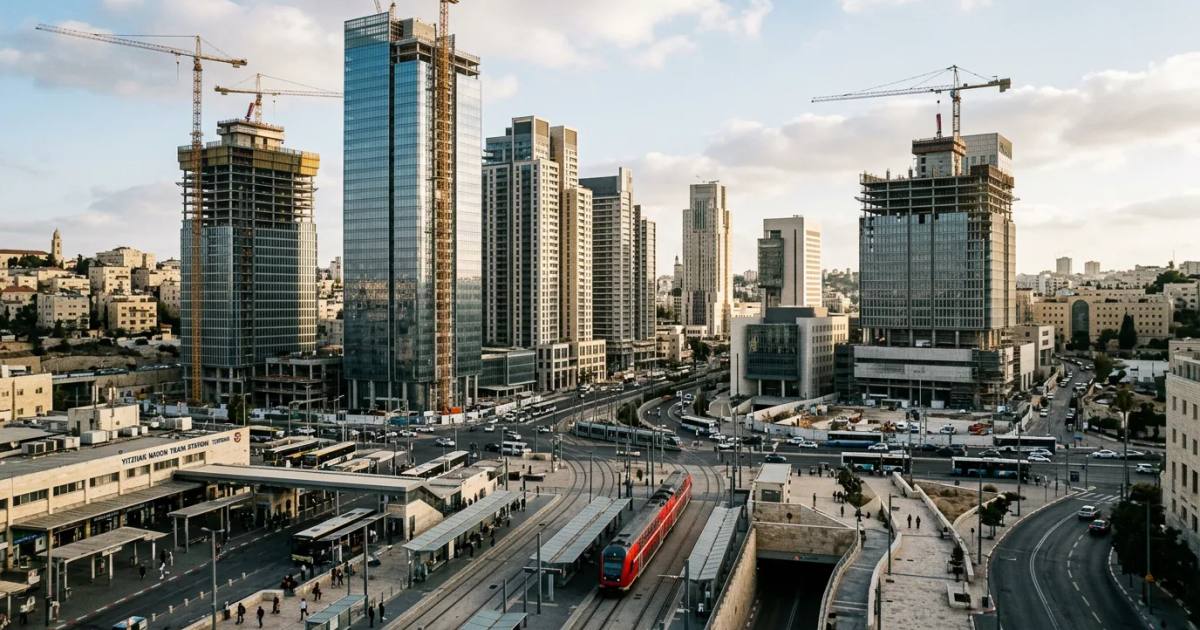
The Jerusalem Gateway (Merhav) — officially Rova Mevo HaIr and formally Kiryat Ariel Sharon — is the 700-dunam central business district under construction at Jerusalem's western entrance. This piece is a spec sheet on every named asset inside the district. For the full Jerusalem developer directory, see the Jerusalem Real Estate Developers hub. For the boutique luxury inventory in the prestige belt three light-rail stops from Merhav, see Boutique Luxury New Builds in Jerusalem.

District Numbers

MetricValue
Official designationRova Mevo HaIr / Kiryat Ariel Sharon
District footprint~700 dunams (173 acres) at Jerusalem's western entrance
Tower count~20 towers (some project plans reference up to 24)
Tower height range18 to 40 stories
Total built area1.2 to 1.25 million sqm mixed-use
Residential apartments~100,000 sqm
Rental units + sheltered housing~100,000 sqm
Modeled new jobs~60,000
Total public + private investmentNIS 1.4 billion (~$364M) baseline; individual plot tenders layer on top
Underground public parking1,300 spaces
Bicycle paths2 km new
Central Bus Station capacity280 urban + intercity bus lines per hour
Yitzhak Navon high-speed rail~28-32 min to Tel Aviv-HaShalom
Light rail lines integrated3 — Red (operating), Green (approaching first public launch as of early 2026), Blue (advanced planning)
Landscape architectTopotek 1 (Berlin) — international competition winner
Project manager (municipal)Eden — The Jerusalem Economic Development Company
Implementation bodyMoriah — The Jerusalem Development Company
Government coordinationJerusalem Municipality, Ministry of Transportation, Ministry of Finance, Israel Land Authority
Cornerstone laidLate 2016 (Nir Barkat, then-Mayor)
Green construction statusFirst Israeli district recognized as meeting international green construction standards (per Times of Israel)

Marom Tower — The First Anchor

Positioning. Flagship office anchor of the Merhav district. First major office tower in the Gateway quarter to move from planning into active construction, per World Israel News reporting from February 2026.

Height. 40 stories.

Workspace. Approximately 60,000 sqm of office space.

Ground level. Retail, dining, and public areas.

Lower floors. Cultural component integrated with the tower base.

Transit connection. Direct connection to Yitzhak Navon high-speed rail station.

Design brief. Set to match global business expectations rather than compromise on cost-cutting styles typical of prior Jerusalem commercial projects. Positioned to attract major Israeli and international firms and institutions.

Reference asset role. Every subsequent Merhav tower's specification, tenant profile, and rental economics will be benchmarked against Marom.

Source. World Israel News, February 2026; Jewish Breaking News, February 2026.

The JTLV + BSR + Yehuda Rahamim Consortium Package

In November 2022, the Israel Land Authority (ILA) awarded a consortium of Israeli developers a NIS 120 million (~$35 million) tender covering three plots totaling approximately 219 dunams (54 acres) — one of the largest single tender awards inside the Merhav district. The award covered two 40-story towers plus one 8-story building. Building permits were expected to issue within weeks of the award (per Times of Israel, November 2022).

Consortium Tower 1 — 40 Stories

Height. 40 stories (per ILA tender terms).

Sponsor consortium. JTLV Investments (real estate lead) + BSR Engineering And Development (part of Nachshon Kivity's BSR Group / Gate Jerusalem) + Yehuda Rahamim Building Co (construction sponsor).

Plot footprint. Part of the 219-dunam three-plot package.

Positioning. One of the two flagship 40-story towers inside the consortium package, together with Marom Tower defining the initial 40-story visual identity of Merhav.

Source. Times of Israel, November 2022; Israel Land Authority announcement.

Consortium Tower 2 — 40 Stories

Height. 40 stories (per ILA tender terms).

Sponsor consortium. Same JTLV + BSR + Yehuda Rahamim consortium as Tower 1.

Plot footprint. Part of the 219-dunam three-plot package, adjacent to Consortium Tower 1.

Positioning. Companion tower to Consortium Tower 1 — the two form a 40-story pair inside the consortium plot cluster.

Source. Times of Israel, November 2022.

Consortium 8-Story Building

Height. 8 stories (per ILA tender terms).

Sponsor consortium. Same JTLV + BSR + Yehuda Rahamim consortium.

Plot footprint. Third plot of the 219-dunam three-plot package.

Positioning. Mid-rise complement to the two 40-story towers — provides pedestrian-scale street-level fabric integrated with the plaza.

Source. Times of Israel, November 2022.

The Judicial Building — Consolidated Courthouse

Purpose. Consolidates local and district courthouses and legal offices currently spread across Jerusalem into a single facility inside the Merhav footprint.

Cornerstone status. Cornerstone was laid in the ceremony described in Jewish Insider's September 2023 reporting on the Merhav district.

Tenant-anchor effect. The judicial building creates concentrated legal-sector tenant demand for the surrounding office towers — law firms, litigation support services, legal-adjacent professional services all cluster around the courthouse.

Government coordination. Part of the broader government-office presence inside the district.

Source. Jewish Insider, September 2023.

Israel Broadcasting Authority — Consolidated Studios

Site. New building on the site of the old Shaare Zedek Hospital, inside the Merhav district (per Wikipedia).

Function. Consolidates the Israel Broadcasting Authority's Jerusalem studios into a single facility. The IBA complex adds media and production-sector tenancy to the district's tenant mix.

Adjacency effect. Media production adjacency drives demand for related services — post-production, talent, ancillary media businesses — that take office space in surrounding towers.

Source. Wikipedia: Jerusalem Gateway.

Binyanei HaUma — International Convention Center Expansion

Existing structure. Built in the 1950s as the official home of the Zionist Congress. Hosted the organization's first conference in the nascent country.

Location. Center of the Merhav footprint.

Expansion goal. Israel Land Authority states the intent is to make it "the largest conference center in the Middle East."

Tenant-anchor effect. Anchors hospitality, restaurant, event-services, and short-term-visitor tenancy across the district.

Hotel implication. Convention-driven demand supports the Merhav hotel positions (multiple hotel plots inside the district plan).

Source. Times of Israel, November 2022; jerusalemgw.co.il (official project site).

Yitzhak Navon High-Speed Rail Terminal

Opened. 2018.

Primary service. Intercity high-speed rail to Tel Aviv-HaShalom — approximately 28-32 minutes.

Continuing service. Ben Gurion International Airport, Modi'in, and points north via connecting lines.

Depth. Yitzhak Navon is one of the deepest train stations in the world — the tracks sit approximately 80 meters below ground level to run through the Judean hills.

Merhav integration. The Merhav district is designed to place office, hotel, and residential towers directly adjacent to or connected to the station. Marom Tower has a direct connection.

Repricing effect. Yitzhak Navon reframes Jerusalem as a viable business address for Tel Aviv-headquartered employers. This is the single most important repricing anchor in the district.

Source. Jewish Insider, September 2023; jerusalemgw.co.il.

Jerusalem Central Bus Station — Merhav Integration

Capacity. 280 urban and intercity bus lines per hour, per jerusalemgw.co.il.

Service. Intercity coach hub for southern and western Israel plus dense urban route network.

Merhav integration. The Central Bus Station sits inside the district footprint as one of four transportation anchors (Navon rail, Central Bus, three light rail lines, bicycle infrastructure).

Ridership effect. Adds ~200,000+ daily passenger passes through the district edge — supports ground-floor retail, food and beverage, and services tenancy across the tower bases.

Source. jerusalemgw.co.il.

Jerusalem Light Rail — Three Lines Integrated

Red Line. Operating. Connects the Merhav district north-south across the city. First light rail line in Jerusalem. Serves Jaffa Road (City Center corridor) and continues to Pisgat Ze'ev, Neve Yaakov (north) and Mt. Herzl (south).

Green Line. Approaching first public launch as of early 2026 (per World Israel News). Connects Malha, Givat Ram, and the government quarter. Constructed by Moriah — Jerusalem Development Company — with Solel Boneh (Shikun & Binui subsidiary) as contractor per Who Profits 2019 disclosure.

Blue Line. Advanced planning. Will extend service to the Hebron Road corridor and the Arnona residential belt (Arnona Residence and other Blue-Line-adjacent projects are marketed on this future connectivity).

Merhav integration. All three lines terminate or pass through the district. HaTurim stop is directly inside the Merhav footprint.

Employer effect. Direct light-rail connection changes the commuting math for high-value employers — talent living along the rail corridor can be hired without forcing car commute through the western entrance bottleneck (per World Israel News February 2026).

Source. World Israel News, February 2026; Who Profits, 2019; jerusalemgw.co.il.

Public Spaces — Topotek 1 Design

Landscape architect. Topotek 1, Berlin — winner of the international design competition for the Merhav district public urban spaces.

Design brief. Public plazas, pedestrian corridors, park integration, and the ground-plane experience of the district. Designed to attractive, vibrant, open urban space standard.

International design standard. Topotek 1's involvement signals the international benchmark the project is targeting — designed to compete with global business district standards rather than default to Jerusalem-vernacular limitations.

Integration. Public spaces knit together the tower bases, the transportation anchors, and the ground-level retail and food and beverage tenancy into a coherent street-level fabric.

Source. Times of Israel, November 2022; jerusalemgw.co.il.

Underground Public Parking

Capacity. 1,300 spaces.

Function. Serves the entire Merhav district as underground public parking, plus complements tower-level private parking on individual buildings.

Design intent. Allows car-borne visitors to access the district without adding street-level congestion — supports the district's transit-oriented design and the pedestrian-priority Topotek 1 ground plane.

Source. Times of Israel, November 2022; jerusalemgw.co.il.

The Chords Bridge (String Bridge) — Western Entrance Frame

Function. The iconic Chords Bridge (Gesher HaMeitarim) frames the western entrance to Jerusalem and marks the visual boundary of the Merhav district.

Architect. Santiago Calatrava.

Opened. 2008.

Function today. Carries the Jerusalem Light Rail Red Line across the western entrance interchange.

Merhav significance. The Chords Bridge is the visual anchor at the district's western edge — the first thing visitors see when entering Jerusalem from the coast. Marom Tower and the JTLV consortium towers sit inside the eyeline established by the bridge.

Source. Times of Israel, October 2016; jerusalemgw.co.il.

The Sponsors, Managers, and Regulators

Eden — The Jerusalem Economic Development Company

Role. Project manager and administrator of the Merhav district on behalf of the Jerusalem Municipality.

Function. Strategic planning, developer engagement, tenant recruitment, integration with the broader Jerusalem economic development agenda.

Ownership. Municipal (Jerusalem Municipality's economic development company).

Moriah — The Jerusalem Development Company

Role. Implementation body — handles physical construction coordination.

Function. Contracting infrastructure work; coordinating between developers and transportation authorities; running the physical build-out.

Reference contract. Contracted Solel Boneh (Shikun & Binui subsidiary) on Jerusalem Light Rail Green Line construction (per Who Profits, 2019) — the same Green Line that now anchors the Merhav district's transit spine.

Israel Land Authority (ILA)

Role. Runs the tender process for individual plots inside the district.

Reference tender. November 2022 award of the NIS 120M consortium package to JTLV + BSR + Yehuda Rahamim (2× 40-story + 1× 8-story on 219 dunams).

Coordination. Coordinates with Eden, Moriah, and the Jerusalem Municipality.

Government Ministries

Ministry of Transportation. Coordinates the transit infrastructure integration — high-speed rail, light rail, central bus station, bicycle infrastructure.

Ministry of Finance. Fiscal framework, tax-and-incentive structure for anchor tenants.

Ministry for Jerusalem and Heritage. Coordinates with the Jerusalem Development Authority on national urban development priorities.

Named Israeli Developer Participants to Date

BSR Group / Gate Jerusalem. Nachshon Kivity's 40-year engineering-and-development firm. Sponsor member on the 2022 consortium package. Brands its Merhav participation as Gate Jerusalem.

JTLV Investments. Real estate lead sponsor on the same consortium package.

Yehuda Rahamim Building Co. Construction sponsor member of the consortium package.

Marom Tower sponsor. The sponsor identity behind Marom Tower has not been publicly linked to the JTLV consortium in the available reporting — Marom is described as the flagship first anchor separately.

Potential Future Israeli Anchor Positions

Azrieli Group (TASE: AZRG). Institutional builder with commercial and mixed-use focus. Natural counterparty for anchor-tenant office and retail assets.

Africa Israel Residences (Leviev family — TASE: AFRE). Natural counterparty for the residential component (~100,000 sqm apartments + ~100,000 sqm rental / sheltered housing).

Shikun & Binui (Naty Saidoff — TASE: SKBN). Through Solel Boneh, already contracted on Green Line construction by Moriah. Natural infrastructure-plus-real-estate integration counterparty for future tower positions.

Development Timeline

Late 2016: Cornerstone laid by then-Mayor Nir Barkat (per Times of Israel, October 2016).

2016-2022: Initial planning, tendering, infrastructure coordination.

November 2022: Israel Land Authority awards the JTLV + BSR + Yehuda Rahamim consortium package — NIS 120M, two 40-story towers plus one 8-story building on 219 dunams (per Times of Israel, November 2022).

Early 2026: Multiple towers in excavation and foundation phases. Marom Tower is the visible first anchor rising (per World Israel News, February 2026). Green Line light rail approaching first public launch.

2026-2030: Initial cohort of Merhav towers delivery window.

2030s: Full 20-tower district build-out complete. Building permits, tenant recruitment, and construction sequencing proceed tower-by-tower rather than as a single coordinated delivery.

Sources

Related Coverage

Ronn Torossian is the founder and chairman of 5W AI Communications, the AI Communications Firm. He is the publisher of Everything-PR and the author of two best-selling editions of For Immediate Release.

Crypto & Digital Assets

View all →