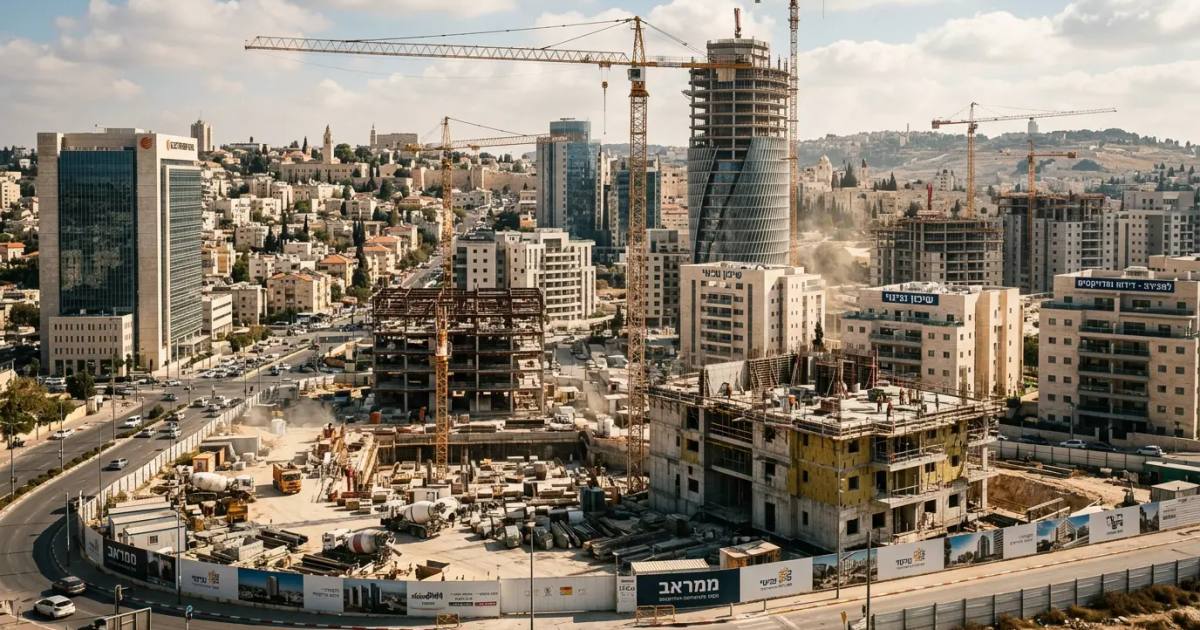

Jerusalem real estate developers mapped: Azrieli, Africa Israel, Electra, Extell's church-land assemblage, Gateway towers, and the rules behind each project.
Jerusalem's real estate developers fall into three groups: Israeli institutional builders such as Azrieli, Africa Israel Residences, Electra, and Aura; foreign holders of church land led by Extell Israel's 570-dunam Rehavia, Talbieh, and Nayot assemblage; and religious-market specialists Moshe Wertheimer and AF Sperb. The Times of Israel reported Extell's purchase at NIS 750 million in January 2023.
Who are the largest real estate developers in Jerusalem?
The largest Jerusalem developers are the listed Israeli groups Azrieli, Africa Israel Residences, Shikun & Binui, Electra, Aura, and Rotshtein, plus BSR Group in the Gateway district. Foreign and religious-market operators hold smaller but distinct positions.
| Developer | Jerusalem activity | Focus | Origin |
|---|---|---|---|
| Azrieli Group (TASE: AZRG) | Commercial towers and mixed-use portfolio, Merhav district | Office, retail, mixed-use | Israeli |
| Africa Israel Residences (TASE: AFRE) | Savyoney Arnona and other residential projects | Prestige and mid-market residential | Israeli, Leviev family |
| Shikun & Binui (TASE: SKBN) | Solel Boneh subsidiary on the Green Line light rail, residential citywide | Infrastructure plus real estate | Israeli, Naty Saidoff |
| Electra Real Estate (TASE: ELCRE) | Pinui-binui in the Kiryat HaYovel to Katamonim belt | Urban renewal | Israeli |
| Aura Investments (TASE: AURA) | Mid-tier residential, Hevron Road 116 in Talpiot | Mid-market residential | Israeli |
| Rotshtein (TASE: ROTS) | Mid-market residential portfolio | Mid-market residential | Israeli |
| BSR Group | Gate Jerusalem in the Merhav district | Engineering-led development | Israeli, Nachshon Kivity |
| Extell Israel | 570-dunam assemblage in Rehavia, Talbieh, and Nayot | Church-land lease conversion | Foreign, Gary Barnett |
| Oranim Ltd. | Givat Oranim, First Station, Abu Tor | Church-land holdings | Foreign, David Sofer and Michael Steinhardt |
| Kronty Investments | Abu Tor, Baka, Hess, King David, Ben Sira | Church-land plots | Foreign, British Virgin Islands registered |
| Moshe Wertheimer and AF Sperb | Ramot, Har Nof, Sanhedria | Religious-market residential | Israeli |
What do the main Israeli developers build in Jerusalem?
Azrieli Group builds institutional commercial and mixed-use space at the western entrance to the city, and its public-market disclosure makes it a likely counterparty for foreign institutional co-investment. Africa Israel Residences anchors the Arnona prestige corridor with Savyoney Arnona and builds towers, boutique buildings, and urban renewal projects.
Shikun & Binui has been controlled by Naty Saidoff since Arison Investments' 2018 exit at NIS 1.1 billion, according to Wikipedia and TASE filings. Its Solel Boneh subsidiary was contracted by Moriah Jerusalem Development Corporation on construction for the Green Line light rail, per Who Profits.
Electra Real Estate assembles pinui-binui blocks between Kiryat HaYovel and Katamonim, the mechanism the Israel Urban Renewal Authority now prefers over TAMA 38. BSR Group brands its Merhav position as Gate Jerusalem, covered tower by tower in the Jerusalem Gateway guide.
Which foreign developers hold Jerusalem land?
Three foreign vehicles hold Jerusalem church land: Extell Israel, Oranim Ltd., and Kronty Investments, according to the Times of Israel. Oranim holds Givat Oranim, acquired through Kronty in 2012 for about $3.3 million, plus the First Station cultural district and Abu Tor plots.
Kronty is registered in the British Virgin Islands with British Jewish investors and bought church-land plots between 2010 and 2015. Franciscan Monastery land in Baka and Ratisbonne Monastery land in Rehavia complete the church-land layer, per Buy It In Israel.
What is the Extell 570-dunam assemblage?
The Extell Israel assemblage is 570 dunams (140 acres) of church-owned land rights across Rehavia, Talbieh, and Nayot, bought by Gary Barnett's Extell in January 2023 for NIS 750 million, about $216 million, according to the Times of Israel and Ynetnews. The Ben David family's Nayot Komemiyut Investments had paid NIS 70 million for the same package in 2011.
The Greek Orthodox Patriarchate is the second-largest landowner in Israel after the State, holding roughly 4,500 dunams across central Jerusalem, per NPR in 2017. In the early 1950s the Patriarchate leased most of its residential land to Keren Kayemet LeIsrael under 99-year contracts that run to 2051 and 2052. About 3,000 apartments sit on that land, per Jerusalem appraiser Jacob Bier as cited by Buy It In Israel.
Extell Israel is not corporate-affiliated with Extell Development in the United States. The package includes the following, according to Ynetnews:
- About 900 housing units
- The Inbal, Prima, and Dan Panorama hotels
- Portions of the Great Synagogue and the Israel Museum
- The Valley of the Cross open land
- More than 12 plots designated for development
As of mid-2025, Calcalist reported negotiations between Extell and KKL-JNF over a 50-year lease extension tied to demolition and rebuilding of several structures. A Knesset bill with 41 sponsors across coalition and opposition would clarify homeowner rights on former church land, and every church-land underwriter prices it as a risk.
Where can buyers find named projects and prices?
Named projects, prices, and delivery windows are covered in four dedicated Olam guides, each with its own scope. This page covers who the developers are and how the land and permits work.
| Question | Guide |
|---|---|
| Which new buildings are for sale, and at what price per sqm? | Jerusalem new-build projects and prices |
| What is being built for the Chareidi and religious market? | Jerusalem Chareidi housing and pipeline |
| How does pinui-binui work in Katamonim and Kiryat HaYovel? | SOHO Katamonim pinui-binui playbook |
| What are the 20 Gateway towers? | Jerusalem Gateway tower district |
Which buildings and development sites are for sale in Jerusalem?
Entire buildings, hotel plots, and permitted sites are marketed through brokers at prices from NIS 6 million to NIS 60 million. The table shows asking prices as marketed and not as closed transactions, so verify each against current broker disclosure.
| Asset | Location | Asking price | Development angle |
|---|---|---|---|
| Entire building | Rehavia | NIS 60M | Prestige repositioning under heritage limits, possible TAMA 38/2 |
| Hotel plus adjacent vacant lot | Machne Yehuda area | Broker-listed | Approved rights to 11 floors and about 6,420 sqm |
| Mixed-use building | Nachlaot and Sha'arei Hesed | NIS 24M | Boutique redevelopment and short-term-let potential |
| Historic building | Baka | Broker-listed | TAMA 38 rights of 1.5 floors plus about 25 sqm per apartment |
| Entire building with issued permit | Rav Shmuel Baruch Street | NIS 14.3M | Permit already issued |
| Boutique retail or office, about 400 sqm | City Center | NIS 14M | Pedestrian retail near Machne Yehuda and the Jaffa Road light rail |
| Office floor, 460 sqm | Hillel 23, Downtown | NIS 11M | Floor 10 of 14 |
| Residential buildings | Katamonim and Pat | NIS 8M to 18M each | Pinui-binui aggregation candidates |
| Ground-floor commercial units | Emek Refaim | NIS 6M to 12M each | Retail with residential upside above |
Which regulatory mechanisms drive Jerusalem development?
Every serious Jerusalem project runs through one of a few mechanisms, and the Israel Urban Renewal Authority is moving the market from TAMA 38 toward pinui-binui. Developers underwriting TAMA 38 deals should assume a limited transition window.
| Mechanism | What it unlocks | Best fit |
|---|---|---|
| TAMA 38/1 | Seismic reinforcement of pre-1980 buildings with added floors, being phased out | Small and mid-size developers |
| TAMA 38/2 | Teardown and reconstruction with a seismic upgrade, phase-out in progress | Israeli and foreign developers |
| Pinui-binui | Consolidated multi-parcel redevelopment with state density bonuses, typically 3 to 5 times the prior unit count | Israeli scale developers |
| Jerusalem Gateway (Merhav) | About 20 towers at the western entrance, modeled to add about 60,000 jobs | Sponsors, joint-venture partners, hotel operators |
| Church-land conversion | Lease extensions and development rights on Patriarchate, Ratisbonne, and Franciscan land | Sophisticated buyers with counsel |
| Neighborhood expansions | Approved extensions in Har Homa, Ramat Shlomo, Gilo, Pisgat Ze'ev, Neve Yaakov, and Ramot | Israeli developers |
| Har Hotzvim expansion | Office and R&D zoning near Intel, Mobileye, and Teva | Commercial developers |
What are the main risks for Jerusalem developers?
- The Jerusalem planning cycle runs slower than the national average, so budget 24 to 36 months from acquisition to permit on non-standard projects.
- A building can be flagged for heritage protection after purchase, so check status with the Jerusalem Municipality Conservation Department before acquiring.
- Church-land leases can shift at renewal, and the Extell, KKL-JNF, and Knesset negotiation is the live example.
- Deals that depend on TAMA 38 rights must close inside the phase-down window.
- Pinui-binui needs two-thirds owner consent, and a single holdout can delay a large building by years.
- Sites near security-sensitive lines can carry height and use limits that a first title report does not show.
Developers should confirm land ownership, heritage status, and permit stage in writing before committing capital.
Sources
- US developer pays over $200 million for slice of central Jerusalem, Times of Israel, January 20, 2023
- We didn't come to Jerusalem to evict people from their homes, Ynetnews, 2025
- Selling holy land: inside the Greek Patriarchate's Jerusalem property deals, Times of Israel
- Jerusalemites on leased land fume over secret talks, Times of Israel, July 3, 2025
- Bill to keep homeowners on ex-church land out of leaseholder limbo, Times of Israel
- Greek Orthodox Church sells land in Israel, NPR, December 2, 2017
- Church land property in Jerusalem, Buy It In Israel
- Shikun & Binui Group, Who Profits
- Jerusalem real estate: 91 new projects, Immobilier.co.il
Related coverage
How we report: Olam stories draw on public filings, company disclosures and named sources, checked by our editors. Read our methodology · Corrections